A morning that began like any other
The two trains left Madrid within six minutes of each other on an ordinary Wednesday morning. The first, an Iryo service bound for the south, departed Atocha station at 07:54 carrying 147 passengers. The second, a Renfe high speed service on the Madrid to Seville route, followed at 08:00 with 397 people on board. Just before 09:00, near the town of Urda in Toledo province, around 140 kilometres south of the capital, the second train struck the first from behind. The stationary Iryo train had stopped because of a computer failure. Several carriages derailed, some tumbling down an embankment, and by the end of the day at least 69 people were dead and dozens more were in hospital.
Those bare facts, reported by the BBC, do not capture what happened next. They do not capture the pharmacist from Urda who was among the first to reach the wreckage carrying first aid supplies, or the local residents who turned a sports hall into a makeshift hospital, bringing blankets, food and water for the injured. They do not capture the passenger who described being thrown around inside a carriage in a matter of seconds, or the young man who told reporters in a shaking voice that he did not know if he would ever recover from what he saw.
But grief, in Spain this week, has not stayed grief for long. Within hours it had become something else: disbelief, then anger, then a political fight. That transformation is the real story of Urda, and it tells us something uncomfortable about a country heading into an election with its trust in a prized national asset badly shaken.
The second time in nine months
The Urda crash is Spain's second rail tragedy this year, and that is what makes it so hard for the public to absorb. Only nine months ago, in the southern village of Adamuz, a collision on the same Madrid to Seville route killed 46 people. Two disasters, more than 100 deaths, on one high speed line, in a single year. For a country whose high speed network was long described as the largest in Europe and the envy of its neighbours, the shock is profound.
Not long ago, the speed, efficiency and safety of that network were a source of national pride. Spain's high speed lines carried 45 million travellers last year, including millions of tourists, and until this year the system had gone more than three decades without a deadly crash. The Adamuz disaster already triggered a national debate about whether the network was still fit for purpose. A summary of the collision and its aftermath records at least 68 deaths and more than 100 injuries, while reporting on the protests notes that the demonstration was organised after a union linked to the far right Vox party called for action outside the ministry. Further coverage of the political fallout records the growing calls for the transport minister to resign. Urda has turned that debate into a crisis of confidence.
Transport Minister Oscar Puente moved quickly to frame the likely cause, saying from the start that a computer failure followed by human error was the probable explanation. By late evening, leaked audio recordings of a control room operator talking to train drivers appeared to back that account up. The recordings suggested a train had been allowed to continue despite a safety system failure, a decision Puente himself has described as inexplicable.
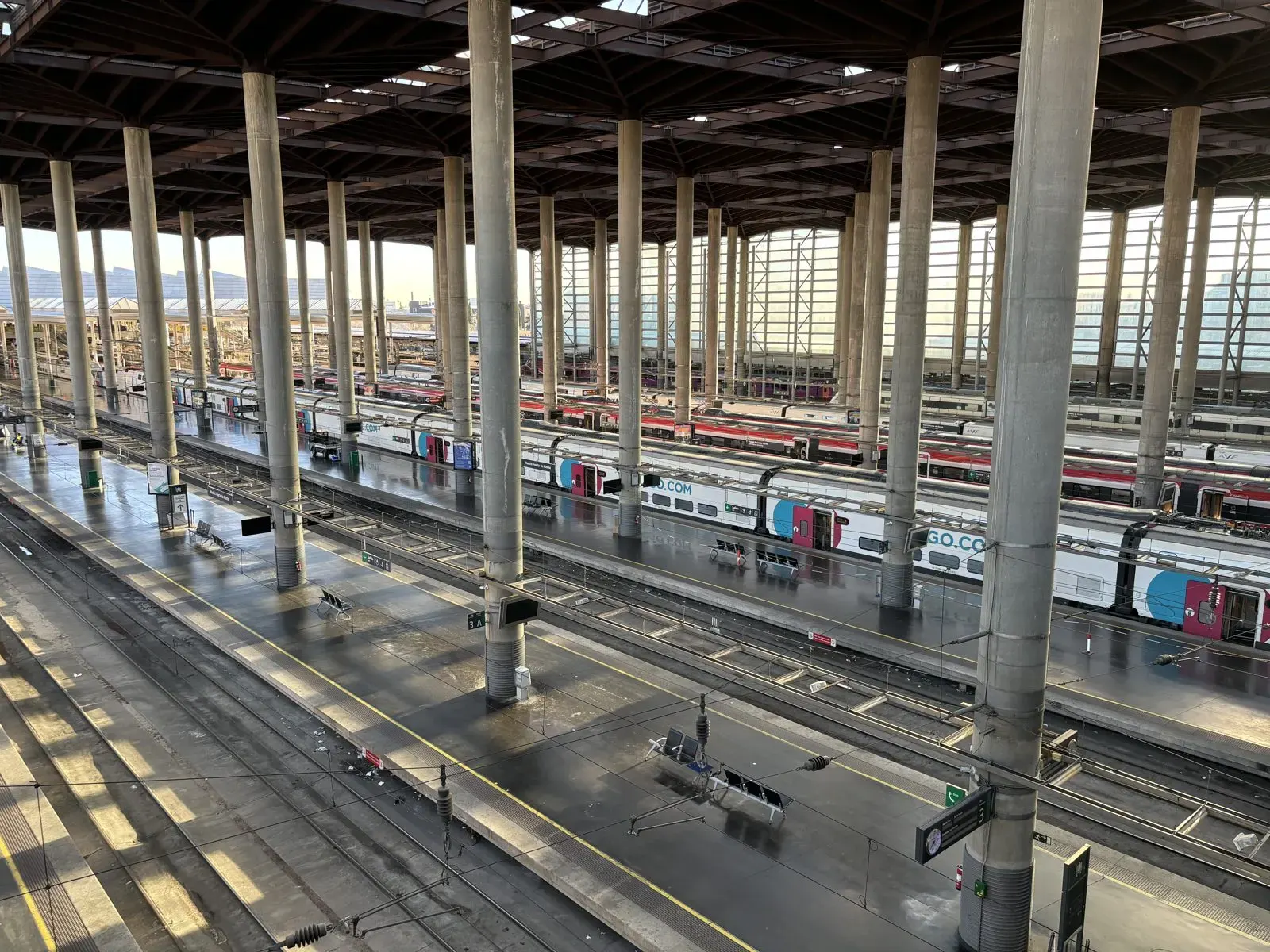 Platforms and trains at Madrid Atocha station
. Credit: Wikimedia Commons, CC BY-SA 4.0
A leak that changed the argument
Leaked audio is a dangerous thing in the middle of a tragedy. It can illuminate, but it can also distort, fixing blame before an investigation has had the chance to establish the full sequence of events. Spain's biggest train drivers union, Semaf, condemned the leak as irresponsible and slanted, and its warning deserves to be taken seriously. One driver put the point sharply, saying investigators always look for the last link in the chain, where it is weakest, while the real question is whether the entire procedure failed, and what the operator on duty could actually see on screen.
That is the question a proper investigation must answer: not simply who pressed what, but what system allowed a train to keep moving toward a stationary service in the first place. Was the failure technical, human, organisational, or all three? Until those answers exist, every political claim about the crash is provisional, however passionately it is made.
Yet provisional claims are exactly what an election campaign produces. On Wednesday night, demonstrators gathered outside the transport ministry in Madrid, with far right groups prominent among them, demanding resignations and clashing with police. Reports of the Madrid protest put the crowd at around 1,500 people, with bottles and flares thrown and tear gas used to disperse the protest. Another account of the clashes describes the same sequence, while coverage of the demands for the minister's resignation notes the union calls for accountability. Some carried banners reading "Criminals" and "Corruption kills". Others chanted for Puente, whom they called the minister of death, to go.
Politics in the middle of mourning
It would be wrong to dismiss the protest as mere opportunism, and equally wrong to treat it as the authentic voice of a grieving nation. Both things can be true at once. Real anger exists, and it is being channelled by organised political forces with their own agendas. The main parties, apart from the far right Vox party, suspended campaigning. Prime Minister Pedro Sanchez visited the crash site twice, and his conservative rival Alberto Nunez Feijoo travelled to Urda on Thursday to say the Spanish people need answers and are wondering what is happening to high speed rail in their country.
Sanchez had not expected rail safety to dominate his campaign. His Socialist party trails the conservatives in most opinion polls, and his government has already endured a difficult year, including corruption scandals touching people close to him. Now, with a general election exactly one month after the crash, he faces a question that cuts deeper than any single policy: can voters still trust the state to run the systems their lives depend on?
Puente has long been a hate figure for the right, and with two of the worst rail tragedies in Spanish history happening on his watch, the criticism will only intensify. But there is a difference between holding a minister politically accountable and deciding, in advance of an investigation, that he is personally responsible for a crash. Spain's trade union CSIF has already accused Puente of shifting blame onto a railway official rather than accepting accountability, and has said it warned in September about excessive working hours at Adif, the state company responsible for railway infrastructure. Those are serious claims, and they deserve to be tested by evidence, not settled by chant.
What Urda should change
Strip away the politics, and Urda leaves three lessons that no party can afford to ignore. First, a safety culture cannot depend on a single decision in a control room. If a computer failure can be followed by an instruction that sends a train forward into danger, then the system has a design flaw, not just a human one. Second, transparency matters more than speed of explanation. Ministers who rush to name a likely cause, and unions who rush to condemn a leak, are both responding to the same pressure: the demand for instant certainty after an event that is anything but certain. Third, trust, once lost, is brutally hard to rebuild. Spain's rail network earned its reputation over decades. It has lost a large part of it in nine months.
The drivers union called a strike for Thursday, saying urgency to travel must never be prioritised over safety. That slogan should be adopted by everyone in this debate, whatever their politics. The passengers on the Iryo and Renfe trains were not thinking about elections or ministers or control rooms. They were travelling to work, to family, to holidays. Sixty nine of them did not arrive. Whatever the investigation finds, and whoever it blames, the measure of Spain's response will be whether anything changes before a third tragedy forces the question again.
For more on Spain and European politics, see our opinion coverage, news coverage and world coverage, our earlier report on Spain train crash audio from the control centre, and our coverage of Serbia's student led election upset, Brazil's election turnaround and Israel's pivotal election. Visit the Verity homepage or learn more about us.