A generation in the wilderness
The race for a US Senate seat in Texas may prove crucial in determining which party controls Congress next year. That alone would make it important. But for both parties, it represents so much more than that. For Democrats, the losing streak in statewide elections in Texas now stretches back more than three decades. In the second most populous state in America, liberals have been in the wilderness for a generation, and every near miss has taught them to hope carefully.
No Democrat has won statewide office in Texas since 1994, the longest drought in the nation. No Democrat has won a Texas Senate seat since Lloyd Bentsen in 1988. Ending that run would reverberate far beyond a state of 31 million people, redrawing America's political map ahead of a wide open contest for the presidency in 2028. That is why a Senate race in a state Republicans have owned for thirty years is now the most expensive in American history, and why both parties are treating Tuesday's vote as a test of something larger than one seat.
But polls suggest the Democrats' candidate, 37 year old James Talarico, may be on the verge of breaking through. Most surveys put the state representative, former schoolteacher and seminarian narrowly ahead of Republican Attorney General Ken Paxton. "If the Democrats do pull it off, I think it's going to cause a lot of soul searching and a lot of psychological damage to the Republican Party in Texas and nationwide," said Brendan Steinhauser, a Texas based Republican campaign strategist, in comments carried by the BBC. That verdict, from a Republican, captures why this race has become the centre of the midterm universe.
The candidate who was unknown a year ago
For Talarico, it has been a remarkable rise. In 2025 he was a relatively unknown state level Democrat. At the Fiesta Center in Lubbock on Tuesday night, the line to see the softly spoken former teacher, who studied to be a Christian minister before entering politics, stretched around the building and down the wide parking lot to a busy road. Lubbock is a dusty western plains town of about 250,000 people which voted overwhelmingly for President Donald Trump two years ago. A visit from a major Democratic candidate on the eve of an election was unusual there. "It's just so amazing to watch," said Aaron Gonzalez, the Democratic Party chair for Hockley County, which borders Lubbock. "This time is different."
Talarico's campaign has focused relentlessly on the cost of living and on the outsize political influence of billionaires. At a rally in the city of Temple last week, he told a thunderous crowd: "We have an affordability crisis because we have a corruption crisis." The line sums up his pitch: that ordinary Texans are squeezed not by accident, but because wealthy interests have captured the state's politics. It is a message aimed at voters who feel the pinch of prices and rents, and it has helped him build a coalition that includes independents and some moderate Republicans.
The polling picture backs up the excitement, without settling anything. A CNN survey of likely voters put Talarico ahead 49 percent to 43 percent. Data for Progress, polling 23 to 27 October, found him up 49 percent to 45 percent. A Marist poll conducted 8 to 11 October had him at 47 percent against Paxton's 45 percent among likely voters, inside the margin of error. The RealClearPolitics average of polls from 8 to 28 October had Talarico ahead by 48.8 percent to 47 percent. The Cook Political Report rates the race a toss-up, and notes that Paxton is the only Republican Senate nominee in a battleground state who is less popular than Trump in his own state.
There are reasons to think this time genuinely is different. For the first time since 1972, Democrats are contesting every state and federal race in Texas, a sign of a party investing in its future rather than in individual candidates. Polling from the University of Texas at Austin shows Talarico leading among likely Latino voters, 54 percent to 41 percent, a significant detail given that Latinos helped deliver Texas to Trump in 2024, giving him 55 percent of their votes in a dramatic swing away from Democrats, according to exit polling. In the governor's race, Democratic state Representative Gina Hinojosa is trailing three term Republican Governor Greg Abbott by just a few points, which suggests the shift may not be limited to one candidate.
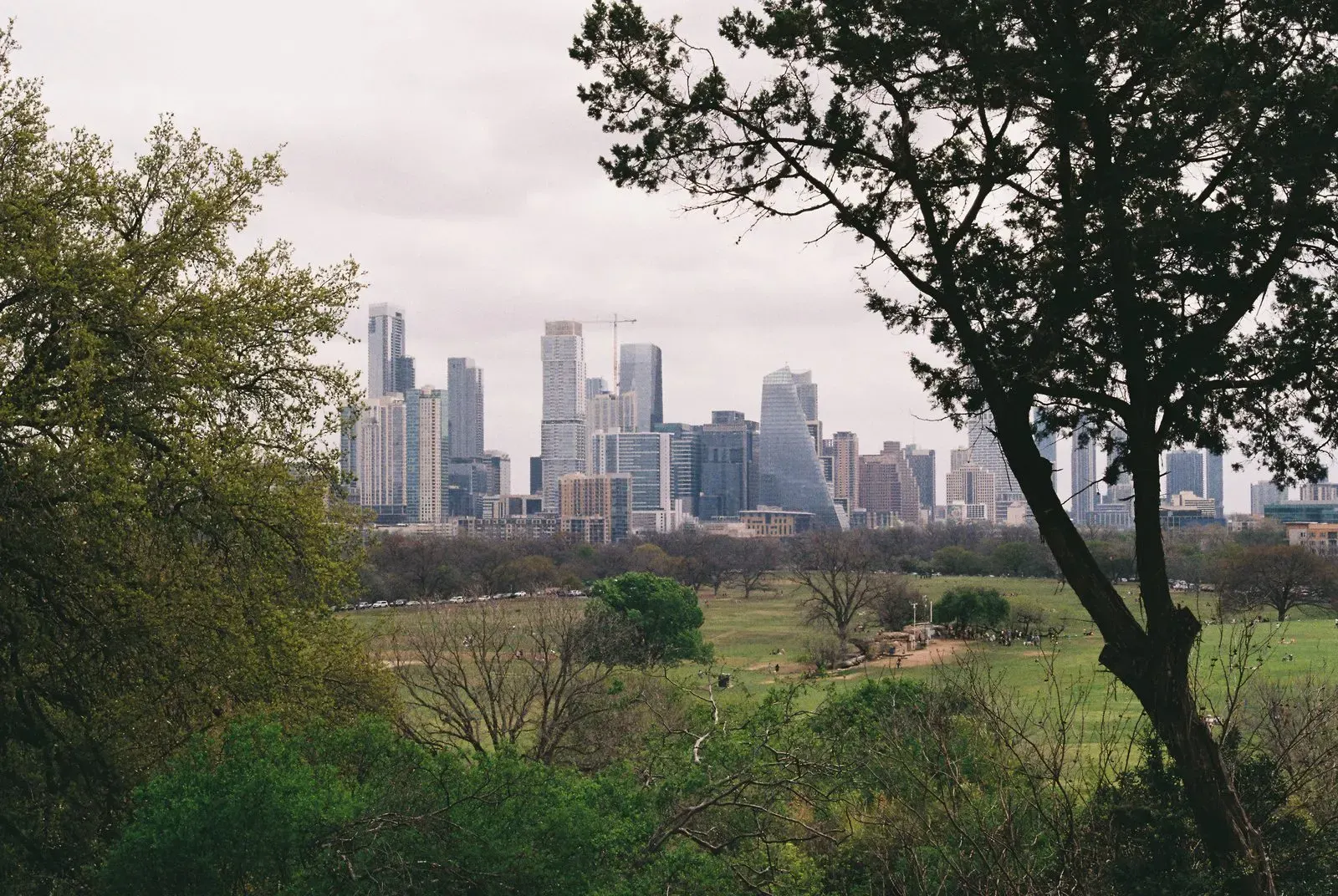 The Austin, Texas skyline, home city of Democratic Senate candidate James Talarico
Credit: Wikimedia Commons, CC BY 4.0
The Republican case, and the money mountain
Yet many Texas Republicans remain confident in their chances on Tuesday, believing the political fundamentals are still in their favour. About 49 percent of Texas voters identify with or lean toward the Republican Party, compared with 40 percent for Democrats, according to University of Texas polling. That is a structural advantage no single candidate can erase in one cycle. Dave Carney, Abbott's chief strategist and a veteran of Republican campaigns in Texas, has said the party's ground game is peaking late by design.
Then there is the money. These dramatic stakes help explain how this Senate race has rocketed to become the most expensive in US history, with total spending reaching more than half a billion dollars. AdImpact Politics says the race is now the most expensive non-presidential contest on record, with 544.5 million dollars in advertising spending including the primaries. In the general election, AdImpact figures put Republican spending for Paxton at 274.1 million dollars and Democratic spending for Talarico at 133.4 million dollars. Reuters, citing Federal Election Commission data, reported a similar imbalance, with Republicans spending over 300 million dollars on ads supporting Paxton against 102 million dollars spent for Talarico. The exact totals differ because the two sources count different things, but the direction is the same: Paxton's side has vastly outspent Talarico's.
Talarico and Hinojosa have also focused on the role of billionaires, including Elon Musk, who Reuters reported poured nearly 160 million dollars into Texas to buoy Paxton. In his ads, Paxton has hammered Talarico over his support for transgender rights and branded him a heretic for his progressive Christianity. At a rally for Paxton last week at a brewery in the small town of Sanger, just north of Dallas, speakers painted Talarico as a radical leftist and described the election stakes as existential. Neither the Paxton nor the Talarico campaign made its candidates available for an interview with the BBC.
Paxton's path to the nomination also shapes the race. After Donald Trump endorsed him in May, he beat Senator John Cornyn in the Republican runoff on 26 May by nearly 30 points, taking about 64 percent of the vote. The primary battle was bruising, with Cornyn's side attacking Paxton over his rising net worth and alleged affairs. Paxton has also carried political baggage from an impeachment fight in which he was acquitted in the Texas Senate. His critics argue that Republican primary voters, by dumping the incumbent Cornyn for Paxton, made the seat harder for their party to hold.
Why Democrats refuse to celebrate early
James Henson, director of the Texas Politics Project at the University of Texas at Austin, told Reuters: "This is the most competitive election between the parties that we have seen here since the early stages of Republican hegemony. If Talarico or Hinojosa win, it's a political earthquake." That word, earthquake, is doing a lot of work. It signals that a Talarico win would not just flip a seat, but would force a rethink of assumptions about Texas, about the durability of Republican dominance, and about the map for 2028.
But the memory of 2018 is exactly why Democrats refuse to celebrate early. That year, Beto O'Rourke thrilled the party, drew enormous crowds and national attention, and came within about 2.6 percentage points of unseating Senator Ted Cruz. Analysts note a telling contrast: O'Rourke never led a single poll in 2018, while Talarico has led in most surveys this cycle, often within the margin of error. Talarico has also raised more money than O'Rourke did and faces a Republican opponent with a more politically complicated record. Those differences favour Talarico, but they do not remove the basic fact that Texas has disappointed Democrats before, and that polls are not votes.
So is this finally the Democrats' year in Texas? The honest answer is that nobody knows, and Tuesday's result will be decided by turnout, by late breaking voters, and by whether the coalition Talarico has built in the polls actually shows up. What can be said now is that the race has already changed Texas politics: Democrats are contesting everything, Republicans are spending at record levels to defend a seat they once took for granted, and a 37 year old former teacher who was little known a year ago is, on the eve of the vote, the slight favourite in the polls. For a party that has known nothing but heartbreak in Texas for thirty years, that alone is a remarkable place to be. Whether it becomes a breakthrough or another chapter in the same old story will be known when the polls close at 7 p.m. local time on Tuesday.
Read more on Verity: Texas Hispanic voters and the shifting tide, the Democrats' identity crisis before the midterms, four investigations that could shape Congress, why so few young politicians reach Congress. Browse the Opinion section, the Politics section and the News section, or return to the Verity homepage and learn more about Verity.
External sources: BBC News report, full syndicated text of the BBC report, Reuters report via Duke FM, Texas Senate race poll tracker, Decision Desk HQ polling analysis, Federal Election Commission, Texas Tribune.