A night few predicted
Few imagined such an outcome was possible in the months after Donald Trump returned to the White House with unified Republican control of Congress in January 2025. That is the starting point of BBC North America correspondent Anthony Zurcher's analysis of a midterm night that, in his reading, reshaped American politics far beyond a routine swing of the pendulum.
As the public mood turned against the president and his party, Democrats had hopes of retaking the House of Representatives. What they contemplated in the Senate, Zurcher notes, was a map that appeared unfriendly, populated by states Trump had won comfortably just two years earlier. Instead, Democrats rewrote the political equations with victories in Texas, Maine, Kansas, Ohio, Iowa and North and South Carolina.
The scale of the result is worth stating plainly. The party won a House majority for the first time since 2022, with CBS, the BBC's US partner, projecting 245 Democratic seats to 166 for Republicans, a tally consistent with Associated Press House results showing Democrats past the 218 seat majority mark. In the Senate, Democrats flipped at least six seats, comfortably securing a majority, as Associated Press Senate results confirm across the 35 states voting. That combination, House and Senate together, is what turns a good night into a historic one, and it is the foundation of Zurcher's argument that this was a rebuke, not a ripple.
Texas delivers the shock of the night
No state illustrates the scale of the shift better than Texas. Ruby red Texas witnessed another seismic result in the governor's race, where Democratic challenger Gina Hinojosa ousted the incumbent Republican Greg Abbott, who earlier in the year had been seen as the prohibitive favourite. In the Senate race, James Talarico beat Republican Ken Paxton, ending a 38 year Democratic losing streak in statewide elections in Texas.
Readers who want the full story of the Texas Senate race can find it in our politics coverage of the 2026 midterms, which explains how a former schoolteacher ended one of the longest droughts in American politics. The Texas results matter beyond the state itself because they show a Democratic Party winning in places where, for a generation, victory had seemed out of reach. Zurcher's point is that these were not narrow, lucky wins. They were part of a pattern repeated across the map.
A Senate map turned upside down
The Senate results, taken together, tell the story of a map turned upside down. Adam Hamilton won in Kansas, a state that last elected a Democrat to the Senate almost 100 years ago during the Great Depression. In South Carolina, Annie Andrews beat Darline Graham, who had been appointed to the seat after the death of her brother, Senator Lindsey Graham. Zurcher notes that few analysts had that seat in play even a few months ago.
Five term Republican Susan Collins conceded Maine's Senate election to Democrat Troy Jackson. Paralympian Josh Turek flipped the Iowa Senate seat held by retiring Republican Senator Joni Ernst. Democrats also wrested a Senate seat from Republicans in Ohio, with Sherrod Brown's comeback victory over Jon Husted. Meanwhile, Democrat Abdul El-Sayed beat Republican Mike Rogers in Michigan's bitterly fought Senate race.
Each of these results has its own local story, and our politics section will keep following them as the new Senate takes shape. But Zurcher's analysis invites readers to see them as a single phenomenon: a Democratic wave that formed on the horizon and crashed deep into Republican terrain. The question he poses is not whether the wave arrived, but exactly how far it travelled.
The House and the voters behind it
The House results reinforce that reading. Democrats flipped House seats in Texas, North Carolina, Pennsylvania, Iowa, Kentucky and Colorado, among others, and were poised to make gains in Virginia and Indiana. Zurcher draws attention to the voters behind those flips. Black Democrats in the southern states turned out in record numbers, helping to carry their party to victory. Hispanic voters, whose support had helped secure Trump's presidential victory in 2024, swung decisively back to the Democrats.
The evidence he cites is concrete. Democrats won all three House races in the overwhelmingly Hispanic congressional districts along the Texas-Mexico border. Hispanic voters also helped Democrats hold House seats in Florida that the state's Republicans had sought to flip by redrawing congressional district lines. In fact, the congressional redistricting battles that dominated headlines for months last year ended up being a bust for Republicans, in Zurcher's assessment. In Texas, Republicans had hoped their line drawing would net five new seats for their party. On Tuesday, Zurcher writes, they may end up losing one seat.
That redistricting failure connects to a broader theme in our coverage of American politics. Readers interested in how district lines shape elections can explore our news coverage of the 2026 cycle, while our earlier report on the money pouring into the midterms shows how expensive this battle for Congress became.
Florida, the exception that tests the rule
If there is a silver lining for conservatives, Zurcher writes, Florida as a whole still appears to tilt to the right. Republican Senator Ashley Moody narrowly won re-election, as did congressman Byron Donalds, who was elected the Sunshine State's first black governor. Embattled Republicans were also able to hold governorships in Vermont and New Hampshire. But the bright spots, in Zurcher's phrase, were few and far between.
Florida's exception matters because it tests the analysis rather than simply confirming it. A wave that stops at one state's border is not a uniform national tide, and Zurcher's careful attention to Florida suggests a contest that was national in scale but still shaped by state level politics. That nuance is worth holding onto as the results are interpreted in the days ahead.
What Trump said, and what it means
Trump's own response, as reported by the BBC, mixed conciliation with defiance. In comments to CBS, he pledged to strike deals with congressional Democrats, adding that he did not want to have to spend his final two years in office rejecting their legislation. He somewhat undermined that sentiment later, posting a picture to Truth Social of his trademark red baseball hat with the word "veto" emblazoned on it. The president went on to note that his name was not on the ballot this year, but said that if it had been, Republicans would have won a decisive victory.
Zurcher gently punctures that claim. Trump had helped elevate many of those Republican candidates, he notes, and had urged voters to pretend he was up for re-election. That tension, between a president who campaigned as if he were on the ballot and a president who explains defeat by noting that he was not, is central to the analysis. It also frames the governing challenge ahead: a president who must now deal with a Democratic Congress, armed with investigative powers and the ability to block his legislation, after two years of unified Republican control.
Why voters turned
Underlying the results, in Zurcher's reading, is a story about the president's standing. Just two years ago, Trump won the presidency with 48 percent of the vote and claimed an electoral mandate. He then went about governing like it, pushing sometimes unpopular policies on trade and immigration, and launching an Iran war that is opposed by most of the American public. On Tuesday, voters gave him the kind of stinging rebuke that will not be easily forgotten.
That is analysis, not just arithmetic, and it should be read as such. Zurcher is interpreting a mood as much as counting seats. But the seats give the interpretation its force. When a party wins the House, flips the Senate and takes governor's races in Iowa, Ohio and Georgia, the last of which made history by electing the first black woman to such a post, the claim of a rebuke rests on more than a single poll or a single state.
For readers following the consequences, our world coverage will track how the new Congress affects American foreign policy, while our report on US strikes and the Iran conflict provides context for one of the issues Zurcher identifies as weighing on voters. The full BBC analysis as carried in syndication and related BBC election coverage show how the night unfolded seat by seat. The next two years of American politics will be shaped by the night Zurcher describes, and by whether Democrats use their new majorities to investigate, to legislate or simply to block.
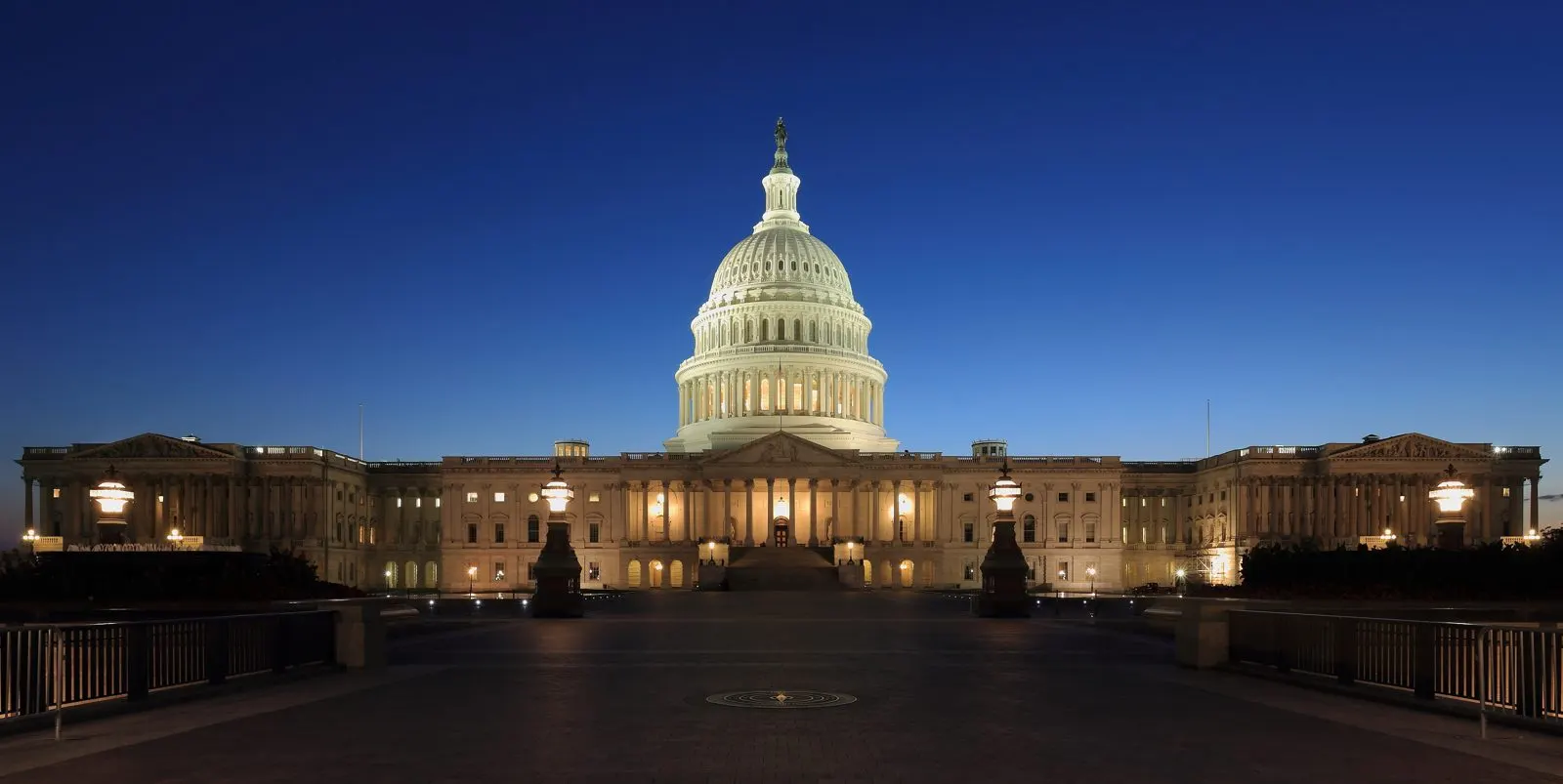
 Capitol Hill in Washington DC
Capitol Hill, Washington DC. Photo by Duane Lempke, released under CC0 via Wikimedia Commons.