A night of chaos at Old Trafford
Everything was going wrong for Michael Carrick in the first 50 minutes. His Manchester United side were two goals down at home to Roma in the Champions League, summer signing Carlos Baleba had been forced off with what appeared to be a hamstring injury, and frustrated supporters had thrown green and gold tennis balls onto the pitch in protest against the club's ownership. Then, seemingly out of nowhere, United came back to win 3-2.
The revival was sparked by a retaken Bruno Fernandes penalty. The United captain saw his initial effort saved by Roma goalkeeper Devis Vasquez, only for the kick to be ordered again after a VAR intervention. The video official ruled that Roma midfielder Bryan Cristante had a foot on the penalty area boundary as Fernandes took his first attempt, a decision TNT Sports explains in detail, and Fernandes smashed home the second to breathe life into the contest. Matheus Cunha then scored twice in the closing minutes, first in the 83rd minute and again in the 86th, to complete a stunning turnaround, before being sent off in a chaotic finale.
Cunha's night entered the record books: he became the first player to win a penalty, score and be sent off in a single Champions League match, as BBC Sport's match coverage noted. The win was United's first in 10 matches and their first victory in 54 days. For Carrick, a 45 year old former United midfielder now carrying the weight of one of football's most scrutinised jobs, it was a much needed boost. The question posed by BBC Sport analysis is whether it will actually save his job, or just earn him a stay of execution.
The ghosts of comebacks past
Looking back at some of his predecessors suggests it will be the latter. That is the unsettling heart of the BBC's analysis, and it rests on two eerily similar nights at the same stadium.
The first parallel takes us to October 2021, when Ole Gunnar Solskjaer was in charge. Current Roma boss Gian Piero Gasperini was then in charge of Atalanta when the Italian side visited Old Trafford for a Champions League game. The Italians gained a 2-0 lead by half time, but United hit back with second half goals from Marcus Rashford, Harry Maguire and Cristiano Ronaldo to win 3-2. The relief did not last. United were thumped 5-0 at home by Liverpool the following weekend, and a 4-1 defeat at Watford saw Solskjaer sacked in November 2021, with Carrick himself then taking three games as interim boss.
The second parallel is older, and belongs to Jose Mourinho. In October 2018, Mourinho's United hosted Newcastle on the back of a four game winless run. United went 2-0 down inside 10 minutes and were still 2-0 down with 20 minutes left, but Juan Mata and Anthony Martial drew them level before Alexis Sanchez scored a last minute winner. The fans cheered Mourinho's name that night. Yet two months later he was sacked after a 3-1 loss at Liverpool. The BBC analysis counts his survival precisely: Mourinho lasted 13 more games after the Newcastle comeback.
The symmetry is hard to ignore, and our sports coverage has followed United's managerial turbulence for years. Our recent report on Arsenal's defensive dilemma shows how quickly a single selection story can define a club's week, but United's story is bigger: it is about a pattern that keeps repeating at Old Trafford, where a dramatic night papers over structural problems for a few weeks before the reckoning arrives.
Why this comeback felt different, and why it did not
There are, of course, differences. Carrick's team won a European tie rather than a domestic league match, and the goalscorer was a Brazilian forward in his first season rather than a fading star. The protest element also sets this night apart: the green and gold tennis balls thrown onto the pitch were a visible reminder that supporter anger at the Glazer family, minority owner Sir Jim Ratcliffe and director of football Jason Wilcox will not stop just because of one thrilling victory, as the BBC analysis puts it.
But the structural similarities are what give the analysis its bite. In each case, a manager under intense pressure watched his team fall two goals behind at home. In each case, a rousing second half comeback produced a 3-2 win. In each case, the celebrations were real and the relief was genuine. And in each of the two earlier cases, the manager was gone within weeks. History does not repeat itself exactly, but at Old Trafford it has developed a habit of rhyming.
The BBC analysis also notes a sobering detail that United supporters will recognise. The sober assessment, it argues, should recall that United came from behind to beat Atalanta 3-2 at Old Trafford during Solskjaer's time, only to lose 5-0 at home to Liverpool four days later. Within a month, the Norwegian had been sacked. The warning is not that Carrick will definitely suffer the same fate, but that a single comeback, however thrilling, has never yet been enough to change the direction of a struggling United side.
What the players said
The dressing room response after Roma was telling. Bruno Fernandes, the captain, came out in support of Carrick but insisted the players did not need to save anyone's job, as Sky Sports reported. It was a careful formulation: loyalty to the coach without accepting that the coach's fate was the players' responsibility. Fernandes had himself been named on the bench for an earlier match after publicly questioning tactics following a sobering 4-1 defeat at Como, a reminder that the tensions around this team run deeper than one result.
Former Premier League winning goalkeeper Kasper Schmeichel, meanwhile, called on United fans to get behind their team more following the win. His intervention speaks to a club where the atmosphere around the team has become part of the story, with protests and chants forming a backdrop to every home game. A comeback win can lift a crowd, but it cannot by itself repair a relationship between a club and its supporters that has been strained for years.
United next host Aston Villa at Old Trafford on Sunday, and that fixture now carries unusual weight. A win there would start to look like momentum rather than a one off. A defeat would revive every doubt the Roma comeback temporarily silenced, and the comparisons with Mourinho and Solskjaer would return with interest. Planet Football's survey of managers saved by one result and The Scottish Sun's account of the eerie omen both reach the same cautious conclusion. For readers tracking the wider football landscape, our sports section will carry the build up, and our homepage will have the result as it happens.
A stay of execution, or a turning point?
The BBC analysis leaves the central question open, and so should we. Carrick may yet prove the exception to the Old Trafford rule, the manager whose comeback win becomes a genuine turning point rather than a stay of execution. The ingredients are there: a captain scoring under pressure, a new forward producing a match winning cameo, and a crowd that, for one night at least, witnessed the kind of drama that built this stadium's legend.
But the precedents counsel caution, and that is precisely why the analysis matters. Mourinho's Newcastle comeback bought him 13 games. Solskjaer's Atalanta comeback bought him about a month. Both managers discovered that a 3-2 fightback can change a mood but cannot change a team overnight. Carrick's task now is to show that his Roma night was the start of something, not just a repeat of something. The next few weeks, starting against Aston Villa, will tell us which it was.
For now, United supporters can enjoy a remarkable European night, one that gave them their first win in 54 days and a Champions League memory to treasure. They should just remember, as the BBC analysis gently reminds them, that they have enjoyed nights exactly like this before, and that the mornings after have not always been kind. Our report on Leinster's coaching change shows how another club handled succession when a long serving coach departed.
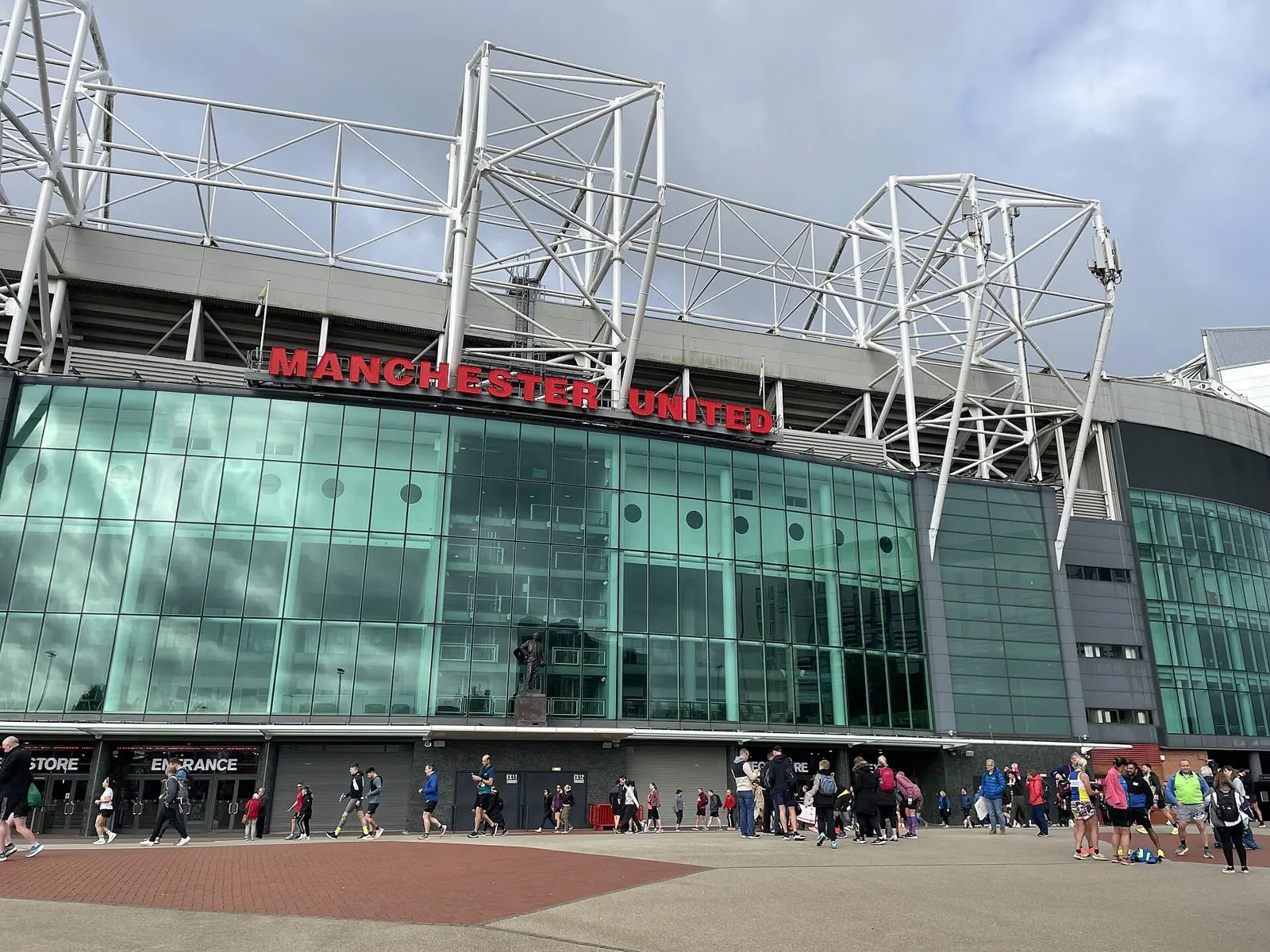 Manchester United's football ground at Old Trafford
Old Trafford, the Theatre of Dreams. Photo by Eirian Evans, licensed under CC BY-SA 2.0 via Wikimedia Commons.