Two falls, one pattern
Almost a year ago, two of Europe's longest serving nationalist leaders sat down to lunch in a small bakery in the northern Serbian town of Subotica. Viktor Orban of Hungary chose cheese for his burek pastry, Aleksandar Vucic of Serbia chose meat, and the two men then moved on to a local winery to talk about oil deals, including a planned Hungarian purchase of Serbia's NIS oil refinery. Within twelve months, both men were out of power.
Orban fell first, in April, defeated at the ballot box by Peter Magyar's Tisza party after sixteen years in office. Last Sunday, a Serbian student movement less than two years old won the country's parliamentary elections by a landslide, ending fourteen years of rule by Vucic. The twin defeats have stunned a continent where both leaders long looked untouchable, and where many observers had come to treat their grip on power as a permanent feature of the political landscape.
The comparison is tempting, and in many details it holds up remarkably well. But an honest reading of the two stories also shows where the mirror cracks. The movements that beat these men borrowed tactics from one another, yet they are organised very differently, and the countries they now inherit face different problems. The value of the comparison lies not in claiming the two falls were identical, but in understanding what changed in Central European politics between April and October, and why two regimes that once seemed to grow stronger with every year in office suddenly collapsed in quick succession.
The monitors who changed the maths
The most concrete link between the two victories is also the least glamorous: election monitoring. In both countries, turnout surged, with nearly four out of five eligible voters casting ballots in Hungary and just under seven in ten doing so in Serbia. In both cases, the surge was driven by young, digitally fluent voters who used artificial intelligence tools to analyse voting data, identify districts where results might be manipulated, and coordinate tens of thousands of volunteer monitors.
The Serbian students borrowed directly from the Hungarian experience. During the summer, before an election had even been called in Serbia, activists from Hungary's DE civic action group ran workshops for their Serbian counterparts, passing on the monitoring methods that had worked months earlier in Hungary. On election weekend itself, the DE group sent 70 monitors to Serbia, where they worked alongside student movement representatives visiting polling stations in the northern province of Vojvodina.
A key technique was to identify so-called infected polling districts in advance, places where surprisingly high votes for the governing party at previous elections suggested voter intimidation or chain voting, a practice in which a pre-marked ballot is passed from voter to voter. On election day, the system was put to the test. Peter Klemm, a student activist from Subotica, told the BBC that from around 16:00, groups of masked men he described as Vucic supporters gathered near voting stations. Mobile teams were sent out, he said, and everything was filmed. Combined with stationary monitors already in place, 20 to 30 volunteers at each threatened polling station acted, in his view, as a strong deterrent against intimidation or fraud.
An hour before polls closed in Serbia, masked and hooded vigilantes took up position in central Belgrade. During voting, similar groups were photographed at many polling stations, and were blocked by election monitors. The picture that emerges is not one of a clean, calm election, but of a contested vote in which organised citizens made it harder for irregularities to pass unnoticed. That, more than any single speech or slogan, may be the practical lesson other opposition movements take from these two campaigns.
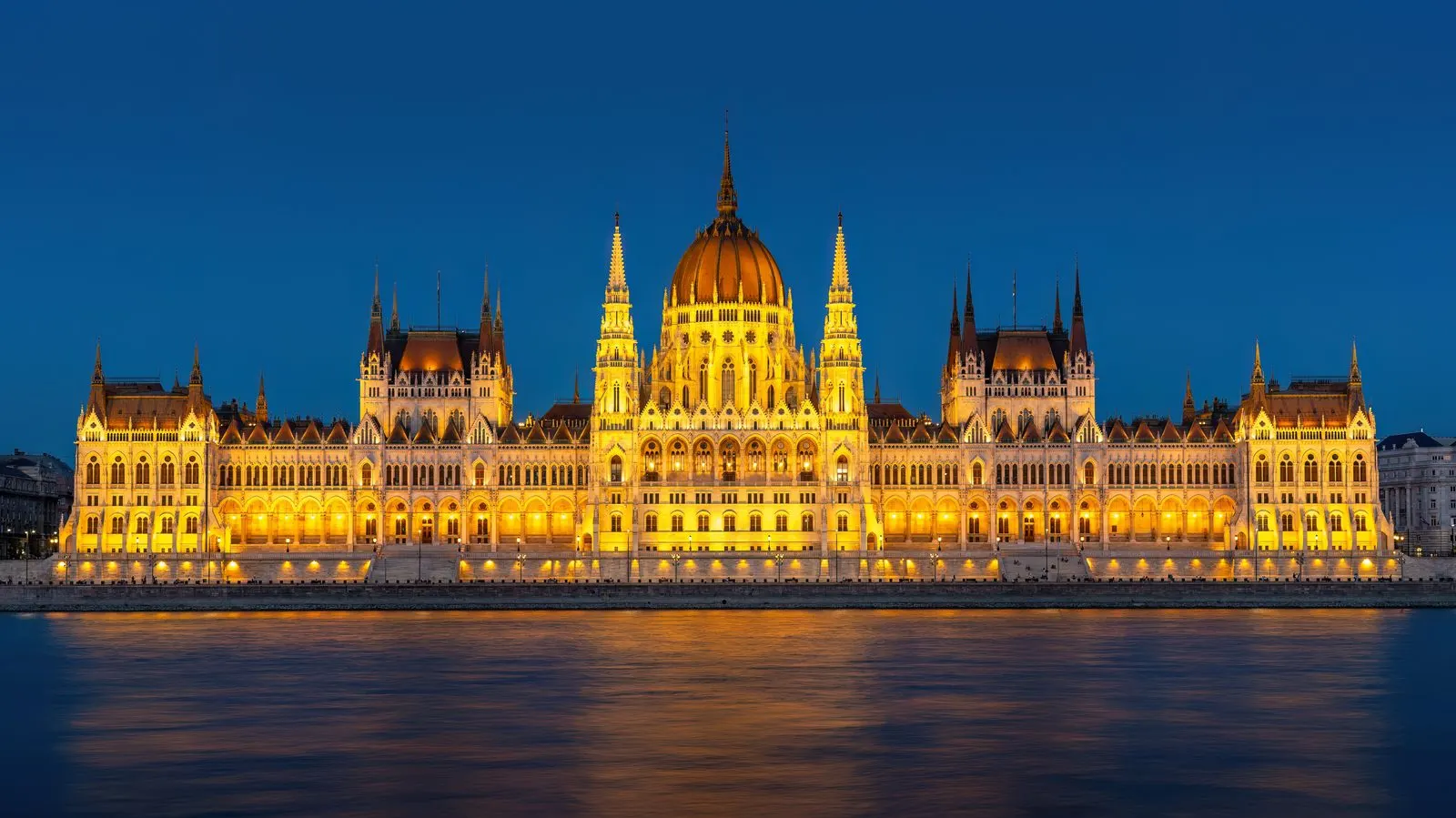 The Hungarian Parliament Building in Budapest beside the Danube
Credit: Wikimedia Commons, CC0
A friendship that tied two systems together
The two leaders had much in common beyond their longevity. Each had extended his influence deep into state institutions while building business networks that crossed the border between their two countries. Both maintained friendly relations with Russia's Vladimir Putin and China's Xi Jinping, and both strongly supported Milorad Dodik, the separatist leader of the Bosnian Serbs. A high speed railway between Belgrade and Budapest is being built with Chinese finance and know-how, and Hungarian firms close to Orban were involved in the construction project at Novi Sad railway station.
That last connection matters, because the deepest roots of the Serbian revolt reach back to a disaster at that station. The collapse of the canopy at Novi Sad railway station on 1 November 2024 killed sixteen people and was widely blamed on corruption as well as negligence. It became the catalyst for the student movement that has now won power. The Hungarian connection to the project is one more thread linking the two regimes, and it helps explain why the Serbian students looked to Hungary not only for tactics, but as proof that a seemingly immovable government could be beaten.
The parallels extend to small, almost eerie details. Vucic admitted defeat at exactly 21:30 on Sunday evening, just as Orban did on 12 April. There has been speculation this week that Vucic spoke to Orban twice on Sunday night to ask his advice, once before he conceded and again at 23:15, and that Orban persuaded his Serbian ally not to use force. Vucic denies that he spoke to Orban before his announcement, but acknowledges the later conversation. Orban, contacted by the BBC, declined to comment. Readers should treat the speculation about the content of those calls for what it is: unconfirmed, denied in part, and impossible to verify from the public record. What is confirmed is the concession itself, and the fact that few observers expected either leader to concede peacefully.
There is another strange numerical similarity. The Student List will hold 140 seats in the 250 seat Serbian parliament, precisely the same tally Tisza won in Hungary's 199 seat assembly. Magyar was the only European leader to ring the students directly to congratulate them that evening, and probably the only one who had their number. "It is always good to hear that the story of Tisza could provide an inspiration for other nations," the Hungarian prime minister told the BBC. Ilija Srdanovic, head of the Student List, had said on the eve of the vote that Hungary's result had shown his movement its approach was sound.
What the parallels do not prove
Analysis should be careful here. Similar outcomes do not prove a single cause, and the differences between the two movements are as instructive as the similarities. Tisza is centred on the personality and energy of its leader, Magyar. The students in Serbia insist they have no leadership at all, a structure that helped them survive pressure but may make governing harder. Hungary's change came through an established opposition party; Serbia's came through a protest movement that had to turn itself into an electoral machine in under two years.
Nor does the fall of two governments prove a regional wave. Each country has its own grievances, its own electoral system and its own opposition history. What the two cases do suggest, however, is that the perception of invincibility around long ruling leaders can be misleading. Aron Timar, founder of the DE civic action group in Hungary, put it this way to the BBC: "There was a perception in Europe that the longer the Orban and Vucic regimes stayed in office, the stronger they got. In fact they got weaker. And once society found its voice and rose up, there was no way of stopping it." That is an activist's interpretation, not a proven law of politics, but it captures the mood of a remarkable year.
The legal shadow over both men
Neither fallen leader is necessarily finished with politics, but both may now face legal jeopardy. At sixty-three and fifty-six respectively, Orban and Vucic could be investigated for corruption and abuse of power by prosecutors whose institutions mirror each other: Serbia's special prosecution service for organised crime, known as JTOK, and Hungary's newly created special prosecutors, known as NVVH, hold comparable powers, and could prove useful to one another's cases.
Whether such investigations happen, and whether they are fair, will be one of the first tests of the new governments. Victorious movements often promise accountability and then struggle to deliver it without looking vindictive. The credibility of both new administrations will depend in part on whether prosecutions, if they come, are built on evidence rather than revenge. For now, the story of 2026 in Central Europe is not only about two men losing power. It is about citizens who learned from each other's victories, organised polling station by polling station, and discovered that regimes which looked permanent were, in the end, beatable. That lesson will travel further than either Orban or Vucic ever did.
Read more on Verity: Serbia's student movement and the road to power, how Serbia's student protests challenged Vucic's rule, what Europe's youth movements have in common. Browse the Opinion section, the World section and the Politics section, or return to the Verity homepage and learn more about Verity.
External sources: BBC News report, full syndicated text of the BBC report, Europe Says mirror, Stocks99 mirror, OSCE election observation, European Union portal.