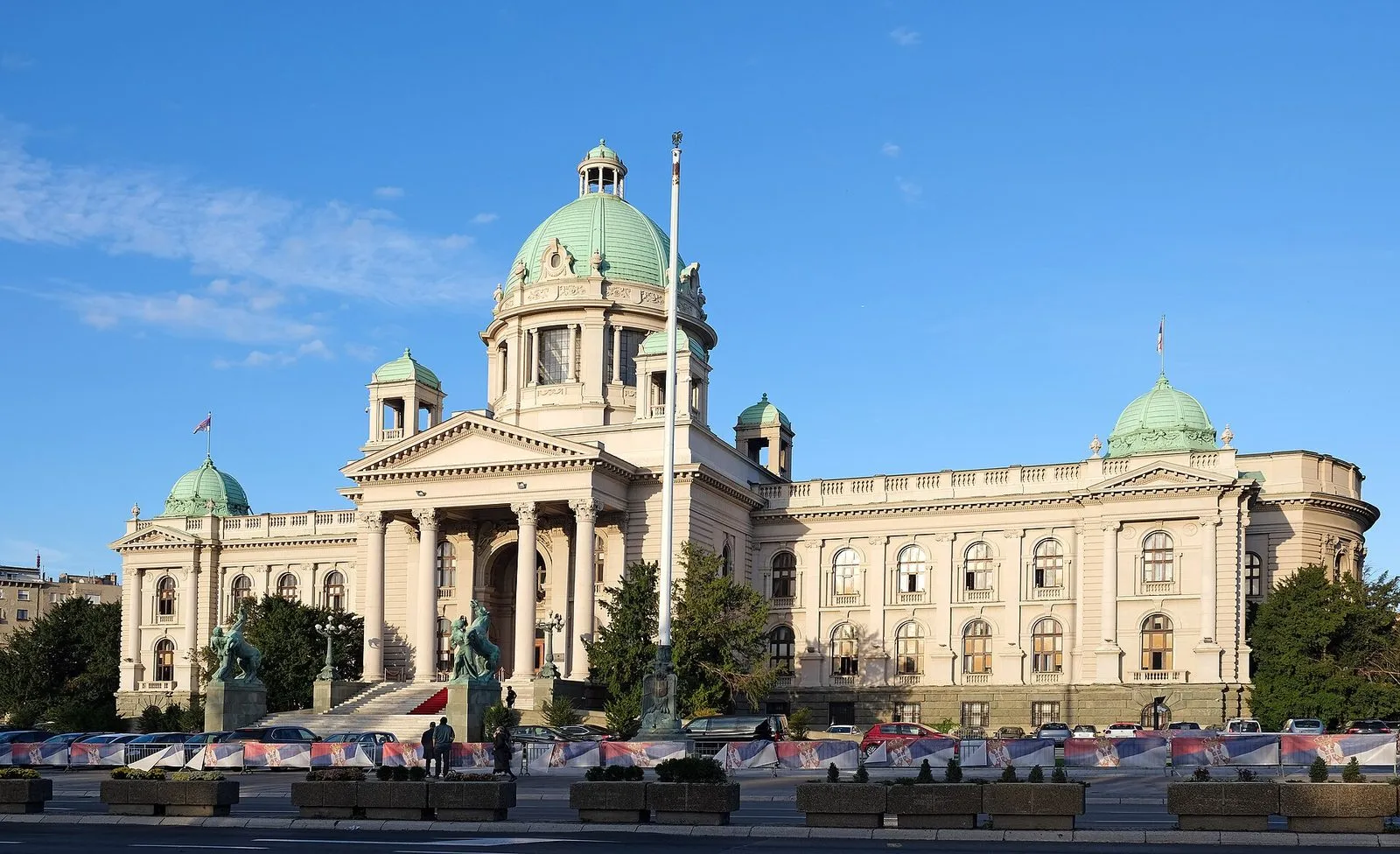
Cover image: The House of the National Assembly of the Republic of Serbia in Belgrade — kallerna, via Wikimedia Commons, CC BY-SA 4.0.
Serbia goes to the polls on 25 October 2026 in a snap parliamentary election that will decide whether a movement born in university lecture halls can end the political dominance of one man. The challenger is not a traditional opposition party but a student protest movement that has kept pressure on the government for nearly two years — and is now trying to convert street demonstrations into parliamentary seats. For Aleksandar Vučić, who has towered over Serbian politics since 2014, the vote is being described by international outlets including Reuters as the most serious threat yet to his 12 years in power.
A deadly collapse becomes a national reckoning
The movement's origin lies in a single catastrophe. On 1 November 2024, a concrete canopy at the newly renovated railway station in Novi Sad collapsed, killing 16 people. The station had been overhauled under a programme closely associated with Vučić, and critics argued the tragedy reflected graft and negligence in public construction projects. As far as international reporting records it, no official has been held criminally responsible for the disaster.
Three weeks after the collapse, students in Belgrade blocked a road to hold a vigil for the dead. According to accounts carried in international coverage, they were attacked by a mob linked to Vučić's Serbian Progressive Party (SNS) — and that confrontation transformed grief into a nationwide campaign. Faculties were occupied, streets were filled, and within weeks the prime minister resigned as the pressure mounted. The canopy at Novi Sad had become a symbol: not merely of an engineering failure, the protesters argued, but of a system in which power answers to no one.
From faculty blockades to a nationwide movement
What set this wave apart was its organisation. The students deliberately avoided crowning formal leaders, instead running the campaign through plenary assemblies at their faculties and rotating spokespeople to shield individuals from government smear campaigns. Residents sympathetic to the cause brought the blockading students food and mattresses; many stopped to debate the demands. One student told Reuters that the experience gave him, for the first time, a sense of belonging to a community — "I realised that my voice mattered."
The demonstrations spread far beyond campuses. Farmers, actors, teachers and even judges joined marches in cities across the country, with thousands flooding central Belgrade to welcome students who had walked for days to reach the capital, as local reporting described. The largest gathering, in Belgrade in March 2025, drew crowd estimates ranging from around 100,000 according to the government to between 300,000 and 500,000 according to the organisers and independent estimates. Protesters alleged that security forces used a sonic device against the crowd — a claim officials have not confirmed. The following May, clashes broke out again after another major student protest in the capital, deepening the standoff. The movement sustained itself through a tightly controlled public message, door-to-door campaigning that reached villages long loyal to Vučić, and days-long protest marches that captured national attention.
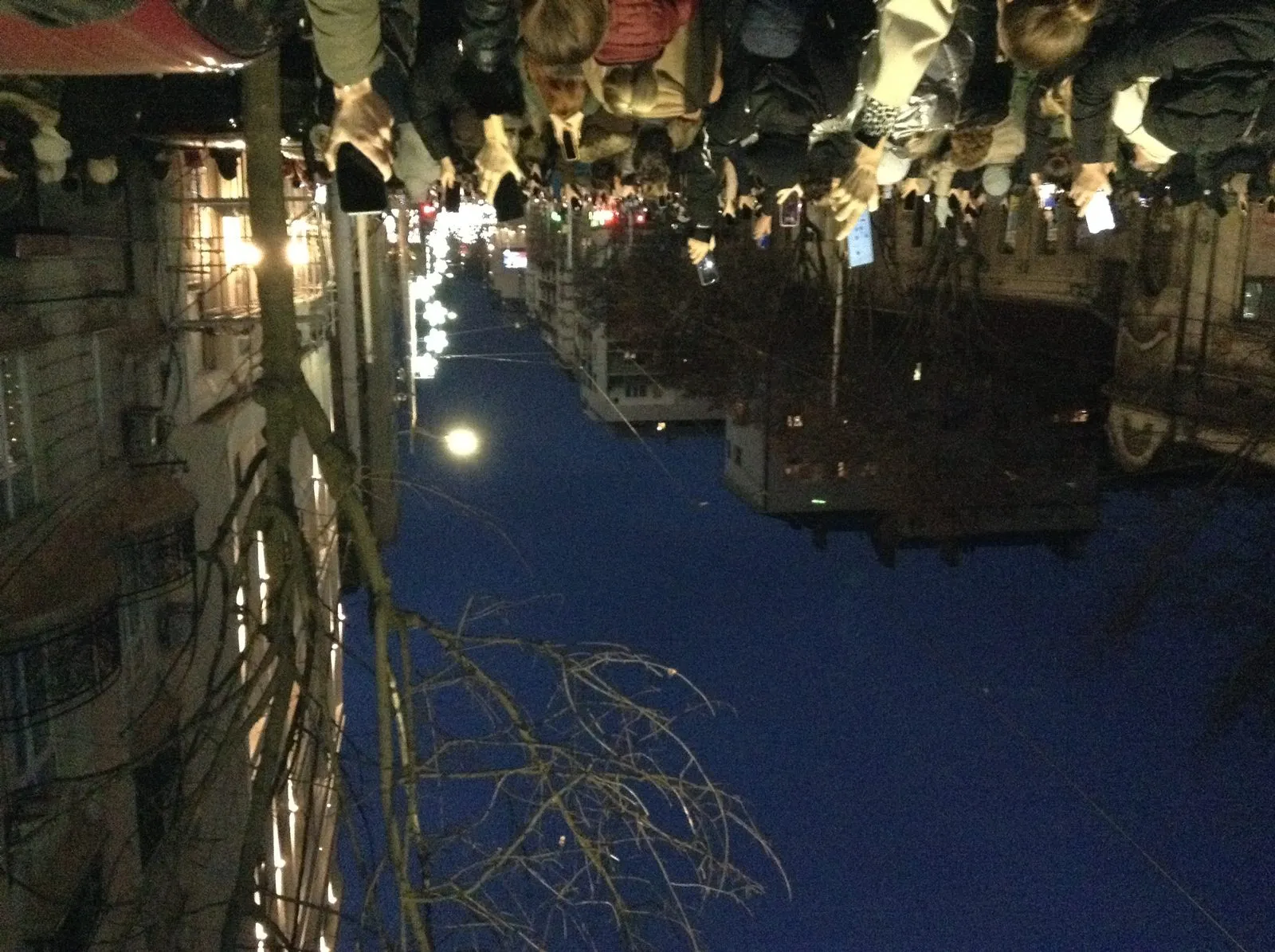 A large crowd of demonstrators in Belgrade on 22 December 2024 during the student-led protest movement against the Serbian government.
Photo by Emilija Knezevic, via Wikimedia Commons, licensed CC BY 4.0.
The demands: accountability first, then power
From the start, the students framed their cause as a matter of institutions rather than personalities. Their early demands were concrete: make public the full documentation of the Novi Sad station's reconstruction, prosecute those who attacked student demonstrators, drop the charges against arrested students, and increase funding for higher education. When the government refused, the movement concluded those demands would never be met under the existing parliament — and added another: early elections.
That demand arrived with an 11-point programme for what the movement would do with power. According to a summary carried by UA News, the platform calls for a special police unit to pursue corruption cases, the removal from the Interior Ministry of officials who broke rules while suppressing protests or who have ties to organised crime, genuine media reform, and an end to the practice of installing party loyalists as heads of state-owned enterprises. Deliberately, the programme avoids the divisive foreign-policy questions that have long split Serbian politics — deferring EU membership to a future referendum — and campaigns under the slogan "Serbia or Mafia."
From the street to the ballot box: the Student List
The most consequential decision the movement made was to stop treating elections as someone else's game. Several opposition parties withdrew from the race to clear the field, and the students fielded their own slate: the "Student List — Students Win," 250 candidates for 250 parliamentary seats. Yet despite the name, no student appears on the list. The candidates are the professors who supported the blockades, plus doctors, lawyers, scientists, farmers, actors and even a rapper — more than 160 of them, by one tally, holding doctorates. Faculties nominated them; plenums vetted them. The top name is Ilija Srdanović, a cardiologist and professor from Novi Sad, alongside figures such as former basketball star Dejan Bodiroga, actor Tihomir Stanić and former central bank governor Dejan Šoškić.
The shift from protest to electoral machine is the gamble of this movement. Organisers have spent months building support outside universities, walking for days through rural Serbia — territory that has long been Vučić's stronghold — to reach voters before the final rally at Belgrade's Slavija Square. An early-October survey by the NSPM polling agency put the Student List at 45 per cent against 43.5 per cent for the SNS coalition — a statistical dead heat that, if borne out, would be a political earthquake in a country where the ruling party has won comfortably for a decade.
Vučić's answer: deny, discredit, return to the arena
The government's response has combined denial with counter-attack. Vučić and his party have repeatedly rejected allegations of corruption and of exerting control over the media, and have denied that demonstrators were mistreated. He has sought to discredit the student movement itself, claiming it is trying to destroy Serbia and accusing foreign agents from Croatia and Montenegro of financing it — a charge the students dismiss, pointing to their transparent, community-funded organisation.
But the most dramatic move was Vučić's own. In late September, he resigned the presidency in the final year of his second term, announcing he would campaign as an ordinary citizen for the SNS and seek to return as prime minister — the post he held from 2014 to 2017, where most of the country's executive power sits. Parliament had already been dissolved on 9 September, and the election was called for 25 October with the shortest legally permissible 45-day campaign. The resignation made the contest personal: a former president, aged 56, betting that the state machinery he built over twelve years can hold back a generation that came of age protesting against it.
A close race — and what comes next
What happens on Sunday will be watched well beyond Serbia. The country is a candidate for European Union membership, and Brussels has repeatedly raised concerns about media freedom and the rule of law in Belgrade — a theme familiar across European politics this season, from electoral overhauls in Italy to the EU debates in Britain. A Serbian monitoring group reported media coverage skewed heavily toward the ruling camp, more than 100 violent incidents during the campaign, and activists being monitored and questioned. International election monitors have expressed concern about the fairness of the ballot following irregularities in past votes, and an OSCE observation mission — reported at roughly 80 parliamentarians and staff from nearly 30 countries — will be on the ground.