Israel's president has begun the formal process of deciding who should get the first chance to form the country's next government, after an election that left parliament deadlocked and neither of the two main blocs able to govern alone.
President Isaac Herzog received the officially certified results of the 27 October general election on Wednesday, in a formal ceremony at the President's Residence in Jerusalem, and immediately began consultations with representatives of the parties elected to the Knesset. The consultations, which are required by law before the president hands out the mandate to form a government, are expected to run over two days.
"I will now begin the process of consultations on tasking a member of Knesset with forming the government," Herzog said after receiving the results, according to reporting of the ceremony.
Certified results reject fraud claims
The results were certified on Wednesday morning by the plenum of the Central Elections Committee, chaired by Supreme Court Justice Noam Sohlberg. The committee said that after a thorough investigation of all claims of fraud, it had found no evidence of irregularities that compromised the integrity of the election or affected its results, according to Gulf News reporting.
That finding dealt a blow to efforts by Prime Minister Benjamin Netanyahu and his allies to discredit the vote. In the days since polling day, Netanyahu's camp had raised doubts about the count, prompting the elections chief to warn that casting doubt on certified results posed a real danger to democracy, as reported by the Times of Israel. Sohlberg called on all parties to compromise on their election campaign commitments in order to form a government and avoid new elections.
The certified results, reported by Al Jazeera, confirm the shape of the deadlock. Netanyahu's religious nationalist bloc won 53 seats in the 120 seat Knesset. The opposition bloc led by former army chief Gadi Eisenkot won 48 seats. The two Arab led parties, Ra'am and the Joint List, won a record 19 seats combined. A majority requires 61 seats, so neither of the two large blocs can govern without support from smaller parties or from the Arab led lists.
How the consultations work
Under Israel's system, the president meets the representative of each faction and asks whom it recommends for prime minister. In a break from custom, Herzog is meeting the smaller parties first. On Wednesday he invited faction representatives in ascending order of Knesset seats, beginning with Religious Zionism, followed by Shas and Yisrael Beytenu. The consultations continue with the other parties on Thursday, ending with Eisenkot's Yashar party and finally Likud, Netanyahu's party.
Once the consultations are complete, Herzog will assign the task of forming a government to the candidate he believes is best placed to succeed, who will in practice usually be the candidate backed by the largest number of party representatives. That candidate will then have 28 days to assemble a coalition, with a possible 14 day extension, making 42 days in all. If that candidate fails, the president can hand the task to another member of the Knesset for 28 days, with no extension. If no one can form a governing coalition, Israel would hold another election early next year.
Published counts suggest Eisenkot could collect around 60 recommendations without Yisrael Beytenu and 67 with it, against roughly 46 for Netanyahu from Likud, Otzma Yehudit, Shas and Religious Zionism, according to analysis of the declared positions. Naftali Bennett's B'Yachad party has announced it will recommend Eisenkot, and the Joint List and Ra'am are expected to do so as well, while United Torah Judaism and Avigdor Liberman's Yisrael Beytenu have not committed. Those figures remain projections, not confirmed recommendations, and the formal consultations are the process that will test them.
The path to a government, or another election
Herzog used the ceremony to urge the factions to face the arithmetic honestly. Addressing the political stalemate, he said the various Knesset factions should understand that they cannot abide by every commitment and promise made in the campaign, if new elections are to be avoided. The message was aimed at both sides: Netanyahu's bloc lost the majority it once held, while Eisenkot's bloc cannot govern without partners it has historically been reluctant to embrace.
The deadlock raises the possibility of a unity government, or an alliance between Eisenkot and some of the Arab led parties. Opposition leaders have already said they are preparing to act immediately to replace Netanyahu's governing coalition with what they call a national emergency government, and to translate what they describe as a clear parliamentary majority into action. Whether that majority holds together in formal coalition talks, where ministries, budgets and policy commitments must be divided, is a different question from the arithmetic of recommendations.
Netanyahu, meanwhile, remains in office as caretaker prime minister, with a caretaker's limits, until a new coalition is sworn in, a process that could run into next year. The new Knesset itself is due to be sworn in on 10 November, coalition or no coalition.
Why the result matters beyond Israel
The election was fought against the backdrop of a region in flux and a domestic debate about the direction of the country, and its inconclusive result prolongs a period of political uncertainty that has seen repeated elections in recent years. The record showing of the Arab led parties, with 19 seats, also marks a shift in the parliamentary map: parties representing Israel's Arab citizens, about a fifth of the population, now hold a bloc large enough that neither of the two larger camps can easily ignore them.
International partners will be watching the consultations closely. A government formed with Arab party support, a unity arrangement, or a return to the polls would each send a different signal about Israel's domestic politics and its approach to the region. For now, the process is in the president's hands, and the formal timetable gives the parties weeks, not days, to find a combination that can command 61 votes.
The BBC reported the start of consultations on Wednesday, as Herzog began meeting party representatives at the President's Residence. The next milestone will be the president's choice of mandate holder, expected once the two days of meetings conclude, and then the hard bargaining over a coalition that can actually govern.
More world coverage is available on our World section, and our Politics section carries analysis of elections and governments. Readers may also like our recent article on the United States striking an Iranian island, available here, and our report on Russian bombing of a Ukraine aid centre here. Our News section has the day's headlines, and the Verity homepage has the latest updates. Background on our newsroom is on our About page.
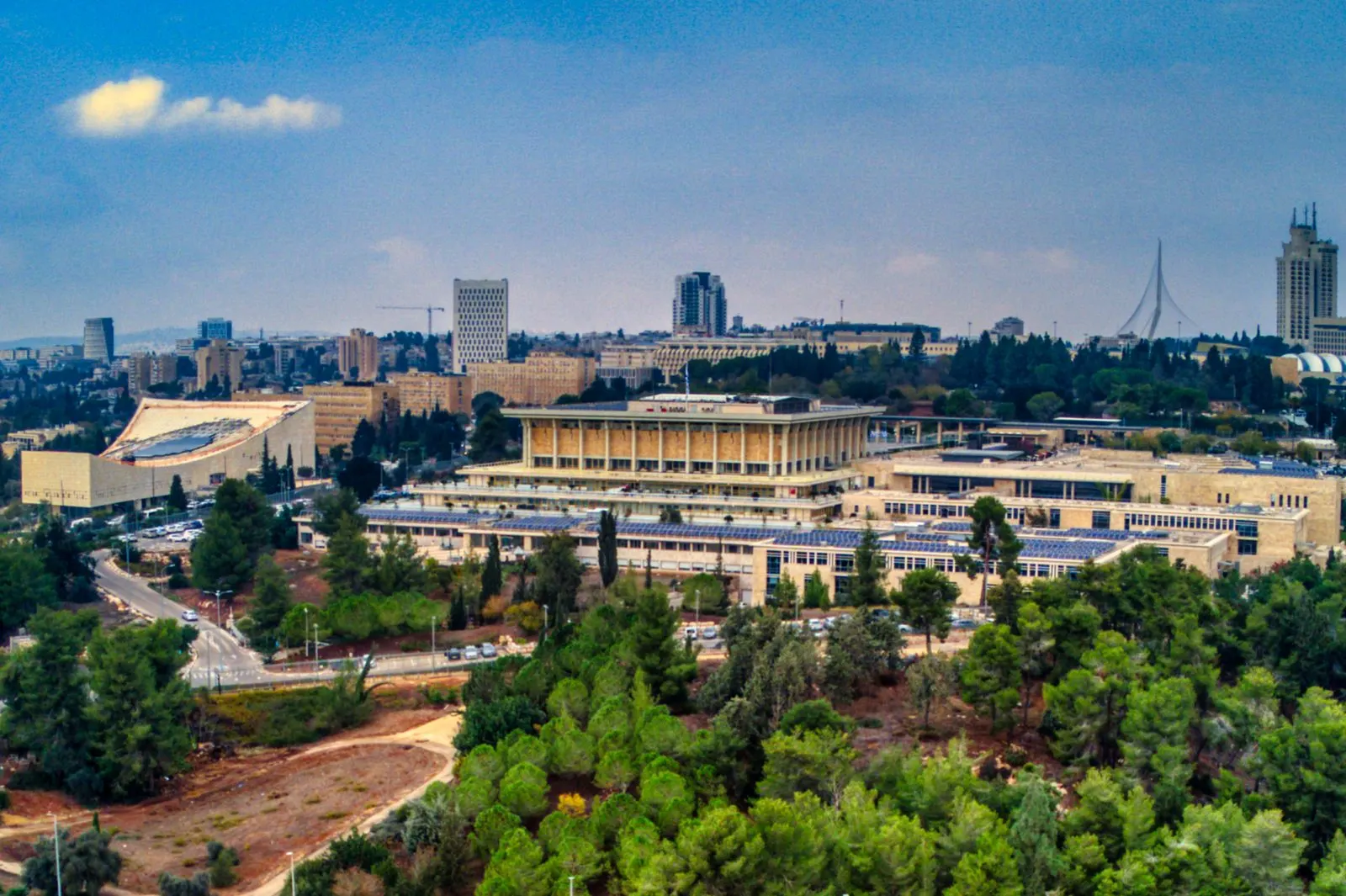 The Knesset building and its surroundings in Jerusalem
The Knesset and its surroundings in Jerusalem in 2022. Photo: Agmonsnir, via Wikimedia Commons.