In Short (TL;DR)Since mid-September, French high-school students have blockaded lycées over staff shortages, crumbling buildings and the Parcoursup university admissions platform; a national day of action on 6 October drew hundreds of thousands. Parts of the movement have turned violent, with hundreds injured and thousands arrested; the government has suspended stun grenades after a teenager was seriously hurt. The grievances are real but limited — France actually funds education comparatively well — so analysts point to a deeper cause: street protest has a long history of winning concessions in France. A lame-duck presidency, a gridlocked parliament and tight finances mean the government has little to offer — which is why a limited school dispute keeps escalating.
For three weeks, France's high schools have been in turmoil. Students have blockaded hundreds of lycées, marched through city centres and clashed with police in scenes that have left hundreds of pupils, teachers and officers injured and thousands under arrest. The trigger was education funding — but anyone who has watched French politics for long knows that the explanation cannot end there. The analysis that follows asks what is really driving the anger.
The grievances themselves are easy to list. Students say their schools are short of teachers, that classes are overcrowded, that buildings are falling apart, that absent teachers go unreplaced for weeks. They resent the ban on mobile phones in schools, complain of punishingly long school days, and direct particular fury at Parcoursup, the online platform that allocates university places — a system they describe as opaque and anxiety-inducing.
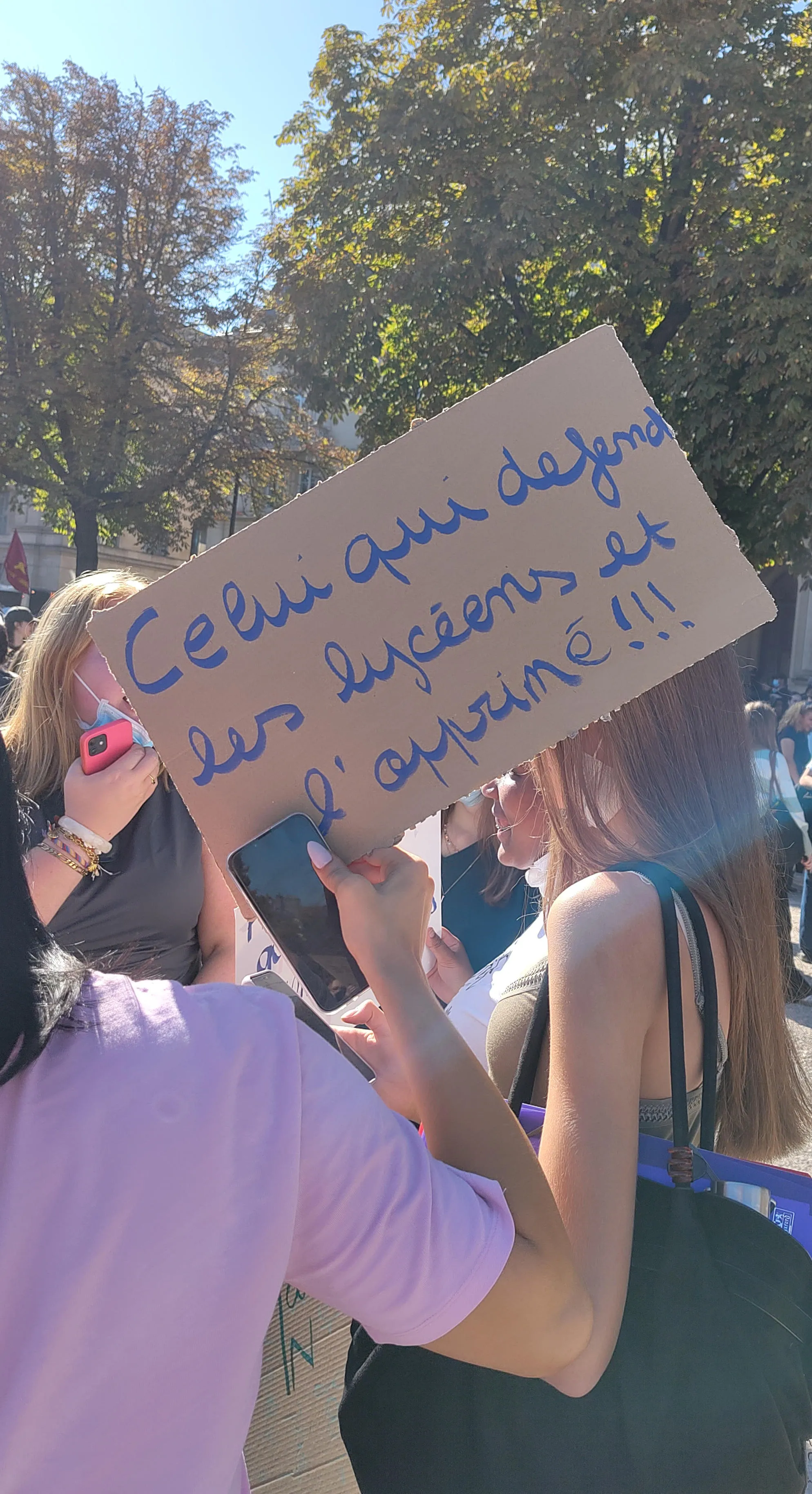
!Students demonstrating in Nancy, France
Students demonstrating in Nancy on 6 October 2026, carrying a placard reading "Défend les lycéens et l'opprimé" (Defend high-school students and the oppressed). Credit: Florian Cuny / Wikimedia Commons (CC BY-SA 4.0)
There is truth in the complaints. A Parisian pupil told the BBC that teachers in her school are sometimes absent for weeks without replacement. Students describe school days stretching from 8am to 6pm, leaving them home at 7pm with homework still to do and no time to sleep. During this year's European heatwaves, classrooms reportedly reached 40°C. And while roughly 80% of students pass the baccalauréat, the exam does not guarantee a place on a preferred course — which is why competition for top programmes through Parcoursup feels so brutal.
But set against international comparisons, the picture is less clear-cut. France actually spends comparatively well on education, and OECD data suggest its teacher shortages are no worse than those of comparable countries. The long school day is a genuine, long-standing French peculiarity — but it is not new, and it does not obviously explain why teenagers who tolerated it last year are burning bins this year. The grievances are legitimate, but they are limited. Something else is turning a school dispute into a national crisis.
That something else is history. In France, taking to the streets has an unrivalled record of producing results — and schoolchildren have been among its most successful practitioners.
In October 1990, unrest erupted after a rape at a school in Seine-Saint-Denis. In October 1998, half a million pupils marched — and won almost €1bn in concessions. In 2006, weeks of protest forced the government to withdraw the CPE youth employment contract. The gilets jaunes of 2018–19, though a different movement, reinforced the lesson that sustained disruption moves governments. And looming over everything is May 1968, the founding myth of modern French protest, when student revolt nearly toppled a republic.
French pupils grow up knowing this history. They know that blockades and marches are not merely expressions of anger but a proven negotiating tactic — one that has worked for their predecessors again and again. When the first lycées were blockaded in the Paris region in mid-September, the script was already written. By 1 October, more than a thousand of France's roughly 3,700 high schools were affected; on 6 October, the interior ministry counted 256,000 demonstrators nationwide (organisers claimed 450,000), with 891 schools suspending classes. The movement had become the largest student mobilisation in a generation — precisely because the students believed, with good reason, that it could work.
The second half of the explanation is the weakness of the government facing them. After nine years in power, Emmanuel Macron is a lame duck. His snap parliamentary election of June 2024 produced a gridlocked National Assembly in which no bloc commands a majority. Rising borrowing costs have tightened the fiscal straitjacket. Prime Minister Sébastien Lecornu cannot open the purse strings even if he wanted to — and the students' core demand, more money for schools, is precisely what he cannot offer.
So the government has reached for the familiar toolkit of gesture and containment. Education Minister Édouard Geffray suspended classes in 400 to 500 high schools on security grounds and has been meeting student and parent representatives. Lecornu condemned the violence, denied ordering any police crackdown on protesters, and announced a half-day suspension of classes to allow "a timeout for democracy" — democratic discussion inside the schools. After a 15-year-old was seriously injured, the interior ministry suspended the use of stun grenades at student protests. Macron himself convened an emergency meeting of ministers.
Meanwhile the state's harder edge has been on display. Thousands of arrests have been made since the movement began — the interior ministry reported nearly 2,000 detentions on 1 October alone, around 85% of them minors — and the government has accused the far left of stirring the unrest for political gain. The justice minister, Gérald Darmanin, has asked prosecutors to hold parents civilly liable for damage caused by their children. None of this addresses what the students are asking for, because what they are asking for — money — is what the government does not have.
!High school and university students marching in Perpignan
High school and university students marching in Perpignan during the October 2026 protests. The movement has drawn support from teachers, unions and parents. Credit: Aurelio Cárdenas / Wikimedia Commons (CC BY 4.0)
One reason the protests keep growing is that they are not unpopular. A BFMTV poll suggests broad public sympathy for the students' cause, and the movement has been backed by many teachers, labour unions and left-wing politicians — Jean-Luc Mélenchon has doubled down on his support even as the clashes escalated. The government's attempt to frame the unrest as the work of outside agitators has not obviously landed with a public that remembers its own schooldays.
This sympathy matters, because it changes the government's calculus. A crackdown on teenagers with parental and union backing is politically perilous; concessions that cannot be funded are fiscally impossible. The result is paralysis — vague promises, crisis meetings and a prime minister publicly denying that he ordered the police to confront the very protesters his government is arresting by the thousand.
Strip away the particulars, and the French school protests of October 2026 look like a collision between two national constants: a protest culture that has learned, over half a century, that the street delivers — and a political system that, at this moment, has almost nothing left to deliver with.
The students' complaints about their schools are sincere, and some of them are justified. But complaints do not blockade a thousand schools. What blockades a thousand schools is the belief — borne out by 1998, by 2006, by the whole long French tradition — that enough disruption forces the government's hand. And what turns that belief into weeks of escalating confrontation is a government too weak, too divided and too broke to answer it.
France has been here before. The question is whether this time, the street will discover that the old magic has run out — or whether a government with nothing to give will find something to give anyway. Follow Verity for continuing coverage of the crisis.