In Short (TL;DR)Tobias Rausch, a 35-year-old AfD politician, has been elected president — speaker — of the Saxony-Anhalt state parliament, the first time since 1945 that a German state legislature has been led by the far right. Rausch won 48 votes in Tuesday's secret ballot, drawing support from beyond the AfD's 39 seats, including the five MPs of the left-wing populist BSW. The result came a month after the AfD's landslide state election victory on 6 September, when it took 43.8 percent of the vote but fell three seats short of an outright majority. Rausch used his inaugural address to declare that "the days of political firewalls should be a thing of the past."
When the newly elected state parliament of Saxony-Anhalt gathered in Magdeburg on Tuesday for its inaugural sitting — as the BBC reported — the opening act produced a moment of genuine historical weight. Tobias Rausch, the 35-year-old candidate of the far-right Alternative for Germany, was elected president of the Landtag — the speaker's chair — making him the first far-right politician to lead a German state parliament since the end of the Second World War.
The secret ballot was not close. Rausch collected 48 votes out of 82 cast (as Osna.FM reported), comfortably clearing the threshold of 42 needed for an absolute majority. Twenty-nine MPs voted against him; five abstained. For a party that less than a decade ago was treated by much of the German establishment as beyond the pale, it was a symbolic victory of the first order — achieved not in a street protest or a television debate, but in the formal heart of a democratic institution.
Under the rules of the chamber, the largest parliamentary group enjoys the exclusive right to nominate a candidate in the first ballot — a privilege the AfD secured with its record September result. The AfD earned that right with its emphatic state election triumph on 6 September, when it captured 43.8 percent of the vote — the best result in the party's history — and 39 of the 83 seats. A similar situation arose after the Thuringia state election in 2024, when the AfD also emerged as the largest party but a cross-party majority was able to block its candidate. This time, no such blocking majority materialised.
On paper, the arithmetic looked tight. The AfD's 39 seats left it three short of a majority, and the other parties had spent weeks insisting that the so-called firewall against the far right would hold. The hard-left populist Sahra Wagenknecht Alliance (BSW), which entered the parliament for the first time in September with five seats, announced in advance that it would vote for Rausch — taking the expected total to 44, just enough.
In the event, Rausch received 48 votes: four more than the combined AfD and BSW delegations. That means at least four ballots came from MPs outside those two groups. Reporting in German media has suggested that some of the extra votes may have been cast by deputies of Chancellor Friedrich Merz's Christian Democrats — a claim that cannot be verified because the ballot is secret, but one that has already set off a furious argument inside the CDU.
The abstention figures added to the intrigue. The CDU's state leadership, under Sven Schulze, had instructed its 15 MPs to abstain. In the end, only five abstentions were recorded in total — a defiance of the party line that speaks volumes about the pressure the conservatives are under in the east. Reuters reported that around 400 protesters gathered peacefully outside the parliament in Magdeburg, reading Germany's constitution aloud and holding a long red banner declaring "No cooperation with the extreme right."
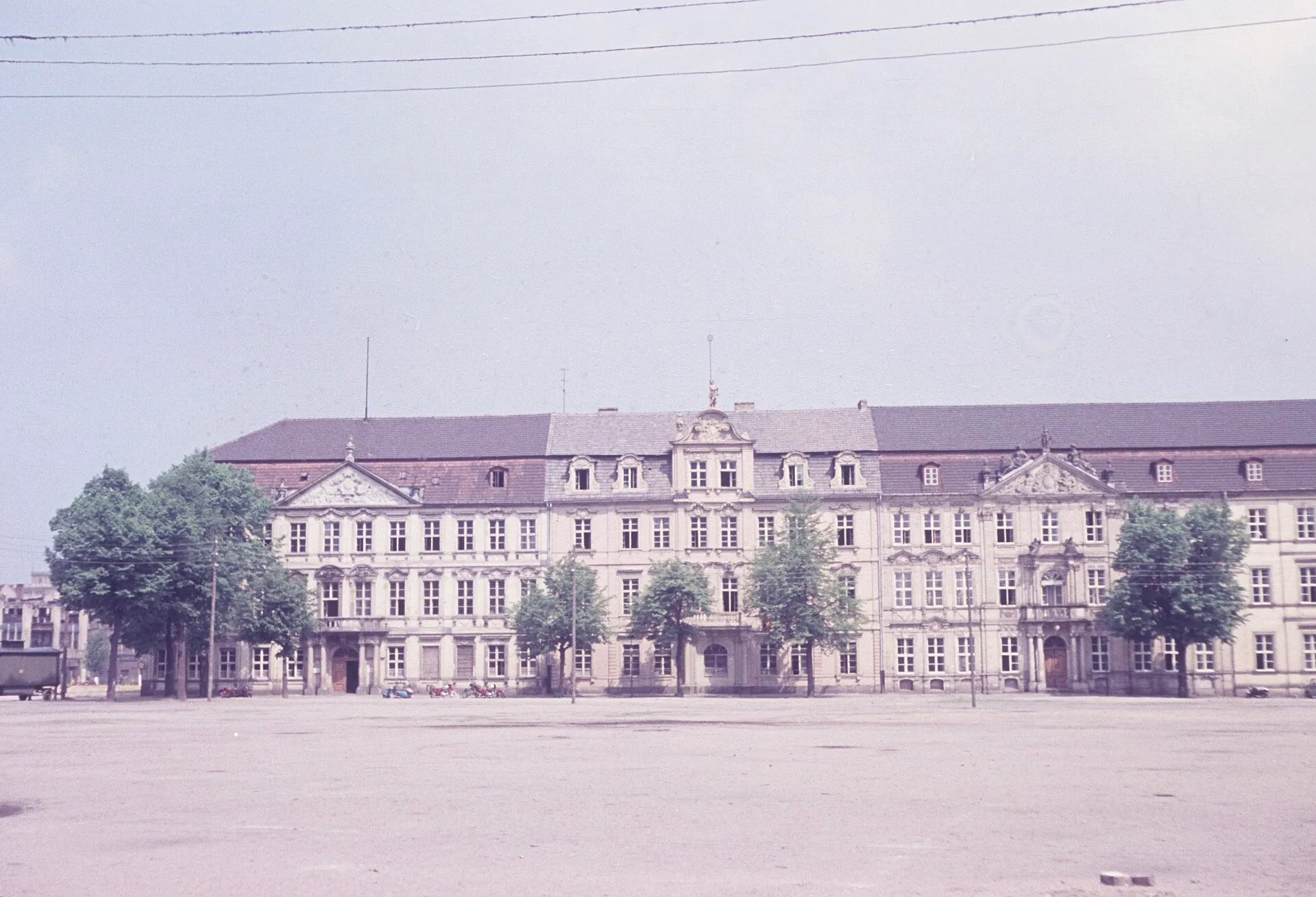
!The Saxony-Anhalt state parliament building on Domplatz in Magdeburg
Photo: Torsten Maue / Wikimedia Commons (CC BY-SA 2.0)
Rausch is, in many ways, the archetype of the AfD's new generation. Born in 1990 in Mellrichstadt, Bavaria (profile), he has been a member of the Saxony-Anhalt Landtag since April 2016 — a full decade in the chamber, which made him a natural choice for a presiding role. Before politics consumed his career, he trained as an estate agent; Reuters described him as a 35-year-old real estate entrepreneur and a confidant of Ulrich Siegmund, the AfD's state leader. He is also the son of Daniel Rausch, another figure in the party's orbit.
Colleagues describe a polished operator rather than a firebrand. But his inaugural speech left no doubt about the political message his election carries. Calling on lawmakers to work together, Rausch declared: "The days of political firewalls should be a thing of the past." It was a direct assault on the cordon sanitaire — the long-standing agreement among Germany's mainstream parties not to cooperate with the far right — delivered from the very chair that symbolises parliamentary order.
That firewall has been the defining feature of German party politics for decades, and its erosion in the east is now impossible to ignore. The AfD's success in Saxony-Anhalt and in two other September state elections has piled pressure on Chancellor Friedrich Merz, whose CDU has governed the state since 2002 and whose personal unpopularity has been widely cited as a factor in the defeat — including by Merz himself.
The controversy is sharpened by how the AfD is viewed by the German state itself. The party's Saxony-Anhalt chapter is classified by the domestic intelligence service as a "secure right-wing extremist aspiration" — in plain terms, an organisation whose extremist character the authorities consider established. Nationally, the AfD's platform combines hardline anti-immigration positions with a pro-Russian foreign policy orientation; among its proposals in the state has been the segregation of refugee children in schools. Supporters of the firewall argue that such positions make cooperation impossible; its critics — including, increasingly, voices within the CDU — say that a party winning more than two-fifths of the vote cannot be frozen out of democratic institutions indefinitely. The debate echoes across Europe, where the far right's advance continues — from Marine Le Pen's bid to return for the 2027 French presidential race to Giorgia Meloni's recent parliamentary setback in Italy.
Outside the parliament, the reaction was visceral. More than 300 protesters assembled with a sign reading "2026. Never again" — a deliberate invocation of the postwar consensus the day's events appeared to breach. Inside, the atmosphere was no less charged: Eva von Angern of the Left party, who opened the session as the presiding president, had compared Rausch's prospective elevation to the National Socialist era, arguing that the first parliament president from a right-wing extremist party should not be a figure in the mould of Hermann Göring, the Reichstag president from 1932 to 1945. The SPD echoed the sentiment on social media: "The first right-wing extremist parliament president since Hermann Göring? Not with us!"
The AfD, for its part, treats such comparisons as an attempt to delegitimise millions of voters. For its supporters, Tuesday was a day of vindication — proof that the party can not only win elections but govern institutions.
It is worth being precise about what Rausch has actually won. The presidency of a state parliament is, in the day-to-day, a procedural office: chairing debates, ruling on points of order, directing the parliament's administration, controlling access to the building, and — most consequentially — swearing in the minister-president once one is elected. It is the parliament's most senior representative office, more than ceremonial but short of executive power.
The AfD is also pursuing a further seat on the Landtag's presidium, a claim the other groups have contested. And under a new seating plan, the party's deputies will move from the right of the chamber to the centre — a piece of parliamentary stagecraft that mirrors the party's claim to have moved from the margins to the mainstream.
For all the symbolism of Tuesday, the AfD's larger ambition remains unfulfilled. Ulrich Siegmund, the party's lead candidate, wants to become minister-president of Saxony-Anhalt — which would make him the first AfD state premier in German history. But the party is still three votes short of the 42 needed, and the BSW has so far ruled out backing him.
That leaves a slow-burning drama. No defections from Merz's CDU have been announced, but the secret-ballot mathematics of Tuesday's vote has already fuelled speculation that some conservative deputies might be persuadable. Schulze himself was elected CDU parliamentary group leader by a razor-thin 8-to-7 vote, a sign of how divided the party is. In the coming weeks, every move inside the Magdeburg chamber will be watched far beyond Saxony-Anhalt — because what happens there may yet decide whether Germany's firewall against the far right holds, bends, or breaks. Follow our World and Politics coverage, and the Verity Newspaper homepage, for updates.