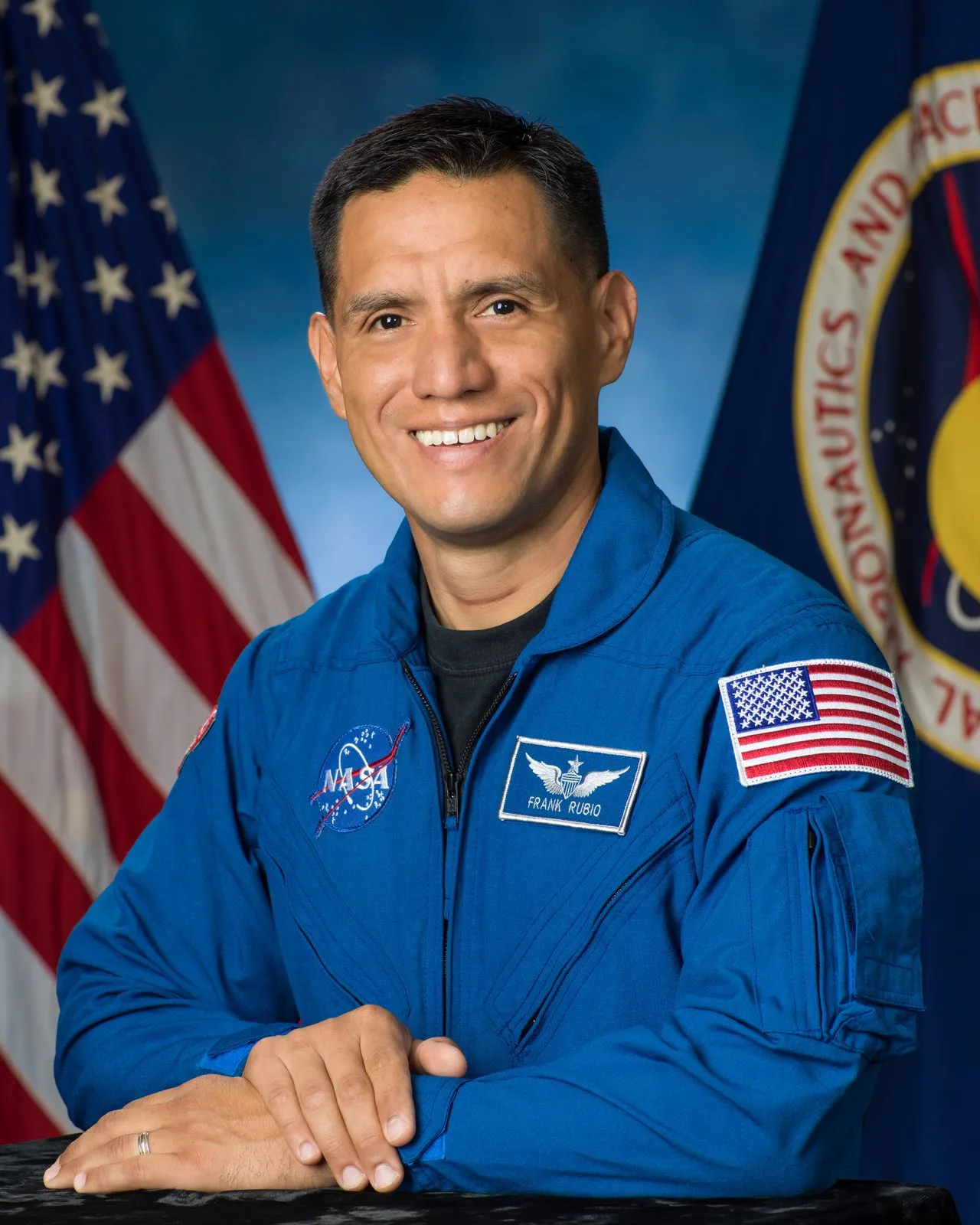
Cover image: Official NASA portrait of astronaut Frank Rubio — NASA / Bill Stafford, public domain, via Wikimedia Commons.
A school hall meets orbit
It is not every school assembly that ends with a man floating hundreds of kilometres above the Earth holding up your class's artwork. Pupils at Ysgol Cemaes on Anglesey, in Wales, got exactly that this week when they met NASA astronaut Frank Rubio in a live video call, according to the BBC, capping a project in which the children designed a badge that was actually sent into space.
The children were, in the words of those around them, very excited. Two of the pupils, Harry and Sofia, were singled out for their delight at meeting a genuine astronaut on screen, and the call drew reactions of wonder from across the school hall. For a small school on an island off the north Wales coast, a direct line to a NASA astronaut is not an everyday event — and the pupils knew it. One ten-year-old, Ruby, described speaking to a real astronaut as "very cool", adding that she believed no other schools in Wales would get that experience.
The link-up was arranged through Dr Melanie Coathup, a former pupil of Ysgol Cemaes who now works as a scientist alongside astronauts — a connection the school says has strengthened its ties with the space industry. Acting headteacher Guto Rhys noted how engaged the pupils had been with the opportunity, having prepared thoroughly for their questions. That a school of this size can count a space scientist among its alumni, and an astronaut among its callers, is the kind of story school space programmes dream of — and it is part of a wider trend of school space education that you can read more about in our science coverage.
The badge that went to space
The centrepiece of the session was the badge. The pupils had been invited to design a mission-style badge, and the winning design was carried into space — a tradition with deep roots in spaceflight, where embroidered mission patches have marked crews and expeditions since the 1960s. During the call, Rubio held the pupil-designed badge up on camera so the children could see it, the BBC reported.
For nine-year-old Lola, the moment carried a personal twist: the winning design belonged to her cousin. "We got to design a badge to go up to space and it was my cousin who won and her badge got to go up to space," she said — a sentence that captures both the pride of the competition and the thrill of seeing the result in an astronaut's hands. The school is not stopping there. It plans to design a new badge very soon, with the aim of sending another one into space next year, building a continuing relationship between the classrooms of Anglesey and the orbital outposts above them. School space projects elsewhere have taken pupils in similar directions — students from Queen's University Belfast, for example, have competed in NASA's Lunabotics contest in Florida — but few primary-aged children can say their own design has orbited the planet.
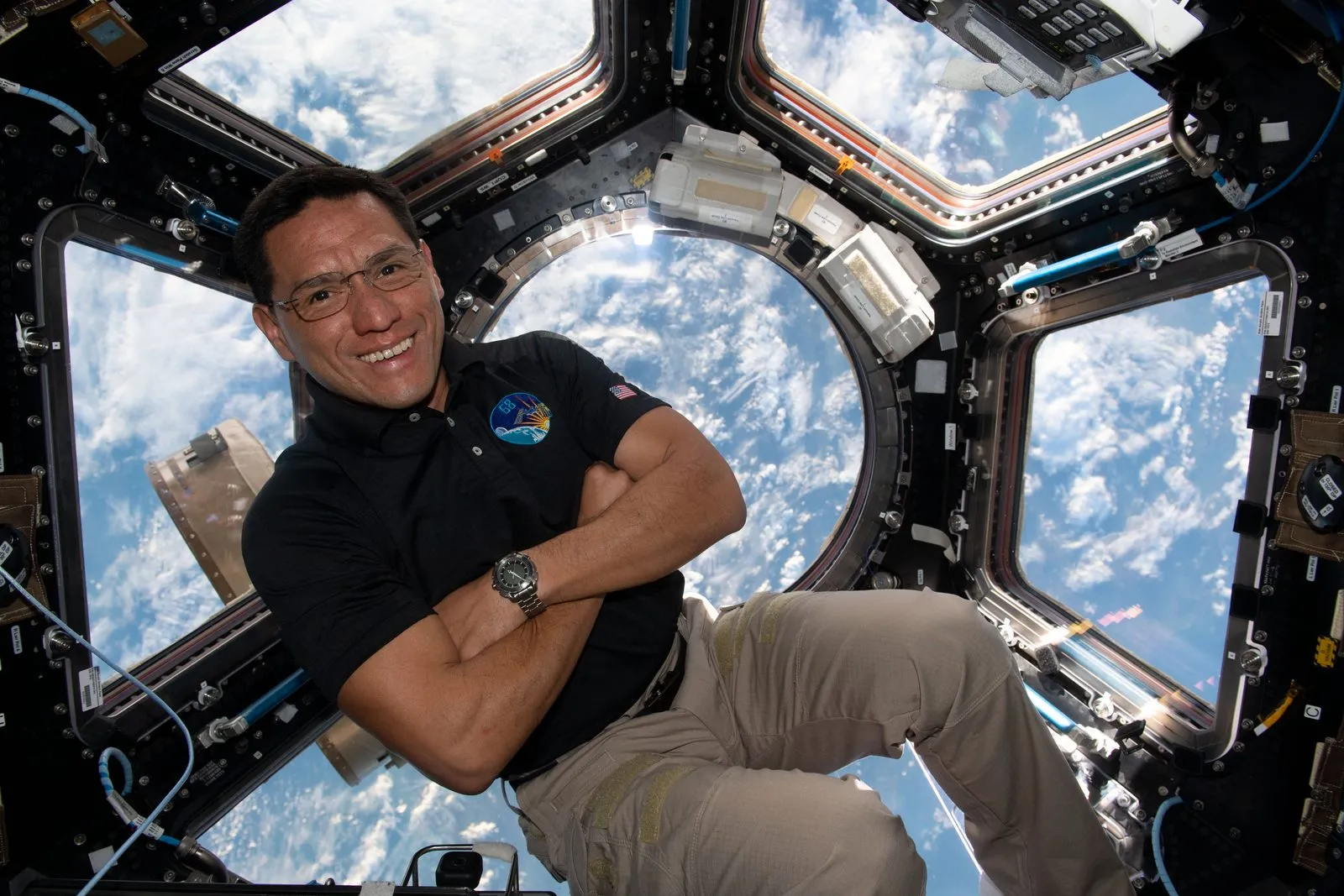 Frank Rubio photographed inside the International Space Station's cupola observation module during Expedition 68.
Photo by NASA / Frank Rubio, public domain, via Wikimedia Commons.
Who is Frank Rubio? A year in orbit
The pupils had done their homework on their visitor. "We've been learning about Frank Rubio and that he was supposed to stay in space for six months, but he ended up staying there for a year," Lola explained — and NASA's official biography backs her up.
Rubio, a Florida native and graduate of the US Military Academy at West Point, was selected as a NASA astronaut in 2017 after a career as a UH-60 Black Hawk helicopter pilot — logging more than 1,100 flight hours, including over 600 hours of combat time in Bosnia, Afghanistan and Iraq — and then as a board-certified family physician and flight surgeon. He launched to the International Space Station on 21 September 2022 aboard the Soyuz MS-22 spacecraft, alongside cosmonauts Sergey Prokopyev and Dmitry Petelin, for what was scheduled to be a routine six-month rotation.
The routine ended when engineers discovered a coolant leak on the docked Soyuz, rendering it unfit to carry the crew home. NASA elected to send a replacement, Soyuz MS-23, and extend the mission. Rubio finally parachuted back to Earth in Kazakhstan on 27 September 2023, having spent 371 consecutive days in space — the longest single spaceflight by a US astronaut in history. In that time he travelled more than 157 million miles, orbited the Earth nearly 6,000 times, saw 15 visiting spacecraft dock with the station, and carried out three spacewalks totalling 21 hours and 24 minutes, including installing new solar arrays.
His extended stay was not just a personal endurance feat: it was a scientific one. NASA says long-duration missions like Rubio's provide some of the most valuable human-body data available for planning the Moon and Mars missions of the future — how the heart, bones, muscles and eyes cope with a year in microgravity, and how astronauts stay healthy enough to keep working. Rubio's mission helped turn an accident into an experiment, and the pupils of Ysgol Cemaes got their lesson from the man who lived it.
What the pupils asked: life in space, up close
The children came to the call with questions shaped by careful preparation. They had been watching videos about the mundane details of orbital life — how astronauts brush their teeth, how they sleep — and learning about the station itself before the big conversation. Their questions, according to reports of the session, ranged across the practical realities of living and working in space, including hygiene routines and how medical procedures are managed in microgravity.
That medical angle is a fitting one for Rubio, who flew to the station partly as the crew's physician. Space medicine — treating injuries, illness and the slow effects of weightlessness in a place where gravity cannot help drain a wound or keep equipment on a table — is one of the less glamorous but most critical disciplines of human spaceflight, and a growing field as agencies plan longer missions. For the pupils, it was simply part of the fascination: "The most interesting thing that I learned today was that there is a space station up in space," said Ruby, ten, with the kind of unfiltered honesty that made the session what it was.
Beyond the curiosity, there is a serious purpose. Encounters like this are deliberately designed to connect classroom science with the real thing — physics lessons with orbital mechanics, biology with the human-body science of long-duration flight — at an age when career ideas are first forming. More of this science and exploration storytelling can be found across the site.
The Artemis III mission ahead
Rubio will not be staying on the ground for long. NASA has confirmed that he is assigned as a mission specialist on the Artemis III crew, the announcement made on 9 June 2026 at the Johnson Space Center in Houston. He will fly alongside commander Randy Bresnik, a retired Marine colonel; mission specialist Andre Douglas, a first-time flier from the 2021 astronaut class; and pilot Luca Parmitano — the Italian European Space Agency astronaut who becomes the first European assigned to an Artemis mission, with Bob Hines named as backup.
The mission is not what many might expect from the programme that is carrying humans back toward the Moon. Artemis III will not land on the lunar surface. Instead, it is planned as a roughly two-week test flight in low Earth orbit — expected to launch no earlier than 2027 — in which the Orion crew capsule will attempt to rendezvous and dock with test versions of the lunar landers being built by SpaceX and Blue Origin, launched on separate rockets. NASA calls it one of the most complex missions the agency has undertaken, and a necessary rehearsal for reducing risk before the actual lunar south pole landing now targeted for Artemis IV in 2028. The European Space Agency says it is contributing its third European Service Module to the flight, underscoring how international the return-to-the-Moon effort has become. Detailed reporting on the crew announcement described it as NASA's next big step toward putting astronauts on the surface for the first time in more than 50 years.
For Rubio, it will be his second spaceflight — a far shorter one than his first, trading a year of weightlessness for a fortnight of intensive spacecraft testing. For the pupils who watched him hold their badge on screen, it is one more reason to keep looking up.
Why a school badge matters in the space age
It is easy to treat the badge as a charming gimmick. It is more than that. Mission patches and student-designed emblems have been part of the emotional infrastructure of spaceflight for decades: they turn an abstract technical programme into something a person — or a class of nine-year-olds — can hold in their hands. A badge that has physically orbited the Earth carries the same imaginative charge as the flight itself, which is precisely why agencies and schools keep organising such projects. Youth space engagement programmes run by the UK Space Agency have funded similar live links between schoolchildren and astronauts, and the tradition of student involvement — from designing mascot zero-gravity indicators to flying experiments — remains one of spaceflight's most reliable recruitment tools.
Ysgol Cemaes, meanwhile, has its own ambitions: another badge, designed and flown next year. Between the badge, the alumni scientist and the astronaut on screen, a small Welsh school has built itself an unusually direct line to the space age — and, for one school hall on Anglesey, the stars have never seemed quite so close. Whether inspiring future scientists or simply making physics class memorable, it is the sort of story that shows why space exploration still captures classrooms — alongside the bigger scientific landmarks of the year, from Nobel-winning physics to breakthroughs in chemistry and remarkable wildlife science closer to home.