In Short (TL;DR)A ten-strong team from Queen's University Belfast is travelling to Florida later this month for NASA's international Lunabotics competition, where they will be the only European team. Their 52kg aluminium-framed rover won the UK qualifier in Milton Keynes earlier this year. In Florida, the robots must autonomously navigate a lunar-simulated arena, dig up regolith simulant and build a wall — against teams from Australia, India and the US.
Ten students from Queen's University Belfast are packing their bags for Florida — and their luggage includes a 52kg robot built to dig on the Moon. The team from the university's Propulsion Lab (QPL) has been invited to NASA's international Lunabotics competition at the University of Central Florida, where they will be the only European team in the field.
For a group of undergraduates and postgraduates who built their aluminium-framed rover in a Belfast laboratory, it is the opportunity of a lifetime: to test their engineering against university teams from Australia, India and the United States, under the eyes of the space agency whose missions their designs might one day support.
The road to Florida began with victory at the UK qualifying competition in Milton Keynes earlier this year. The Queen's team triumphed there with a machine they designed and built themselves, earning the right to represent not just their university but the UK — and, as PhD student Jack Fitzpatrick puts it, "by extension, Europe at this competition".
Fitzpatrick, a PhD researcher in mechanical engineering, said the invitation was vindication for months of painstaking work. "It's a great feeling," he said. "We are the winning team from the United Kingdom competition and we will be representing the UK and, by extension, Europe at this competition." He is realistic about the odds in Florida — "we may not win the competition this year" — but sees the bigger picture: "we're building a base upon which we can improve year on year and maybe come back in a few years and really come through with a winning design."
The team has been selected by NASA and engineering giant Caterpillar to compete in what Queen's describes as the very first International Lunabotics Competition — a milestone that underlines how seriously the space industry takes student engineering talent.
Lunabotics is no ordinary student robotics contest. Run by NASA since 2010 as one of its Artemis Student Challenges, it asks teams to apply the agency's own systems engineering principles to design and build a prototype lunar construction robot — a machine capable of the kind of off-world construction work that future Moon bases will require.
In the arena, the robots must operate largely on their own. They navigate a room simulating the lunar surface, dig up lunar simulant — the abrasive, specially manufactured dust that mimics Moon soil — haul it across obstacle-strewn terrain, and then use the material to build a wall. It is a demanding test of mechanical design, software, power management and autonomy, judged alongside engineering reports, project plans and public outreach.
The competition is deliberately aligned with NASA's Artemis programme, which aims to establish a long-term human presence on the Moon. The data and design ideas generated by student teams feed directly into NASA's thinking about future robotic excavators and in-situ resource utilisation — the art of living off the land on another world.
The Queen's machine is a study in focused engineering. Weighing 52kg with an aluminium frame, it was built in the team's Belfast lab to survive the specific tortures of the Lunabotics arena: the clogging, corrosive nature of regolith simulant, the need to carry heavy loads of excavated material, and the precision required to construct a stable wall from loose dust.
The software is as critical as the hardware. Jamie Smith, a third-year electrical and electronic engineering student, leads the software effort — the code that must let the rover navigate autonomously, identify where to dig, and manage its energy budget through a punishing series of runs. Team members Sandro O'Hara, Eoin Conway and Alex Dunne round out a ten-strong squad spanning mechanical, electrical and software disciplines.
Caolán Boyle, Head of Robotics at QPL, said the team was "exceptionally proud and excited" to have been selected, noting that "hundreds of hours have gone into making the rover mission ready for the event". The students have spent recent weeks upgrading the machine that won at Milton Keynes, toughening it for the step up to international competition.
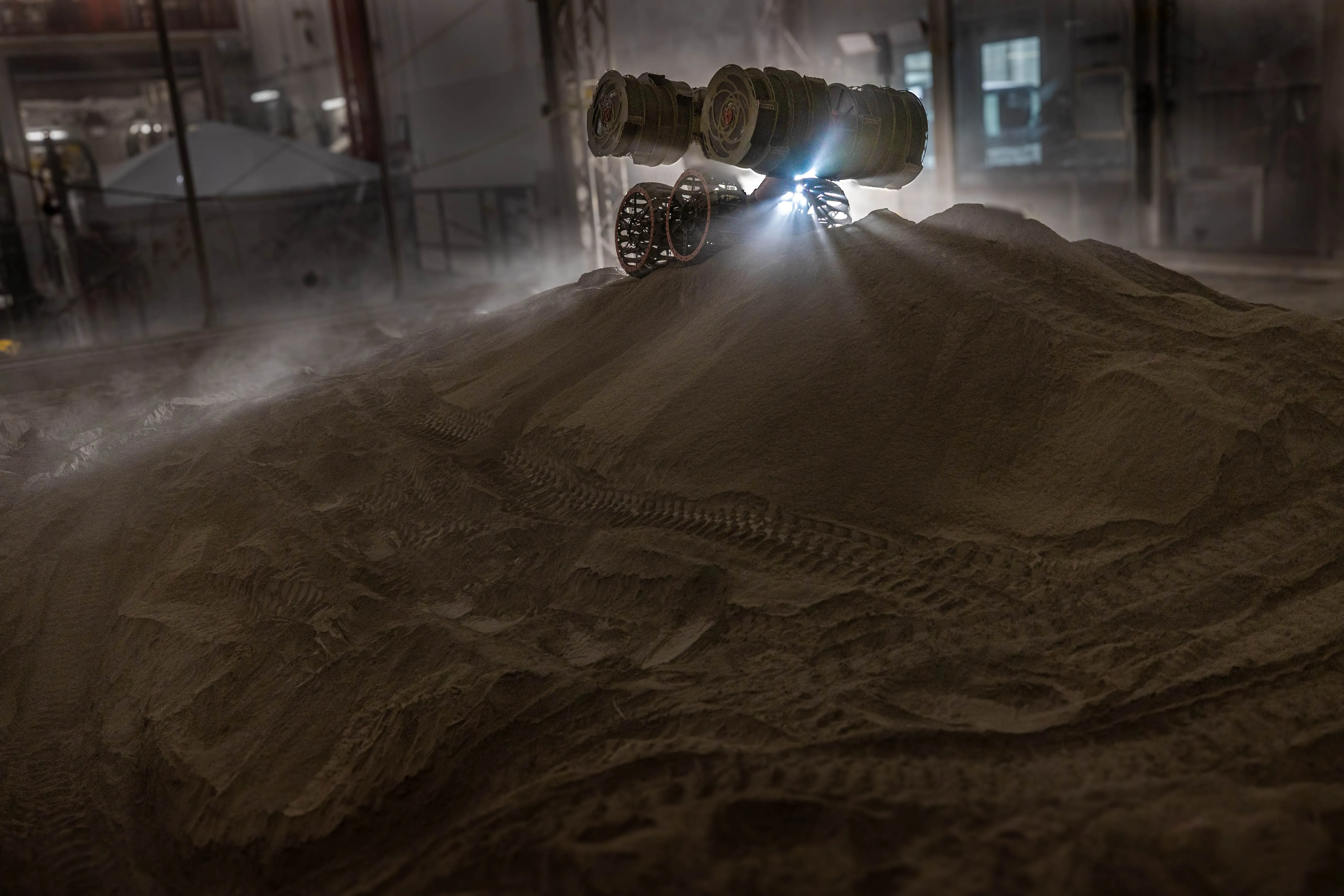
!Lunar excavation robot digging through simulated Moon dust (illustrative of the Lunabotics challenge)
Credit: NASA/Frank Michaux, public domain, via Wikimedia Commons
The journey reflects a growing culture of student space engineering in the UK. The Milton Keynes qualifier — the UK leg of the competition — tested the same skills the Florida finals will demand, and the Queen's team's victory there marked them out as the country's best university lunar-robotics outfit.
The trip itself has been made possible by the Queen's Annual Fund, which channels alumni donations into student-led projects. Eddie Friel, the university's Director of Alumni Engagement and Philanthropy, said the fund was "an effective way for the University's alumni and friends to support dozens of student-led projects each year", adding: "We are delighted to be able to support the team as they fly the flag for Queen's and wish them the best of luck in the competition."
Academic backing comes from Dr Charlie McCartan, academic lead in the School of Mechanical and Aerospace Engineering, whose department has championed the project from the start.
The team heads to Florida later this month, with the competition taking place at the University of Central Florida's facilities. Whatever the final standings, the experience is the prize: alumni of Lunabotics have gone on to careers across the space industry, and NASA openly treats the competition as a pipeline for the engineers who will build the Moon bases of the 2030s.
For Queen's, the longer game is Fitzpatrick's "year on year" plan — returning with an improved design and, eventually, a genuine shot at the title. Win or lose in Florida, ten students from Belfast will come home having tested their robot where it matters most: in front of the people who might one day send machines like it to the Moon for real.
*VERITY is an independent digital news platform covering technology news, science and more. Read about our editorial standards.*