As space missions move farther from Earth, NASA engineers are revisiting a navigation method that predates modern spacecraft by centuries: the sextant.
The traditional seafaring instrument allows users to determine their position by measuring angles between celestial objects such as stars and planets. NASA has adapted the concept for spaceflight and continues to train astronauts in celestial navigation as a possible fallback when communications, tracking systems or electronic navigation become unavailable.
Greg Holt, navigation system manager for NASA's Orion spacecraft and its Artemis missions, says traditional navigation techniques become increasingly valuable as spacecraft travel farther from Earth.
The basic principle is straightforward: identify known celestial objects, measure their positions relative to one another and use geometry to establish where the spacecraft is located.
A backup when Earth-based navigation is unavailable
Modern spacecraft normally depend on sophisticated onboard systems and navigation support from Earth. But deep-space missions introduce a fundamental problem: the farther a spacecraft travels, the more difficult it becomes to depend entirely on Earth-based infrastructure.
A loss of communication would also remove the radio-navigation support normally available from Earth. For that reason, NASA has explored ways for astronauts to determine their position independently.
This is where celestial navigation becomes useful.
Rather than depending entirely on satellites or communications networks, astronauts can use visible celestial objects as reference points. The method requires equipment, mathematical calculations and training, but its underlying principles have remained remarkably consistent for centuries.
NASA tested a sextant aboard the ISS
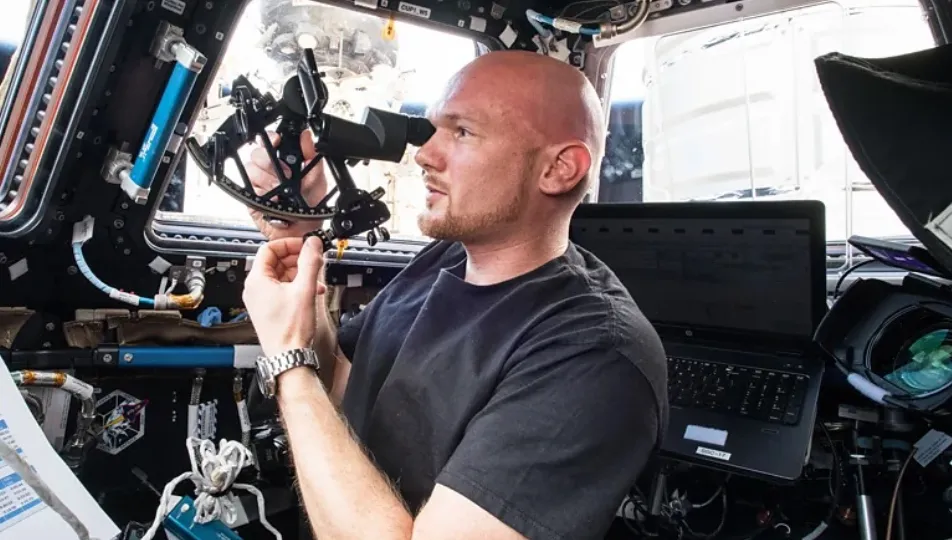
NASA put the idea through a practical test in 2018, when astronauts Serena Auñón-Chancellor and Alexander Gerst used a hand-held sextant aboard the International Space Station.
The astronauts took measurements manually, relying on their ability to sight celestial objects while working in microgravity.
The experiment produced results accurate enough to indicate that a hand-held sextant could potentially help astronauts navigate during an emergency. The crew also reported that the instrument was comfortable to operate in the weightless environment.
NASA made several small modifications to the traditional device for spacecraft use. Its edges were rounded to reduce the risk of accidental damage, while a hook-and-loop attachment could keep it secured inside the spacecraft.
Otherwise, the instrument remained fundamentally the same type of sextant used by sailors on Earth.
Astronauts have used celestial navigation before
The idea is not entirely new to human spaceflight.
NASA incorporated celestial navigation techniques into missions during the 1960s. Early astronauts had to consider whether they could independently determine their position if communication with Earth failed.
Neil Armstrong later recalled concerns about whether celestial navigation would be accurate enough for astronauts to rely on without ground support. Those concerns were eventually tested in actual missions.
During Gemini XII in 1966, Buzz Aldrin used a hand-held sextant and chart after a radar problem affected the spacecraft's navigation capabilities.
Celestial observations also played a role during Apollo 13 in 1970, when Jim Lovell used observations of Earth during the spacecraft's journey back toward home.
These experiences demonstrated that basic celestial references could remain useful even when spacecraft systems encountered serious problems.
Orion uses a modern version of the same idea
NASA's Orion spacecraft takes the concept further with an automated optical navigation system.
Instead of requiring an astronaut to manually operate a sextant, Orion uses a camera to observe stars and planets. The system measures relationships between celestial objects, including angles between stars and planets and the apparent size of a planet.
Computers can then process those measurements and use them to help determine the spacecraft's trajectory and potential course corrections.
According to Holt, Orion's optical navigation system provides an onboard backup if communication with Earth and ground-based navigation support are lost.
During Artemis missions, the system is activated approximately once a day. These regular checks allow engineers to monitor its condition, gather imagery and performance information, and compare its results with navigation solutions produced through Earth-based tracking.
The hand-held sextant remains a final fallback
The automated system is not the only backup.
During the Artemis II mission to the Moon in April, NASA kept a hand-held emergency sextant available before launch. If there had been a problem with the spacecraft's optical-navigation cameras at that stage, the manual instrument could have been added to the mission.
However, it is not normally carried on Orion because spacecraft mass is carefully controlled and the sextant is considered emergency equipment rather than standard operational hardware.
If a major navigation failure occurred after launch and the manual sextant was not aboard, astronauts could still use other celestial techniques.
One method involves observing when particular stars disappear behind the Earth or Moon. The timing of those events can provide a rough indication of the spacecraft's position.
Mars could make celestial navigation even more important
The need for independent navigation becomes more significant as NASA and other space agencies look toward Mars and more distant destinations.
Near Earth, spacecraft can make extensive use of communications, tracking infrastructure and familiar reference points. A Mars mission would operate in a much more remote environment, making independent navigation capabilities increasingly valuable.
Holt says asteroids could eventually serve as additional reference points for astronauts travelling toward Mars.
An astronaut could be given an expected location for an asteroid relative to recognizable stars. By finding the object and measuring its position, the crew could compare the observation with the expected position and make calculations to determine whether a course adjustment was needed.
An old principle behind new technology
For NASA engineers, learning to use a traditional sextant is about more than preserving an old piece of navigation equipment.
Holt encourages members of engineering teams working on advanced navigation systems to practise with a sextant so they understand the mathematical and geometric principles behind the technology.
The contrast between the manual instrument and modern optical navigation is striking, but the underlying science is closely related.
Whether an astronaut is manually measuring the position of a celestial object or a spacecraft camera is performing the same task automatically, both approaches rely on observations of stars, planets and geometric relationships.
That makes the centuries-old sextant more than a historical curiosity. As humans prepare for increasingly distant missions, the simple ability to look toward the sky and determine where a spacecraft is could remain an important part of the safety toolkit.