On a cold evening in late autumn, the sky above a reedbed or a city centre can suddenly start to move. Thousands of starlings pour in from every direction, fold together into a dark, shifting cloud, and then twist, stretch, and collapse in patterns that look choreographed. The display may last half an hour. Then, almost without warning, the birds funnel downward and the sky is empty again.
These flights are called murmurations, named for the soft rushing sound made by thousands of wings beating together. They are one of the most familiar wildlife spectacles in Britain and across northern Europe, and they are also one of the most studied puzzles in animal behaviour. How can so many birds fly so fast, so close together, and never collide, all without a leader telling them where to go?
A new citizen science project from the University of Gloucestershire is now inviting the public to help answer the remaining questions. The study, now under way, asks volunteers across the UK to report murmurations through a short online survey during autumn and winter, recording when a display happened, roughly how many birds were involved, and whether birds of prey were nearby. It builds on earlier work by Professor Anne Goodenough and Professor Adam Hart, who ran a similar survey with the Royal Society of Biology in the winters of 2014 and 2015. That project gathered more than 3,000 reports from 23 countries, most of them from the UK, and it remains one of the largest sets of murmuration observations ever collected.
The new study will test whether murmurations have changed over the past decade. Researchers want to know whether flocks are getting bigger or smaller, whether displays are lasting longer or shorter, and whether the presence of predators still shapes them in the same way. For a phenomenon that depends on huge numbers of birds gathering in one place, even small shifts could say something important about the health of the wider countryside.
No leader, no plan
The first surprise about murmurations is that nobody is in charge. For a long time, watchers assumed that some birds must lead and the rest must follow, or that the flock somehow shared a single mind. Careful tracking work has shown something simpler and stranger. Each starling pays attention only to a handful of its closest neighbours, roughly six or seven of them, and adjusts its own speed, direction, and spacing to match theirs. Those neighbours are doing the same with their own neighbours, so a change that starts on one edge of the flock can travel across the whole group in a wave.
Physicists working in Rome in the winter of 2005 and 2006 tested this idea directly. Using cameras set 25 metres apart on a museum roof near a starling roost by Termini station, they reconstructed the three-dimensional positions of birds in flocks of up to 2,600 individuals. They found that each bird responded to an average of 6.5 nearest neighbours, and that number stayed steady even when the distance between birds varied. What mattered was how many neighbours a bird tracked, not how far away they were. That finding, published in the Proceedings of the National Academy of Sciences in 2008, became known as the topological rule, and it explains why a flock can stretch, compress, split, and rejoin without falling apart.
Computer models had pointed in the same direction years earlier. In 1986, computer scientist Craig Reynolds built a simulation called Boids, in which simple digital agents followed three rules: do not crowd your neighbours, match their speed and direction, and steer toward the centre of the group. The simulated flocks behaved in ways that looked remarkably like real starlings, changing shape, dividing, and reforming. The models suggested that complex, beautiful group behaviour could emerge from simple local rules, with no central control at all. The Oxford University Press blog has an accessible account of how such collective behaviour emerges from simple individual behaviours, and a detailed explainer of how a murmuration works walks through the six or seven neighbour rule step by step.
Later work added a deeper layer. Physicists found that the orientation and speed of starlings are strongly correlated across the entire flock, no matter how large it grows. In practical terms, that means a bird on one side of a murmuration can respond, through its neighbours, to something happening on the far side. The flock behaves like a single sensitive surface, able to react as a whole even though each bird only senses what is close by.
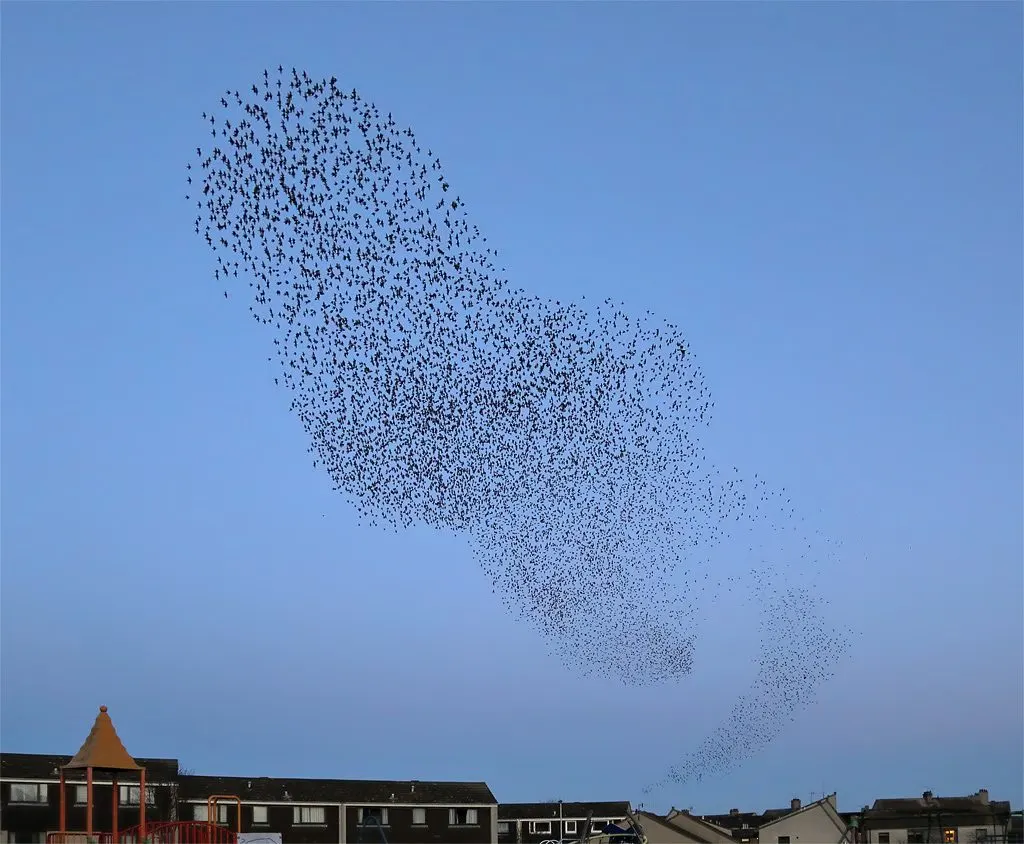 Starlings gathered in a dense, dark cloud shape above the landscape
Starlings form a dense cloud before dropping to roost. Image via Wikimedia Commons, CC BY-SA 2.0.
Why gather at all?
If the mechanics of murmurations are now fairly well understood, the reason for them is still debated, and the citizen science evidence has helped narrow the field. Two explanations have dominated. The first is safety in numbers: a huge, fast-moving flock confuses predators and makes it hard for a falcon to single out one bird. The second is warmth: birds that roost together stay warmer through a cold night.
ScienceBase has summarised the two main hypotheses, safer together and warmer together, that researchers have tested against the citizen science data. The 2014-2015 survey gave the safety explanation a strong boost. Birds of prey were recorded at almost one in three murmurations, and displays were larger and longer when raptors such as peregrines, sparrowhawks, or harriers were present. When a predator came close, flocks were also more likely to end by dropping en masse to the roost. Temperature, by contrast, showed only a weak link with how long a display lasted. The researchers concluded that murmurations function primarily as an anti-predator behaviour, rather than as a way to gather birds together for warmth, although warmth may still play a smaller part.
Direct studies of hunts support that conclusion. Researchers who filmed 182 hunts at two roosts in Rome catalogued the evasive shapes flocks use when a falcon attacks. Sometimes the flock flashes outward in a sudden expansion. Sometimes it darkens and compresses. Sometimes a wave ripples away from the attacker, or a hollow space opens in the middle of the flock, or the group strings out into a thin ribbon before splitting. In another Rome study, falcons succeeded in only about 23 percent of 328 hunts, although they still caught at least one bird most evenings. The flock does not make predation impossible, but it makes it much harder, and that is enough for the behaviour to be worth the energy it costs.
The density of a murmuration may also matter. One study has suggested that large flocks block between a quarter and three fifths of the sky behind them, close to the maximum density at which each bird can still see out. A predator looking into such a mass faces a wall of moving targets, with no single bird standing still long enough to lock onto. Scientists call this the confusion effect, and it is the same principle that protects shoals of fish and herds of grazing animals.
A winter spectacle worth watching
Murmurations follow a clear seasonal rhythm. In Britain, they build from October to early February and then fade as birds disperse toward spring. Displays happen at dusk, just before the birds settle for the night, and in the earlier citizen science reports they lasted 26 minutes on average. The longest displays came at the start and end of the season, when twilight lasts longer. Flock sizes varied enormously, from a few thousand birds to the remarkable report of 750,000, with an average of around 30,000.
Famous roost sites draw crowds every winter, from the Somerset Levels to the piers of seaside towns, and the displays have become a fixture of the British winter calendar. Elsewhere, Popular Science has profiled the Black Sun displays of Denmark, where vast flocks gather over the Wadden Sea. Yet starlings themselves have had a difficult century in Britain, with numbers falling sharply since the 1970s, which makes long-term monitoring more valuable. A spectacle that depends on abundance can quietly shrink if the birds that create it become scarcer, and only repeated counts can show whether that is happening.
That is where the new survey comes in. By repeating the methods of the earlier study a decade later, researchers can compare like with like and look for real change rather than relying on memory or anecdote. Anyone who sees a murmuration this winter can contribute, and the questions are deliberately simple: when, where, how big, and were predators present. The hope is that thousands of small observations will add up to a picture no single research team could gather alone.
There is also a wider lesson in the murmuration, and it is one that reaches beyond birds. Engineers studying drone swarms and robot teams have borrowed the same local rules, because a system in which each unit watches only a few neighbours is resilient. If one unit fails, the group keeps working. If the group changes shape, no central controller needs to be reprogrammed. Nature, as so often, solved a coordination problem long before people started asking how to solve it.
For now, the simplest advice for anyone who wants to see the science firsthand is to head out at dusk on a calm, cold evening, find a known roost site, and look up. The birds will do the rest, and this winter, their performance will also be data. This article is based on the BBC's report of the new research, together with the studies linked above. For more on the natural world, see our science coverage, and for the latest wildlife discoveries, read about the rare beetle breeding programme in Wales and the tidal trapdoor spider found in Mauritius. Our homepage carries the day's other top stories, and you can learn more about this site on our about page. For a different kind of collective effort, see our sports coverage and our world news.