Wales's public sector is highly unlikely to meet its ambition of reaching net zero carbon emissions by 2030, according to a new assessment from the country's public spending watchdog. Audit Wales found that financial pressures, skills shortages and a lack of coordinated action are slowing progress, even though individual public bodies can point to genuine examples of good work.
The Welsh Government declared a climate emergency in 2019 and set a collective ambition for the public sector to reach net zero carbon emissions by 2030. The idea was that councils, health boards and other public organisations would lead by example and act as a catalyst for change across the wider economy. Seven years on from that declaration, with four years left until the deadline, the auditors say the pace of change has not accelerated the way they called for in their last major review in 2022.
The findings land at an awkward moment for climate policy in Wales and beyond. Readers following climate and environment coverage will know that net zero targets are easy to announce and hard to deliver, because they touch almost every spending decision a public body makes, from heating schools and hospitals to running vehicle fleets and buying goods and services. Governments across the UK are wrestling with the same delivery problem, and the technology needed to decarbonise old buildings is still expensive at scale.
A 2030 ambition under strain
The report says decarbonisation has become a lower priority for some public bodies as financial pressures intensify. Climate considerations have not been fully built into everyday decision-making, the auditors found, and organisations are not doing enough to work together on cutting emissions. The collective ambition itself has also been criticised as poorly defined and, in the view of some, unachievable in its current form.
That criticism matters. A target that nobody can define clearly is hard to plan for, hard to fund and hard to hold anyone to account for. Public bodies have called for greater practical support to turn strategic commitments into programmes that can actually be delivered, while the auditors note that the Welsh Government is not consistently checking whether organisations are meeting their stated milestones. The result is a gap between what is promised in strategy documents and what happens on the ground. MyWelshpool's report on the findings carries the same warning about the pace of change.
The BBC's original report on the findings is available here. It is worth reading alongside the wider debate about how governments across the UK are handling the costs of the energy transition, a theme that also appears regularly in our business coverage.
The cost question
One of the most striking figures in the coverage of the report concerns buildings. Decarbonising Welsh council buildings alone has been estimated to cost at least 2.3 billion pounds, according to an unpublished 2025 study commissioned by the Welsh Government and the Welsh Local Government Association and cited by Audit Wales. Estimates for individual councils ranged from at least 49 million pounds in Ceredigion to at least 218 million pounds in Cardiff, according to LocalGov's report on the findings.
That scale of spending sits uneasily alongside the current state of public finances. Audit Wales found that public bodies have made limited progress in understanding the short and long term costs of reaching net zero. Where longer term estimates have been developed, some organisations described the costs as unaffordable. The auditors are not saying the money should not be spent. They are saying that without honest costings and a plan for where the money comes from, the target risks becoming an aspiration rather than a programme.
This is not a uniquely Welsh problem. Councils and health services across the UK face the same tension between day to day service pressures and long term investment in cleaner buildings and heating systems. But Wales set itself one of the earliest public sector net zero dates, which makes the shortfall more visible. Business News Wales covered the same warning in detail, noting that decarbonisation is increasingly competing against other spending priorities.
Data gaps cloud the picture
The report also raises concerns about how emissions are measured and reported. More public bodies are now taking part in the Welsh Government's emissions reporting system, and earlier gaps in information have been addressed. Even so, the auditors say worries remain about data quality, particularly for emissions linked to supply chains, the goods and services that public bodies buy in.
Reported emissions have gone up, but the report cautions against reading too much into that rise. Better reporting coverage has contributed to the increase, which means the figures do not necessarily show that underlying performance has worsened. The problem runs the other way too: if the data is patchy, leaders cannot tell which actions are working and which are not. The auditors want reporting to become more accurate and more consistent, so that progress, or the lack of it, can be judged fairly.
Supply chain emissions are a known weak spot in carbon accounting everywhere. A council can count the gas it burns in its own boilers with reasonable confidence, but tracking the carbon embedded in everything from construction materials to catering contracts is far harder. Until that improves, any claim about being on track for net zero rests on shaky ground.
Skills shortages hold back delivery
Workforce capability is another obstacle. Public bodies have identified gaps in the specialist skills needed to plan and deliver decarbonisation programmes, but many lack a full picture of what they will need in future. As a result, they continue to depend on outside expertise, which costs money and does not build lasting capacity inside organisations.
The auditors link this to a broader point about leadership. Ann-Marie Harkin, Executive Director for Audit Delivery, said the ambition was meant to see the public sector lead by example and act as a catalyst for wider change. She added: "We can list positive examples, but not enough progress has been made overall, and we owe it to future generations to do better."
That quote captures the tone of the report. It is not a claim that nothing has happened. It is a judgment that good examples have not added up to system wide change at the speed required. Harkin also pointed to open questions about future spending and how it is prioritised, how bodies secure the skills they need, and how emissions reporting can be made as accurate as possible.
What happens next
Audit Wales has made recommendations focused on the Welsh Government's leadership role. They include clarifying the strategic direction, improving emissions reporting and giving public bodies greater support with financial planning. Public bodies are also being encouraged to measure their own progress against a checklist included in the report.
The Welsh Government responded by saying the 2030 ambition has driven action and leadership, but that it is clear there is more work to do on decarbonisation across and beyond the public sector in Wales. It said it will set out its future vision and priorities for public sector climate action in due course, drawing on the findings and recommendations in the Audit Wales report.
What that future vision looks like will matter. Options range from restating the 2030 date with a clearer definition and a funded delivery plan, to resetting the timetable to something the auditors would regard as credible. Either way, the report makes it hard to carry on as before. A target that is described by the watchdog as highly unlikely to be met cannot simply be repeated without a plan to close the gap.
For readers interested in how environmental promises are tested in practice, our news section follows these accountability stories closely. The Welsh case also has lessons for other governments that have set early net zero dates for their own operations. Ambition gets the headlines, but delivery depends on budgets, skills, data and coordination, and on those four tests, Wales's public sector is currently falling short.
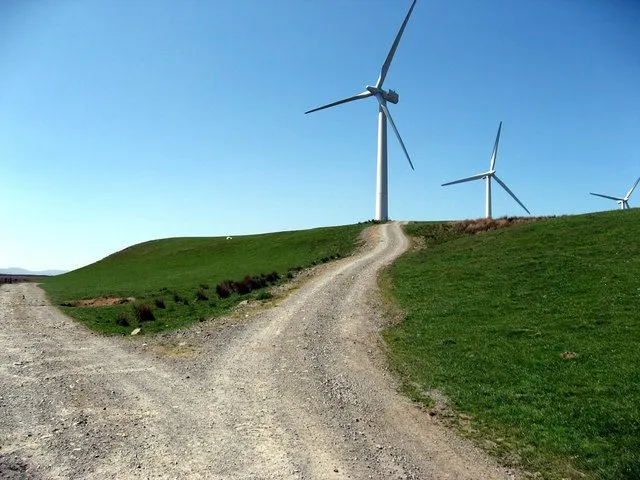 A wind turbine on a hillside track at Moel Maelogan in north Wales
Illustrative image of Welsh wind power. Credit: Alwyn Williams, Wikimedia Commons, CC BY-SA 2.0.