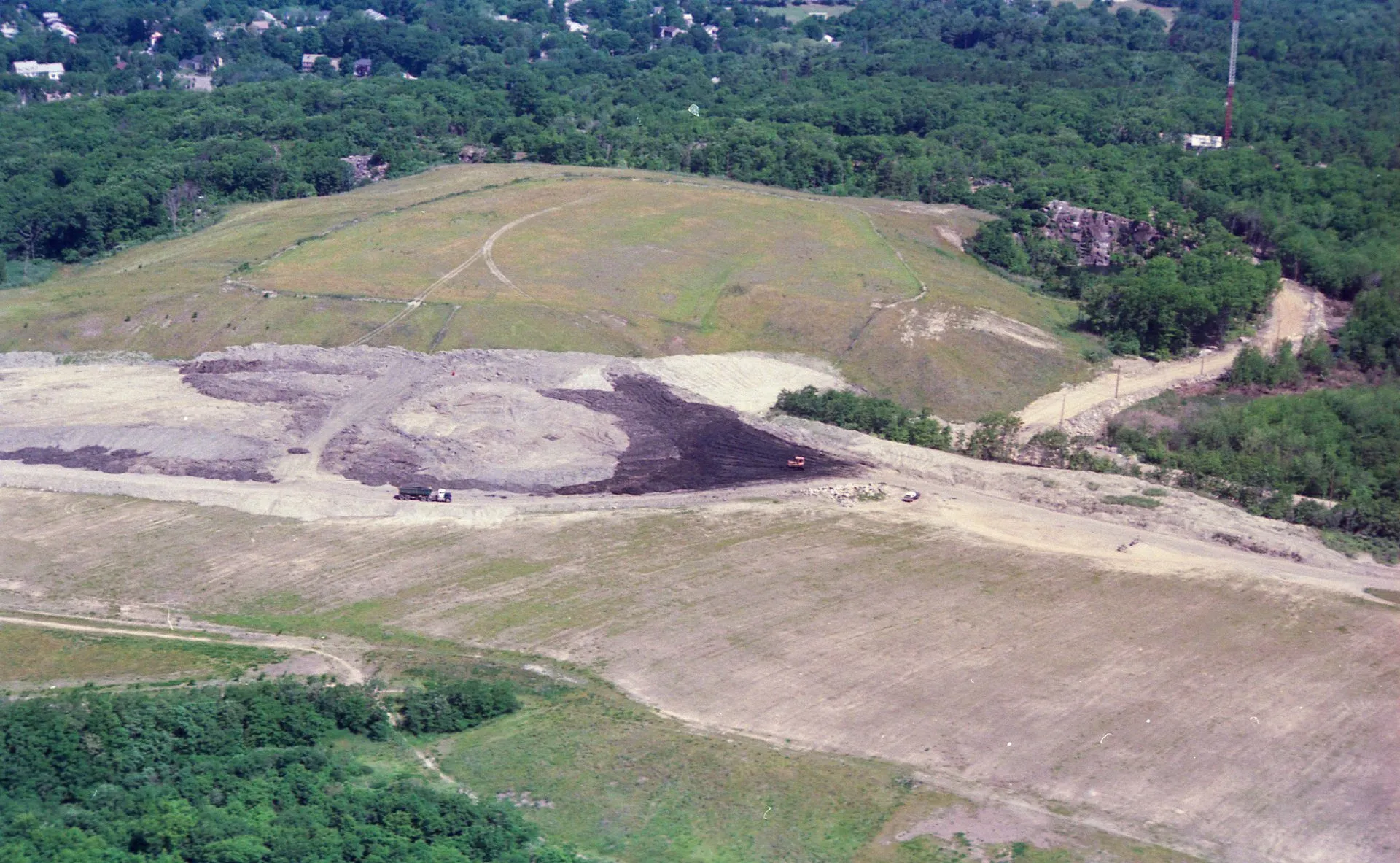
In Short (TL;DR)- Milpitas, California, has ordered the operators of the 342-acre Newby Island landfill to use drones and install monitors to track the chemicals behind its notorious odours.
- One US city authority is spending about $240,000 a year on a ring of odour monitors paired with a weather station to pinpoint which facility each smell comes from.
- Electronic noses — sensor arrays that detect hydrogen sulphide, VOCs and ammonia in real time — are replacing weekly manual checks and volunteer sniff panels.
- The US EPA does not regulate environmental odours as a pollutant, so states and cities are left to build their own high-tech enforcement cases.
- Researchers have even built a solar-powered bin-lid insert that breaks down the acetic acid behind rotting-food smells.
Nobody forgets the smell of a rubbish dump on a hot day. For the people who live next to one, it is not a passing nuisance — it is the background of their lives. In Milpitas, an affluent city in California's Silicon Valley tech hub, residents have endured rank smells wafting from industrial sites for decades, among them a 342-acre landfill. "When I first moved here, I could not open my window for over 10 years," says Chia-Ling Kong, an engineer for a tech firm who lives around half a mile from the dump. Things have improved in recent years, she says, but she and her neighbours must still contend with around two or three hours of bad smells a day.
Perhaps befitting Silicon Valley, the community is putting its hopes in technology. The operators of Newby Island landfill have been ordered by local authorities to use drones and install monitors to systematically track and measure the chemicals responsible for bad odours. They have also been told to automate the collection of landfill gases responsible for smells. Kong, who is part of a citizen's campaign against the odours, is optimistic a data-driven approach will make a difference: "Hopefully with this continuous monitoring, it makes it easier to pinpoint problems at the moment it starts." The operators say they are committed to operating the site safely and protecting air quality.
Milpitas is far from alone. Just like there, communities around the world are raising a stink about bad smells making day-to-day life miserable. Sometimes a rubbish dump is to blame, or it might be a sewage treatment works, or a reeking factory. And when the complaints start stacking up, resolving them is not always simple — because a smell is one of the hardest things in environmental enforcement to prove.
A study commissioned by one American city's authorities found that a trio of industrial meat companies were among the culprits behind persistent odour complaints. "Within 10 miles, there's about half a million people," says Dalton Jacobus, who works in the city's Department of Neighborhood Services. "If the winds are out of the wrong direction, 100,000 people can be in the middle of that odour plume." With several potential sources in the area, every complaint used to trigger a round of mutual blame between the plants.
The authorities are now paying around $240,000 (£182,000) a year on technology to track the stink, so they can take action. "What we wanted to do was build a ring of odour monitors around the facilities that we suspected of emitting odours," says Jacobus. The monitors, which measure levels of chemical compounds in the air, work in combination with a weather station to provide real-time data on the concentrations coming from each facility based off the wind patterns. That, Jacobus says, has put an end to the finger pointing: "Now we can say with reasonable certainty that 'this odour event did originate from your facility, what was going on'?"
The devices at the heart of this shift are often called electronic noses: arrays of chemical sensors that sample the air continuously and build a profile of what is in it. The idea is not new — scientists at the University of Manchester built one of the first landfill versions two decades ago. Their device, developed by Professor Krishna Persaud, used four sensors to analyse the composition of gases in the air, drawing samples in at regular intervals and sending the chemical profile in real time via a built-in GPS modem to a remote computer. It was tested around the perimeter of the Brookhurst Wood waste landfill site near Gatwick Airport, offering waste companies the ability to act before odour levels reached unacceptable levels rather than discovering the problem on a weekly manual inspection.
Today's commercial systems are far more sophisticated. Companies such as Kunak build compact, solar-powered monitoring stations that measure a battery of pollutants — hydrogen sulphide, volatile organic compounds, ammonia, methane, nitrogen oxides and particulate matter — and combine them with wind-speed and direction sensors. In independent evaluations, their hydrogen sulphide sensors have shown a correlation coefficient of 0.77 against reference analysers, with a mean absolute error of just 6.9 parts per billion. Because the sensors can also pick up compounds like methyl-mercaptans that standard analysers miss, the combined readings give a fuller picture of an odour event. Kunak says its stations cost around thirty times less than conventional reference monitoring, which is what makes it practical to ring-fence a whole industrial area with them.
Mobile air quality monitoring station with sensor masts photographed at night
Credit: Balise42 / Wikimedia Commons, CC BY 4.0
Milpitas itself has been down this road before. Back in 2019 the city council authorised an $85,000 pilot programme to uncover the source of the stink, placing odour detectors on top of buildings and light poles while the Bay Area Air Quality Management District ran an investigation of its own. Possible sources on the list included the Newby Island landfill, the San Jose–Santa Clara Regional Wastewater Facility and the Zanker Recycling Facility. A few years earlier the city had seen 500 odour complaints in a single month, hired a law firm to explore suing the landfill's operator, and watched the operator form the South Bay Odor Coalition in response. The long history shows why residents like Kong have learned to be cautiously optimistic: technology can find the smell, but fixing it still takes political will.
Part of the problem is that the rulebook is thin. Many countries have no regulations in place dictating how to manage smells. In the US, for example, the Environmental Protection Agency does not regulate environmental odours as a pollutant. That leaves states and local governments to take charge of the issue — which is why enforcement ends up looking like a patchwork of local pilots, lawsuits and voluntary coalitions rather than a national standard.
Urban sprawl is often part of the problem too, bringing communities closer to smelly facilities that may historically have been kept at a distance. A landfill or rendering plant that once sat in open countryside can find itself, a decade later, upwind of a housing estate — and the residents did not sign up for the smell. This is a regulatory gap that echoes other corners of the tech world, where rules struggle to keep pace with reality — the same tension explored in the debate over whether AI is less regulated than milk. Continuous, public, timestamped sensor data may do for odours what disclosure rules have done for other pollutants: make the invisible visible enough to act on.
Monitoring is only half the battle; the other half is stopping the stink at its source. Landfill operators are being pushed to automate the collection of the gases that decomposing waste releases — the same gases that, unmanaged, drift into nearby neighbourhoods. And researchers are attacking the problem at an even smaller scale: the household bin.
In a study published in the journal Environmental Science & Technology in October 2026, researchers described a solar-powered insert that fits onto the lid of a standard wheeled trash bin. Household waste rots quickly in warm, humid climates, producing acetic acid — the vinegary compound largely responsible for garbage odour. The insert uses a transparent, gas-permeable membrane with a lens that concentrates sunlight onto a manganese oxide catalyst, boosted with lithium to make its oxygen far more reactive. In tests with real food, the insert broke down the acetic acid generated by decaying fruit, bread and wine for more than 40 days in natural sunlight, outperforming both plain manganese oxide and the activated-carbon filters commonly used today.
The same data-driven spirit is visible in other environmental monitoring efforts covered by Verity — from the sensor networks tracking wildfire smoke as it becomes a global health threat to the connected fridges and supermarket systems hit by hackers, where cheap sensors meet the internet to watch the physical world in real time.
For communities like Milpitas, the promise is simpler: fewer mornings when opening the window is not an option. Continuous monitoring cannot make a landfill smell like a meadow, but it can do something almost as valuable — turn a smell into a number, a time, a wind direction and a facility name. Once a stink has a paper trail, it is much harder to ignore. Browse more stories on how sensors and software are reshaping the physical world in our Technology section, and see how data-driven trials are changing behaviour everywhere from Bradford classrooms to the cases of rogue AI agents testing the limits of the systems around them.