In Short (TL;DR)Norse explorers reached the coast of Canada around the year 1000, roughly 500 years before Columbus's 1492 voyage to the Bahamas. | They island-hopped across the North Atlantic, settling Iceland around 870 and Greenland about a century later as staging posts for the crossing. | In 1960, a Norse camp was discovered at L'Anse aux Meadows on Newfoundland's northern tip — the first confirmed European settlement in the Americas. | Modern science, including tree-ring dating of wood cut in 1021, has confirmed the site, and the Icelandic sagas are now treated as credible historical accounts.
Every schoolchild learns that Christopher Columbus "discovered" America in 1492. It is one of history's most durable stories — and it is wrong by about 500 years. Roughly half a millennium before Columbus reached the Bahamas, Norse seafarers had already crossed the Atlantic, walked the shores of Canada and built houses there. We know this not from legend alone, but from the ground itself: at L'Anse aux Meadows, on the northern tip of Newfoundland, archaeologists found their camp.
The story of how the Vikings beat Columbus to the Americas is a tale of extraordinary seamanship, medieval outlaws, stories dismissed as fairy tales for centuries — and a discovery in 1960 that forced history books to be rewritten.
The Norse did not sail into the unknown in a single leap. They crossed the North Atlantic the way a climber tackles a mountain: one staging post at a time.
The first was Iceland, settled by Norse voyagers around 870. A century or so later came the second and more audacious jump: Greenland. Around 960, a Norwegian settler named Erik the Red arrived in Iceland; in 982 he was banished for killings committed in a feud, and rather than slink home he sailed west to explore a landmass glimpsed by earlier voyagers. He returned with glowing reports — and a marketing masterstroke of a name. "Greenland", he reasoned, would attract settlers far better than the icy truth.
It worked. Erik founded a Norse colony on Greenland's southwestern fjords that would endure for roughly 500 years, until the early 15th century. The Greenland settlement became the springboard for everything that followed: the westernmost Norse outpost, and the base from which ships pushed further west into truly unknown waters.
The leap to North America is credited in the Icelandic sagas to Leif Erikson, Erik the Red's son. Around the year 1000, sailing from Greenland with a small crew, Leif followed reports of land to the west and reached a coastline the Norse would name in three parts: Helluland ("flat-stone land"), Markland ("forest land") and Vinland ("wine land") — the last supposedly for wild grapes or berries found growing there.
Historians generally associate these names with regions of modern Canada: Helluland with Baffin Island, Markland with Labrador, and Vinland with Newfoundland and the coast beyond. The sagas describe houses built, timber harvested and encounters — sometimes peaceful, sometimes violent — with the Indigenous peoples the Norse called skrælingar. One of the voyagers, Gudrid Thorbjarnardóttir, is said to have given birth to a son there: arguably the first European child born in the Americas.
For centuries, scholars treated all of this as embroidery. The sagas — the Saga of the Greenlanders and Erik the Red's Saga — were written down in the 13th century, hundreds of years after the events they describe, and Vinland was filed alongside Atlantis as a pleasant fiction. The sagas are now recognised as credible historical accounts — but that recognition took a Norwegian explorer with a hunch.
In 1960, Helge Ingstad — a Norwegian explorer who had spent years studying the sagas as if they were treasure maps — and his wife, the archaeologist Anne Stine Ingstad, identified the remains of a Norse settlement at L'Anse aux Meadows, a windswept terrace on the eastern shore of Epaves Bay near the tip of Newfoundland's Great Northern Peninsula.
Grass-covered remains of Norse turf buildings at L'Anse aux Meadows
Credit: Mo Laidlaw / Wikimedia Commons, CC BY-SA 3.0
Excavations through the 1960s proved it beyond doubt. The team uncovered the remains of eight buildings: great halls and workshops of timber frames overlaid with turf sod, built in precisely the style the Norse used in Iceland and Greenland. Around 800 objects of wood, stone, bronze and bone emerged from the soil. A bronze ring-headed cloak pin, typical of the Viking Age, confirmed the Norse character of the site conclusively. Traces of bog iron were found too — evidence of iron smelting and forging, the first known ironworking in the New World — alongside wooden debris and broken nails from ship repair, suggesting boat maintenance was a major activity.
The site was probably a base camp rather than a true colony, as visitor guides to the historic site describe. Parks Canada's research indicates it could have housed around 90 people and was occupied for only a few years, with exploration parties pushing southward during the summer months. The clinching evidence for those southern voyages came in the form of butternuts and a butternut burl found at the site — nuts whose northern range is Nova Scotia and New Brunswick, proving the Norse travelled well beyond Newfoundland, just as the sagas claimed.
In 2021, scientists added a precise date to the story. Analysing tree rings in wood cut with metal tools at the site, researchers fixed Norse activity at L'Anse aux Meadows to the year 1021, a dating breakthrough widely reported at the time — the first securely dated European presence in the Americas, and a date that lands squarely in the saga era.
If the Norse reached North America, why did they not stay? The honest answer is that the settlement was never meant to last. Distance was the decisive factor: L'Anse aux Meadows lay at the end of a supply line stretching back across the Davis Strait to Greenland — waters whose changing climate scientists are still tracking — and on to Iceland and Norway — thousands of miles of North Atlantic water. The sagas add conflict with Indigenous peoples and quarrels among the Norse themselves. Within a few years, the camp was abandoned.
And then Europe simply forgot. Without a printing press, without a monarch or pope to champion the voyage, and with the Greenland colony itself fading by the 1400s, the story of Vinland shrank into the Icelandic sagas — read as literature, not history. Columbus, sailing with the backing of the Spanish crown in 1492, triggered permanent contact, colonisation and the Columbian Exchange; the Norse had triggered nothing but a story. That is why the textbooks credited Columbus, and why it took until 1960 — and the Ingstads' shovels — to set the record straight.
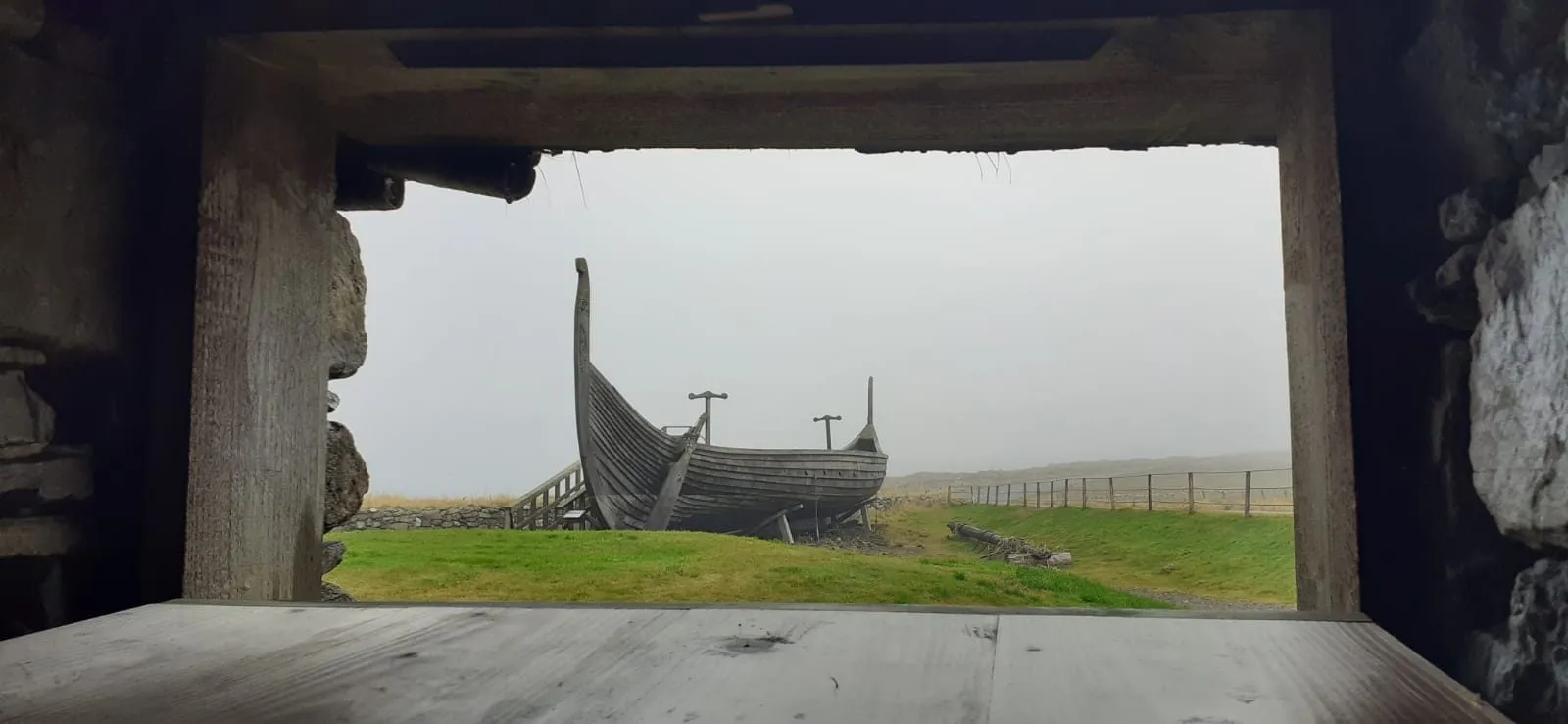
Today, L'Anse aux Meadows is a place of pilgrimage for history lovers. Designated a National Historic Site of Canada in 1968, it was among the very first properties inscribed on the UNESCO World Heritage List in 1978, recognised for its outstanding significance in the history of human migration and discovery. Parks Canada manages the site, where reconstructed turf longhouses stand near the original foundations and costumed interpreters demonstrate Norse crafts each summer.
It remains the only authenticated Norse site in the Americas — the farthest known extent of European exploration before Columbus, and proof that the first Europeans to cross the Atlantic did so in open wooden ships, navigating by sun, stars and seabirds, five centuries before anyone gave them credit — exploration in its purest form, the kind of endeavour that still inspires student explorers today.
The next time someone says Columbus discovered America, the reply writes itself. He was not the first European to reach these shores. He was not even close. The Vikings got there around the year 1000 — and left the evidence in the Newfoundland turf to prove it. More science and discovery stories like this one appear on Verity every day.