In Short (TL;DR)Coronal mass ejections from the Sun struck Earth's magnetic field late last week, triggering vivid aurora displays across the UK on the nights of 9 and 10 October. | Geomagnetic activity reached 600nT on Saturday evening, pushing the lights far south — sightings stretched from Orkney to Kent, Devon and Hampshire. | The Met Office says further sightings could be possible until Tuesday, depending on solar activity and clear skies. | 2026 is a peak year for auroras: the Sun is in a heightened phase of its roughly 11-year cycle, making strong displays more likely.
The skies over Britain put on an extraordinary show this weekend, as the Northern Lights — the aurora borealis — rippled across the country in greens, pinks and purples, reaching places that almost never see them.
Sightings were reported on the nights of Friday 9 and Saturday 10 October from the far north of Scotland all the way to the south coast of England. In Orkney and the Shetland Islands the display was spectacular; in Cumbria, Northumberland and North Yorkshire, skywatchers watched curtains of colour shift overhead; and in Devon, Hampshire and Kent, people more used to light pollution than light shows stepped outside to find the horizon glowing. The Met Office says the show may not be over, with further sightings possible until Tuesday.
The aurora began, as it always does, 93 million miles away. Earlier last week, the Sun unleashed a series of powerful eruptions known as coronal mass ejections — vast expulsions of plasma and magnetic field that travel outward through space at around two million miles per hour. According to BBC Sky at Night Magazine, space weather centres in North America and the UK had been tracking an expected increase in solar activity after one such eruption on Tuesday 6 October, with three coronal mass ejections heading in Earth's direction.
When those clouds of charged particles arrived, they slammed into Earth's magnetic field and set off a geomagnetic storm. The US Space Weather Prediction Center reported a G2-class storm — officially only "moderate", but strong enough to interfere with power and communication systems and to supercharge the auroral oval, the ring of light that normally hugs the Arctic. The Met Office also flagged the possible arrival of a glancing blow from another coronal mass ejection on Saturday 10 October, which helped sustain the display into the weekend.
On Saturday evening, geomagnetic activity measured on UK instruments reached 600 nanoteslas — a reading that explains why the lights pushed so far south. When the solar wind is strong and its magnetic polarity opposes Earth's, the auroral oval expands dramatically, dragging the visible lights down over latitudes that usually see nothing but stars.
What made this weekend's event remarkable was its reach. The aurora is a familiar sight in the north of Scotland and around the Arctic Circle; in southern England it is a genuine rarity, the kind of thing people remember for years.
This time, the colours stretched from Orkney to Kent. Photographers in Devon and Hampshire captured vivid displays, while on the North Kent coast at Bishopstone, one observer reported an excellent show lasting a good hour from 19:30 on Saturday. A time-lapse from North Yorkshire showed the lights dancing across the evening sky. The Guardian noted that sightings in southern England are unusual precisely because the phenomenon is normally something people travel to the Arctic Circle or the north of Scotland to see.
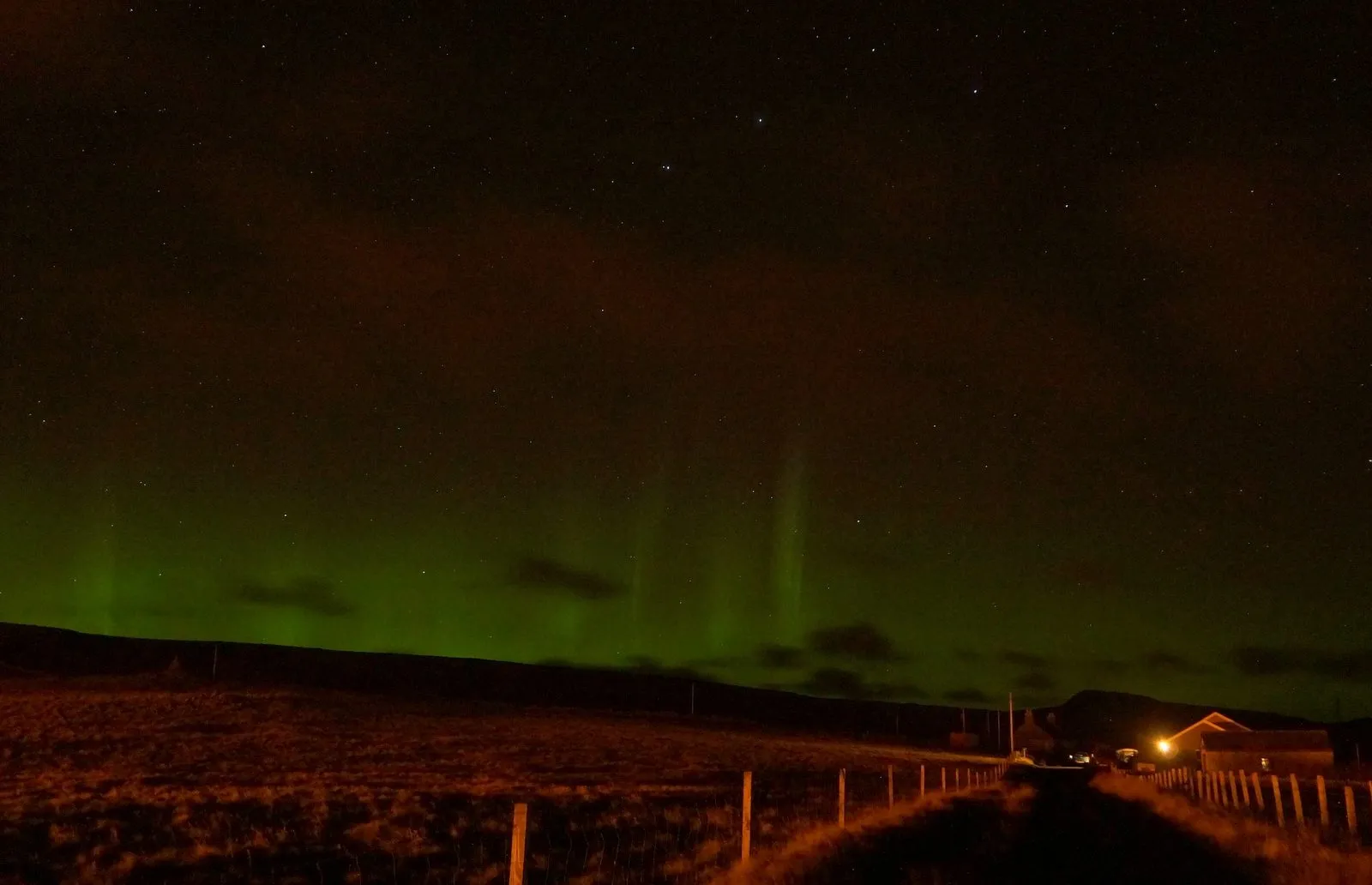
Vivid aurora borealis with pink and green bands over the Shetland Islands
Credit: Mike Pennington / Geograph Britain and Ireland, via Wikimedia Commons, CC BY-SA 2.0
Clear, dark skies helped. With the Moon below the horizon during the peak aurora-watching hours this weekend, there was no lunar glare to wash out the fainter colours — a small piece of luck that made a big difference to photographers and naked-eye observers alike.
The Northern Lights are, at root, a collision. The Sun constantly throws off a stream of charged particles — the solar wind — travelling at roughly a million miles per hour. Earth's magnetic field steers most of them toward the magnetic poles, and there they crash into gases high in the atmosphere. The collisions excite atoms of oxygen and nitrogen, which release the extra energy as light.
The colour depends on the gas and the altitude. Oxygen produces the classic green glow, and at greater heights it can generate rare red displays; nitrogen contributes blue and purple shades. The pinks and purples that so many UK observers photographed this weekend are the signature of nitrogen caught in an especially energetic storm.
It is the same fundamental physics — charged particles exciting matter until it glows — that underpins some of the most exotic research in modern physics, from the ghost particles that earned this year's Nobel Prize to the cosmic rays that constantly rain through our atmosphere. The aurora is simply the version you can watch from your back garden.
If the Northern Lights seem to have been visiting Britain more often lately, there is a reason. The Sun runs on an approximately 11-year cycle of activity, swinging between quiet "solar minimum" and stormy "solar maximum". 2026 falls in a heightened phase of that cycle, when sunspots multiply, eruptions grow more violent and coronal mass ejections aimed at Earth become far more common.
That is why the UK has seen multiple strong displays this year, and why forecasters expect more. Each eruption is a roll of the dice: only those aimed squarely at Earth produce storms, and only storms that coincide with dark, clear skies produce visible auroras. But with the Sun this active, the odds are the best they have been in a decade.
The same solar restlessness that paints the sky can also rattle technology. Strong geomagnetic storms can disrupt satellite navigation, radio communications and even power grids — a reminder that "space weather" is not just a pretty phrase. Forecasters at the Met Office's space weather desk track every eruption for exactly that reason, and their outlooks double as aurora forecasts for the public.
For anyone hoping to see the lights before the current spell of activity fades, the advice from forecasters and seasoned aurora hunters is consistent. First, get dark: head away from streetlights and towns to somewhere with an unobstructed view toward the northern horizon. Rural locations, north-facing coasts and high ground all help. Second, be patient and let your eyes adjust — the aurora can fade and flare over minutes. Third, bring a camera. The lights often appear brighter through a lens than to the naked eye, because long exposures collect light your eyes cannot.
The Met Office's latest outlook suggests sightings remain possible across Scotland and similar geomagnetic latitudes between 12 and 14 October, with a chance of the display strengthening again and reaching further into central England. But nothing about the aurora is guaranteed: it can change in intensity within minutes, and even the strongest solar storm is invisible behind thick cloud. Chances looked slimmer for the nights of 11 and 12 October as cloud blanketed much of the country — a familiar frustration for British skywatchers, and one that makes the clear-sky displays all the sweeter.
Whether or not the lights return this week, the weekend's show was a reminder of how much drama the night sky still holds. In an age of satellites and streetlights, millions of people looked up and saw the atmosphere itself glowing — a natural spectacle to rank alongside the wildlife comebacks and natural wonders that make the British outdoors worth watching. Verity's science desk will keep an eye on the Sun for you — more science stories every day.