In Short (TL;DR)- Drone surveys of North Point Reef near Lizard Island found at least 97% of corals had died within three months of a severe bleaching event.
- In March, CSIRO scientist George Roff's drone footage showed bleaching and fluorescing — an emergency stress response; by June, Prof Jane Williamson's team found the reef largely dead.
- The event was the fifth mass bleaching on the Great Barrier Reef in eight years, driven by record marine heat stress.
- Coral bleaching happens when heat-stressed corals expel the symbiotic algae (zooxanthellae) that feed them and give them colour.
- The reef retains recovery capacity — AIMS found coral cover holding steady in 2026 — but scientists warn its ability to bounce back is being pushed to its limits.
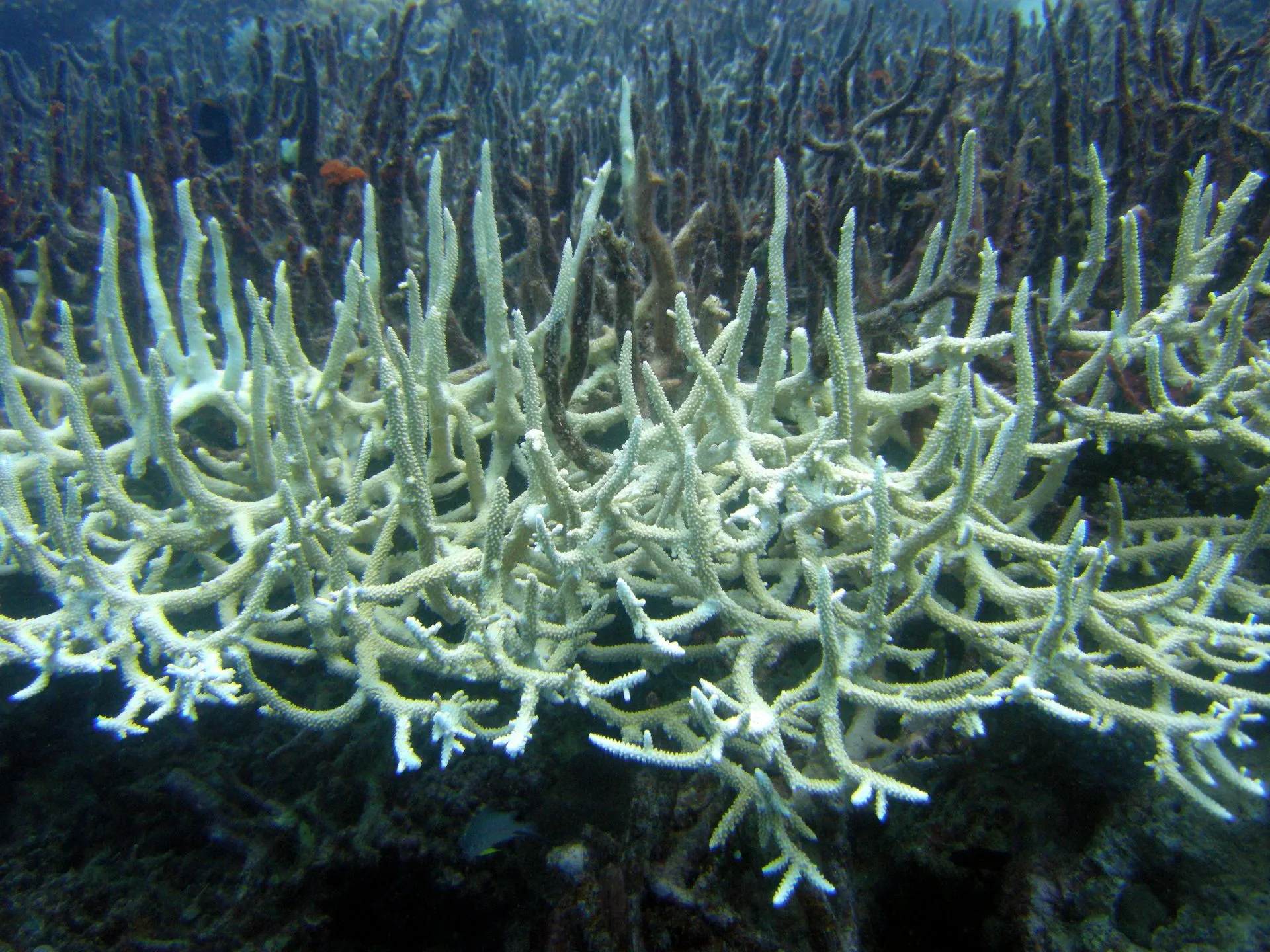
The images told the story before the scientists could find the words. In March, a drone flying over North Point Reef near Lizard Island, in the northern Great Barrier Reef, captured corals bleaching and fluorescing — glowing with bright pigments that scientists describe as a kind of emergency sunscreen, a visible sign of heat stress. Three months later, researchers flew the same route and then snorkelled the reef to see what had happened. "At least 97% of the corals had died over those three months," said Prof Jane Williamson, the Macquarie University marine biologist who co-led the analysis. "We came out of the water and didn't know what to say. It's an iconic reef and most of it was dead."
It is one of the worst bleaching events ever recorded on the world's largest coral reef system. The March flight had been made by George Roff of Australia's Commonwealth Scientific and Industrial Research Organisation (CSIRO); the June follow-up was carried out by Williamson and her team, and the footage was independently analysed by four scientists. Dr Lyle Vail, director of the Australian Museum's Lizard Island Research Station, said the loss was devastating: until recently the reef at North Point had been "truly amazing", recovering well from a major bleaching event in 2016. "It's pretty heartbreaking to lose all that coral recovery," he said.
The event was the fifth mass bleaching to hit the Great Barrier Reef in eight years, with heat stress reaching record levels across parts of the reef. It was also the first time scientists had produced a quantitative, coral-by-coral assessment of mortality from such an event, using high-resolution drone imagery to track individual colonies from stress to death. The team has called for the work to be extended: the full extent of mortality beyond this one reef is still not known, though aerial surveys found nearly a third of the Great Barrier Reef suffered "very high" and "extreme" bleaching that summer.
To understand what happened at Lizard Island, you have to understand the partnership at the heart of every coral. Reef-building corals live in symbiosis with microscopic algae called zooxanthellae, which dwell inside the coral's tissues. The algae are the coral's primary food source, feeding it through photosynthesis, and they give the coral its colour. When the water gets too warm, the relationship breaks down: the coral expels the algae, its transparent tissue revealing the white skeleton beneath. That is bleaching.
A bleached coral is not yet a dead coral. As the US National Oceanic and Atmospheric Administration explains, corals can survive a bleaching event and recover — but they are under far greater stress and far more vulnerable to mortality. If the heat persists and the algae stay gone, the coral starves. The fluorescing seen in the March drone footage sits at the knife-edge of that process: a last-ditch protective response before the colony either pulls through or perishes. At North Point Reef, almost all of them perished.
Increased ocean temperature driven by climate change is the leading cause of mass bleaching, but it is not the only one. Runoff and pollution can bleach near-shore corals, overexposure to sunlight compounds the damage in shallow water, and even extreme low tides can trigger it. What has changed in recent decades is the frequency: the Australian Institute of Marine Science (AIMS) has recorded six mass bleaching events on the Great Barrier Reef between 2016 and 2025. Before the 1990s, bleaching events there were exceptionally rare.
Satellite image of the Great Barrier Reef from Copernicus Sentinel-2
Credit: European Union, Copernicus Sentinel-2 imagery / Wikimedia Commons, Attribution
The Lizard Island finding is a local catastrophe, but it sits inside a bigger and more complicated picture — one in which the reef is simultaneously dying in places and recovering in others. AIMS's 40th annual Long-Term Monitoring Program report, published in August 2026, found that a late-summer monsoon had given the reef a reprieve: increased cloud cover cooled the water and limited bleaching in the 2025–26 summer. Coral cover held steady or increased slightly across all three regions of the reef. In the northern region — the same stretch of coast as Lizard Island — average hard coral cover actually rose from 30% to 35.1%, a relative increase of 16.7%.
Of the 121 reefs surveyed, 56% showed no change in coral cover, 28% showed an increase and only 16% declined. Just three reefs had hard coral cover below 10%. On the surface, that looks like resilience. But AIMS scientists urge caution about what lies beneath the headline numbers. Detailed surveys of permanently marked sites at 71 reefs showed that fast-growing, shallow-water Acropora corals — the staghorn and table corals that build the reef's three-dimensional habitat — were the most severely affected by the 2024 mass bleaching. "The reefs with high levels of Acropora now exist in a highly vulnerable state," said Dr Mike Emslie, leader of the Long-Term Monitoring Program. "It's possible that what looks like complete recovery on these reefs can be reversed in just a year."
The 2024 event also pushed damage into deeper water than usual: acute heat stress in the southern Great Barrier Reef increased bleaching and mortality in reef habitats 10 to 15 metres deep, across most types of coral. Normally bleaching mostly strikes shallow-water corals, where temperatures are highest — a warning, Emslie said, that future warming could put deeper corals at greater risk too.
And bleaching is only one of the pressures. The reef is also being hit by cyclones, flood plumes and outbreaks of the coral-eating crown-of-thorns starfish, with a fifth wave of outbreaks now emerging in the north. "We have seen six mass bleaching events between 2016 and 2025," Emslie said. "Before the '90s, bleaching events were exceptionally rare on the Great Barrier Reef. This increased frequency and escalating impact is compounded by the damage from cyclones, floods and outbreaks of crown-of-thorns starfish. While the reef is showing resilience, it is being pushed, and its capacity to recover is limited."
The scientists behind the Lizard Island analysis want two things: more surveys to measure mortality beyond North Point Reef, and faster public release of the data. UNESCO has urged Australia to publish mortality figures as soon as possible, while declining — for now — to recommend the reef for its "in danger" list. AIMS chief executive Prof Selina Stead says the path forward combines emissions cuts, good reef management and science-led interventions to help reefs adapt.
Coral reefs can survive bleaching, but they need time — often decades — to recover. The tragedy of North Point Reef is that it had done exactly that after 2016, and then ran out of time. Every mass bleaching event now arrives before the last one's damage has healed, compressing the recovery window a little further. The drone footage that documented the 97% die-off is, in that sense, both a scientific tool and a warning: from the air, you can watch a reef die in three months. The question is whether the world will act in time to give the next one its decades back.
Follow our Science desk for more: the bluefin tuna's comeback, the rainbow sea slug in Cornwall as a climate warning, great white sharks moving north into warming Canadian waters, and how the Vikings crossed the Atlantic centuries before Columbus. Start from Verity's homepage for the full picture.