In Short (TL;DR)- Researchers attached satellite aerials to the backs of eight green sea turtles breeding in the Chagos Islands to track where they went after nesting.
- One turtle travelled 3,979 km (2,472 miles) in a year to the coast of Somalia — believed to be the furthest green sea turtle migration ever recorded.
- Seven of the eight turtles swam more than 1,000 km outside the protected area around the Chagos Archipelago; only one stayed inside it.
- The study, published in Conservation Biology by Prof Graeme Hays and colleagues, questions whether even giant marine parks can protect migratory species.
- The team argues for networks of smaller protected areas, backed by international cooperation across the Indian Ocean.
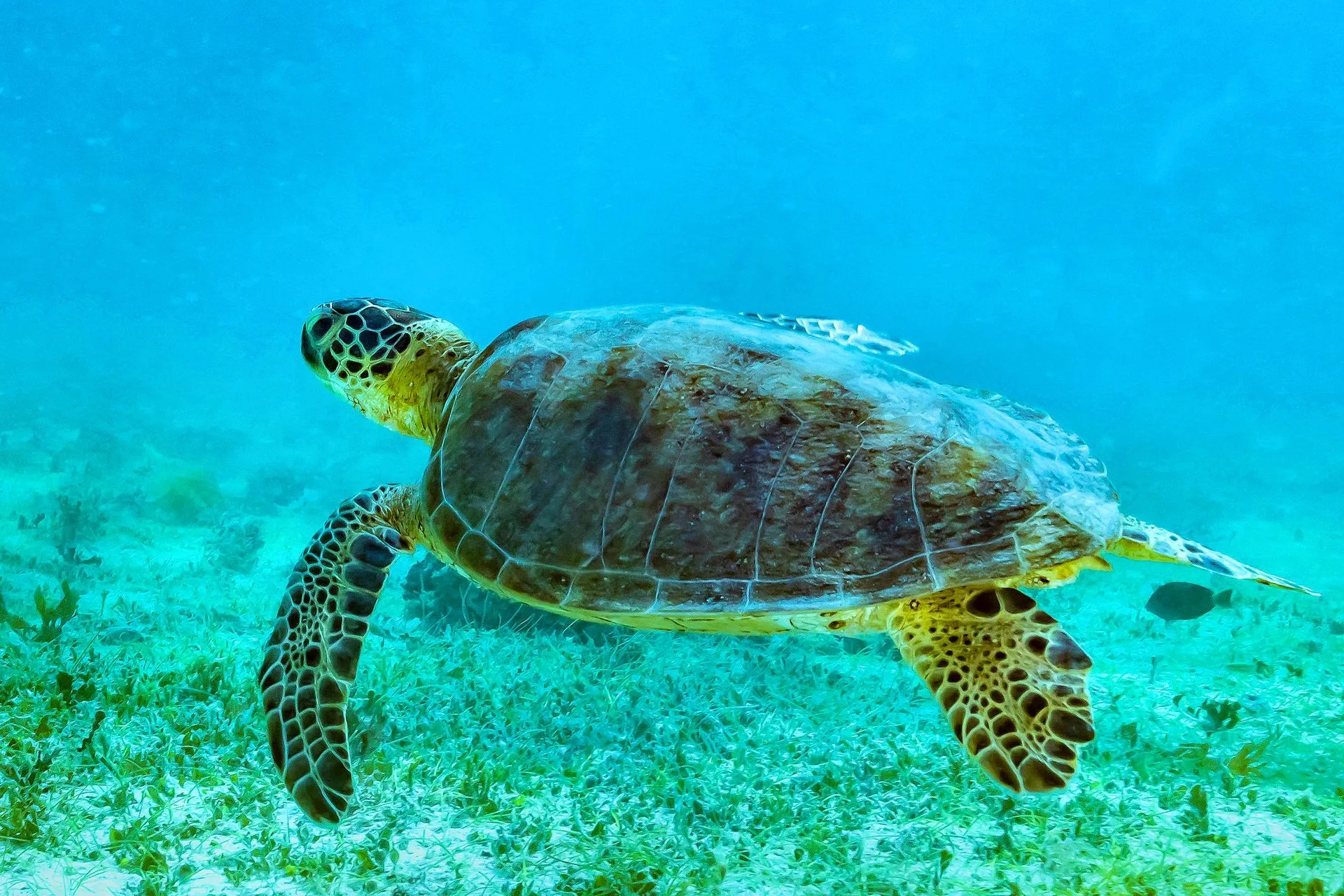
It is one of the great endurance journeys in the animal kingdom, and it has just set a record. A green sea turtle has migrated a staggering 3,979 km (2,472 miles) in a year — believed to be the furthest migration ever recorded for the species.
The turtle was one of eight fitted with satellite aerials on their backs by scientists from Swansea University, working with colleagues in Australia and the Seychelles. The team located the turtles nesting ashore at night in the Chagos Islands and attached the tags so they could follow the animals' movements from their breeding grounds. The record-breaking individual travelled from the Chagos Archipelago in the middle of the Indian Ocean all the way to the coast of Somalia in East Africa.
The project was designed to answer a bigger question than who swims furthest: do the world's giant marine protected areas actually protect the animals they were created for? The Chagos Archipelago became a protected area in 2010, covering some 640,000 square kilometres of ocean — one of the largest marine parks on the planet, renowned for pristine coral reefs and endangered species. The findings, published in the journal Conservation Biology, suggest that for a long-distance migrant like the green turtle, even a park that size has limits.
Seven of the eight tracked turtles migrated to foraging grounds that lay outside the protected boundary around the Chagos Islands. Only one of the eight remained inside the protected area after the breeding season had finished. Most of the travellers ventured more than 1,000 km beyond the park's borders. Two of the turtles swam more than 3,800 km westwards to the coast of Somalia, while another headed 1,000 km north to the Maldives. The turtles' destinations make sense biologically: after nesting, females head for shallow coastal waters rich in the seagrass meadows they feed on — and the best seagrass is not always inside the lines humans draw on maps.
"Over the last few years, governments around the world have declared some massive marine parks, typically around ocean islands," Prof Graeme Hays of Swansea University's College of Science said when the research was announced. "How well these protect marine life has been heavily debated." The data provided a stark answer for turtles: the marine protected area did little to protect them during migration. Only about one per cent of the world's ocean waters are protected for wildlife, and this study suggests that for animals that cross entire ocean basins, even the largest reserves cover a small fraction of their lives.
That does not mean the parks are worthless. The Chagos protected area still guards the nesting beaches themselves — the most vulnerable stage of a turtle's life, when females heave themselves ashore to lay their eggs. Around 1,000 adult green and hawksbill turtles nest in the British Indian Ocean Territory's protected area each year, and a female may lay up to 150 eggs in a single exhausting night. Protecting that window matters enormously. But the researchers argue that the giant parks need to be supplemented with networks of smaller protected areas along migration routes, backed by international cooperation — because a turtle that nests under one country's protection may feed in another's waters, or in the lawless high seas in between.
Green sea turtle nesting on a beach at night
Credit: U.S. Fish and Wildlife Service / Wikimedia Commons, Public domain
The stakes are high. Green turtles are classified globally as endangered by the IUCN, with roughly a 55 per cent decline in nesting females over the last three generations. Across the Western Indian Ocean, the biggest threats are incidental bycatch in gillnets and pelagic longlines, the harvesting of turtles and eggs, and the loss of nesting beaches. The species also takes longer than any other sea turtle population to mature — around 26 years — which makes population recovery painfully slow. A female that survived to breeding age has beaten extraordinary odds; losing her to a net a thousand kilometres from any protected boundary is a conservation failure the tracking data makes visible.
The new findings land alongside fresh insight into how turtles pull off these voyages at all. In June 2026, a team led by Hays published research in the journal Science Advances showing that green turtles navigate across hundreds of miles of open ocean using Earth's magnetic field. Researchers attached dual-sensor tags — combining a magnetometer that logs the animal's compass heading with Argos satellite positioning accurate to within 100 metres — to six female green turtles that took about a month to navigate more than 1,600 km westward across the Indian Ocean. The tags, developed over five years specifically for the study, revealed that the turtles travel in straight lines rather than drifting with currents, periodically reorienting over the course of about 15 hours.
The system, the researchers concluded, is "not perfect, but adequate": the turtles know their approximate position from the magnetic field and hold a heading, correcting course as the field shifts beneath them. It is an extraordinary feat of biology — a reptile the size of a dustbin lid steering by the planet itself.
Satellite tracking of these same Chagos turtles has already paid scientific dividends beyond migration maps. Research by Swansea and Deakin University academics used turtle movements to discover extensive deep-water seagrass meadows on the Great Chagos Bank — the world's largest contiguous atoll structure — finding seagrass cover averaging 74 per cent at depths down to 29 metres. Those meadows store huge amounts of carbon in their sediments and support rich fish populations, showing how following one species can reveal entire hidden ecosystems.
For conservation planners, the message of the record migration is clear. Marine protected areas work best for creatures that stay put — corals, reef fish, nesting seabirds. For ocean wanderers like turtles, whales, seals and sharks, a single giant park will always be a partial answer. The future, the researchers say, lies in networks: smaller reserves stitched across the Indian Ocean, agreed between nations, protecting the corridors as well as the destinations.
Read more of our Science coverage, from the bluefin tuna's remarkable comeback to the rainbow sea slug found in Cornwall, great white sharks heading north as Atlantic waters warm, and the northern lights over the UK. You can also explore how we got here on Verity's homepage — or how the Vikings reached America centuries before Columbus using navigation of their own.