In Short (TL;DR)Great white sharks are ranging further north as Canada's Atlantic waters warm and seal populations recover — Nova Scotia's surface waters have warmed about 1.5°C in 30 years, the seafloor by about 3°C. A 14ft shark nicknamed Contender was tracked from Florida to Nova Scotia this summer. Researchers identified 120 individual sharks in 55 days last year, most seen only once. Experts advise mindfulness rather than fear: avoid seal-heavy areas and poor-visibility water.
A 14ft great white shark nicknamed Contender spent this summer cruising from the waters off Florida all the way to Nova Scotia, his satellite tag pinging every time his dorsal fin broke the surface. His journey is the latest sign that Canada's Atlantic waters are becoming a hotspot for the ocean's most famous predator — drawn north by recovering seal populations and steadily warming seas.
It is a remarkable shift. Waters that were once considered the chilly fringe of the great white's range are now firmly on the map, and the scientists, divers and coastal communities of Atlantic Canada are adjusting to life alongside an apex predator that, not long ago, was a rarity this far north.
Contender is no ordinary shark. The mature male measures about 14ft (4.2m) and weighs an estimated 1,653lb, and he is the largest male white shark the research organisation OCEARCH has ever tagged in the western North Atlantic. Tagged on 17 January 2025 off the Florida–Georgia border and thought to be around 30 years old, he carries a satellite tag that transmits his position whenever his fin breaks the surface within range of a satellite.
This summer's northward run took him to Nova Scotia — and, according to tracking reports, further north than any OCEARCH-tagged shark on record, into waters off Newfoundland. Members of the public can follow his movements on OCEARCH's free Global Shark Tracker. For researchers, every ping is a data point in a migration story that is still being written — as BBC Future reports.
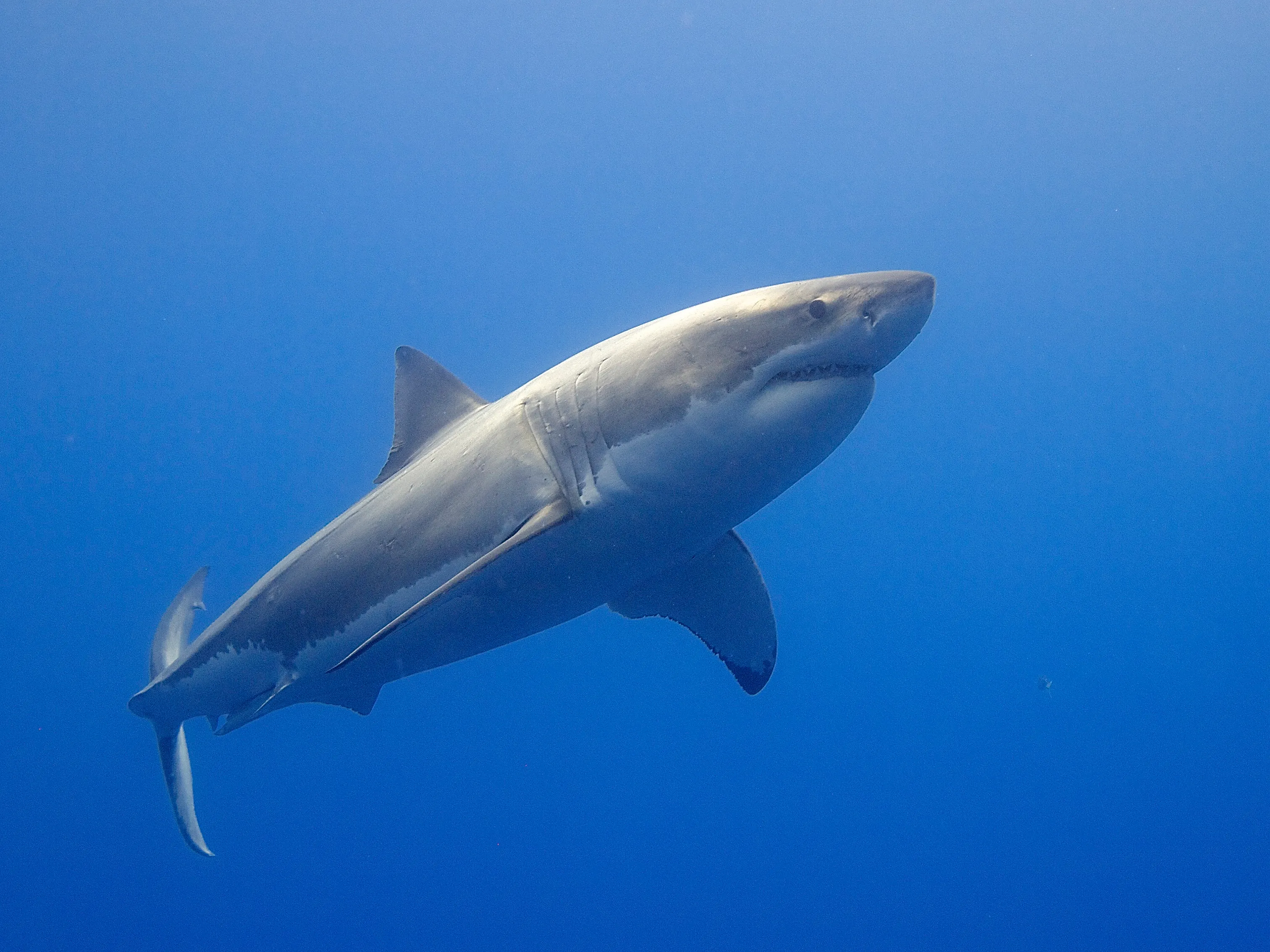
!Side view of a great white shark gliding through clear blue water
Credit: Godot13, CC BY-SA 4.0, via Wikimedia Commons
Two powerful forces are pulling white sharks north. The first is food. Seal populations — grey seals in particular — have rebounded strongly along the Atlantic coast after decades of protection, creating a rich hunting ground. As shark scientist and marine biologist Neil Hammerschlag puts it: "Nova Scotia has a lot of food options for them." A long-term NOAA-led study of white shark records found the animals increasingly associated with the return of grey seal colonies off the Massachusetts coast.
The second force is temperature. The surface waters off Nova Scotia have warmed by about 1.5°C over the past 30 years, while the seafloor has warmed by roughly 3°C. For a species whose range is constrained by cold, that is a transformation: habitat that was once marginal is now comfortably within the white shark's preferences, and the boundary of its world is sliding poleward.
Hammerschlag, who also operates cage-diving trips, says the trend is unmistakable on the water: "I can definitely say last year was the most sharks we saw, and this year already we seem to be seeing the sharks even earlier than last year." The numbers back him up: researchers identified 120 different great whites in just 55 days last year — though 80% were seen only once, a reminder of how vast an ocean these animals roam and how briefly they linger in any one spot.
For those who work in Atlantic Canada's waters, the change is not abstract. Alanna Canaran, a Halifax dive instructor and ocean science educator, says the presence of the animals is now something she plans around: "There have been a few days where you're in the water and it feels very sharky." She has adapted her teaching accordingly: "I include a briefing about sharks for my courses and for my guided dives that I take out."
The sharks themselves, researchers stress, are far from the mindless killers of legend. "The individuals learn, they have memories, they have mental maps," Hammerschlag says — intelligent, wide-ranging animals following food and temperature across thousands of miles of ocean. NOAA Fisheries' white shark science pages describe a protected, slow-maturing species whose populations are still recovering from historical depletion.
In September, a diver was attacked by a great white off Quebec's Gaspé Coast. The injuries were not life-threatening, but the incident was a jolt in a region still getting used to its new apex residents — and a reminder that sharing the water with large predators carries real, if small, risks.
Context matters. The white shark is a prohibited species in US waters — it must be released immediately if caught — and is protected internationally under CITES Appendix II, the Convention on Migratory Species and other agreements. A landmark study compiling 649 confirmed white shark records from 1800 to 2010 found the northwest Atlantic population showing signs of recovery after decades of decline. In ecological terms, the sharks' return is a success story: a top predator reclaiming habitat as its prey recovers and waters warm.
So how should swimmers, divers and coastal communities respond? Hammerschlag's philosophy is simple: "not to be fearful, but to be mindful." Practical advice follows the sharks' own logic: "Avoid areas that have preferred prey of sharks (such as seals), especially in areas with poor water visibility which could make it harder for a shark to distinguish between their natural prey and a human."
It is guidance Canaran already lives by on her Halifax dives — briefings, awareness, and respect for an animal that was here long before the dive boats. As Nova Scotia's human population passes one million, with Halifax alone topping 400,000, more people than ever share these waters with the ocean's most iconic predator. Coexistence, researchers say, is a matter of understanding behaviour — theirs and ours.
The natural world keeps delivering reminders of how fast it is changing. Scientists are tracking a rainbow sea slug's northward march in Cornwall, probing how memory survives hibernation in mice, and warning that wildfire smoke is becoming a global health threat — while NASA prepares its next great space telescope and engineers quietly electrify the landscaping industry. The sharks off Nova Scotia belong on that same list: another line of evidence that the planet's systems are on the move.
The "sharkiest" season runs until October, when the animals head south again before returning around March. Next year's arrivals will be closely watched: was 2026 a peak, or simply the new normal for Atlantic Canada? With Contender's tag expected to keep transmitting for years, and researchers identifying more individuals each season, the answers are coming — one ping at a time.
*VERITY is an independent digital news platform covering science, world news, business and more. Read about our editorial standards.*