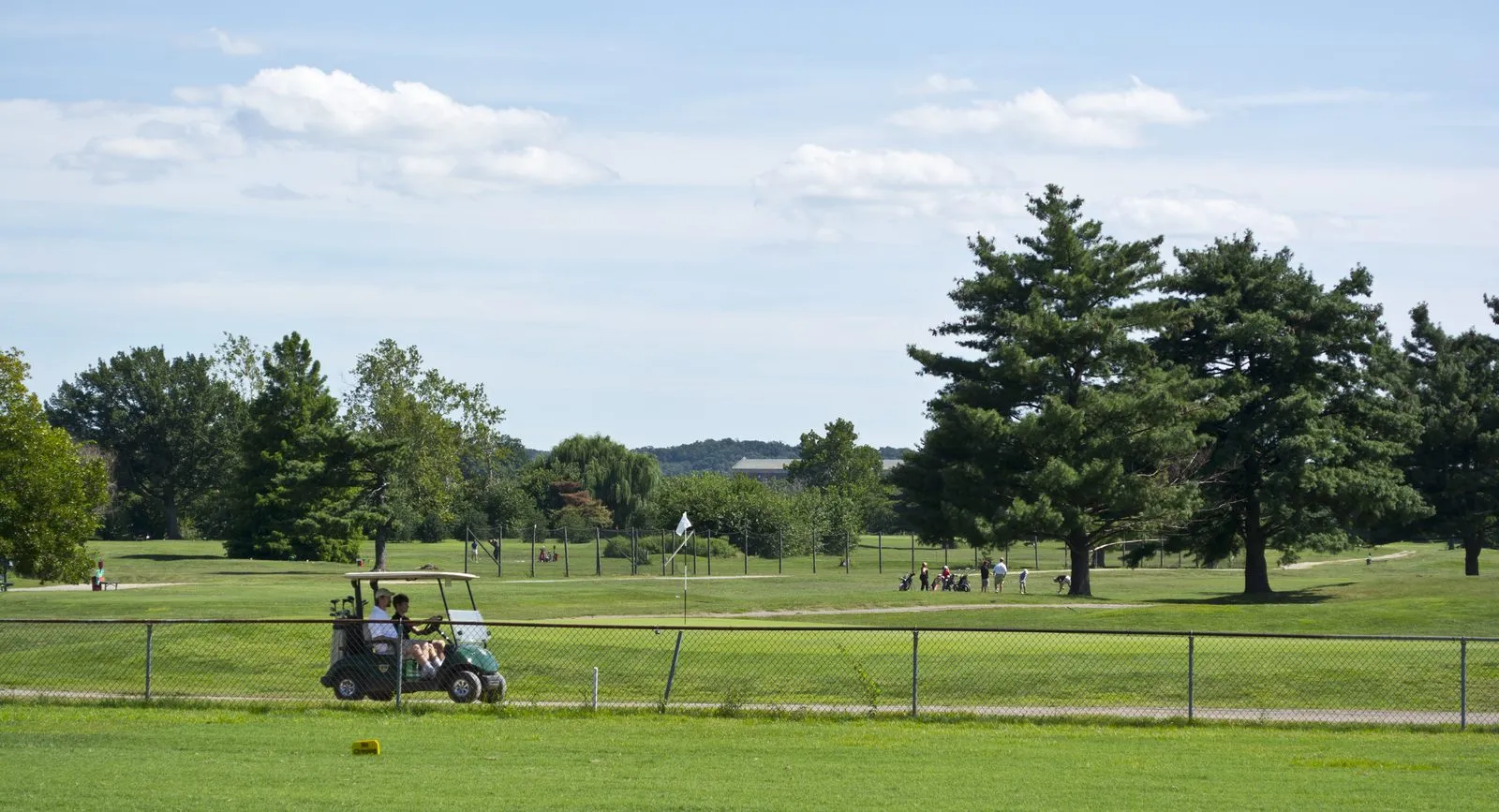
Few disputes capture the character of Donald Trump's second presidency quite like the fight over a municipal golf course. East Potomac Golf Links is not Mar-a-Lago. It is a 106-year-old public course on federal parkland, two miles south of the White House, where ordinary Washingtonians have paid modest green fees for generations. The president wants to close it from 15 November and rebuild it as a championship venue fit for the U.S. Open. A federal judge has told him, in effect, not so fast. And in that collision — between a president's vision and a court's order, between $29 rounds and tournament prestige — sits a question much bigger than golf.
The BBC's reporting lays out the facts. What follows is an attempt to say what they mean. More of our opinion and analysis takes on the week's big stories.
Two visions of "improvement"
Start with what everyone agrees on: East Potomac needs work. Even the regulars interviewed by the BBC accept that. The course has diseased and dangerous trees, tired facilities and a collapsing seawall along the Potomac. The National Park Service itself has estimated construction costs of between $20 million and $49 million, and contracts for engineering, environmental and historic-preservation work have already been concluded.
The disagreement is about what improvement means. For the regulars, it means fixing what is broken while keeping the course what it has always been: public, welcoming and cheap. Jourdain Yardan, 35, who plays twice a week, describes a course that welcomes everyone at a reasonable price. Thomas Snow, 70, has played there for 15 years and pays $29 for 18 holes — "nowhere else in the wider DC region offering a comparable round at that price". Both men called Trump's description of the course as "old, broken, dilapidated, and of no further use or effect" a gross overstatement.
For the president, improvement means transformation: an 18-hole championship layout, a shorter nine-hole course and a large practice range, designed with the involvement of leading architect Tom Fazio's firm, capable of hosting professional tournaments and even, eventually, a Ryder Cup. It is the difference between maintaining a public good and building a monument. Golf's business side has seen plenty of big-money moves lately — Verity recently covered a potential $300 million investment into LIV Golf — but this is public land, not a private asset, and that changes the moral arithmetic entirely.
The weekend the trees came down
The legal fight, however, is not really about landscape architecture. It is about process — and the process story is damning for the administration.
The DC Preservation League and two golfers sued back in February, arguing that a championship-style rebuild would inflate costs at a facility meant to be open to all. They are represented by Democracy Forward, whose president and CEO is Skye Perryman. In May, Judge Ana Reyes issued an order requiring court approval before more than 10 trees could be removed. Then, over the 9–10 October holiday weekend, the National Park Service felled more than 400 of them.
At an emergency hearing, Reyes did not hide her fury. She told Justice Department lawyers: "I trusted you all not to do precisely what you have done." Court filings showed the decision to remove the trees had been ordered, considered and approved within five days before machinery arrived — an unusually compressed federal process for work on protected parkland. The judge's resulting order bars further tree felling and any "irreparable modification" of the course through at least 26 October, as detailed in court coverage.
The administration's response was not contrition but escalation: a motion to disqualify Reyes herself, accusing her of "egregious" bias. Whatever the merits of that motion, the sequence — a court order sidestepped, then an attack on the judge who noticed — is a pattern worth watching. As further reporting on the hearings makes clear, the plaintiffs' core claim is that the administration tried to present a fait accompli before the courts could rule.
A pattern, not an isolated project
East Potomac does not stand alone. In his second term, Trump has pursued a sweeping programme of remaking Washington's public realm — the White House itself, the Kennedy Center, and now the capital's parkland courses. The Hill's reporting notes the golf course was eyed by the president as part of this broader refurbishment of the capital, with the National Links Trust — the nonprofit that has run the courses since the pandemic — striking a deal with the Interior Department earlier this year.
There is nothing inherently illegitimate about a president wanting the capital to look magnificent. But there is a difference between stewardship and personalisation, and the golf course sits exactly on that line. A championship venue bearing the unmistakable imprint of a golf-obsessed president, built on land held in trust for the public, invites the question of whose legacy is being constructed. Trump's political positioning — the subject of our recent analysis of Republicans navigating the Trump era and his remarks on Los Angeles — increasingly treats the federal estate as a canvas. The courts are now deciding whether that canvas has owners other than him.
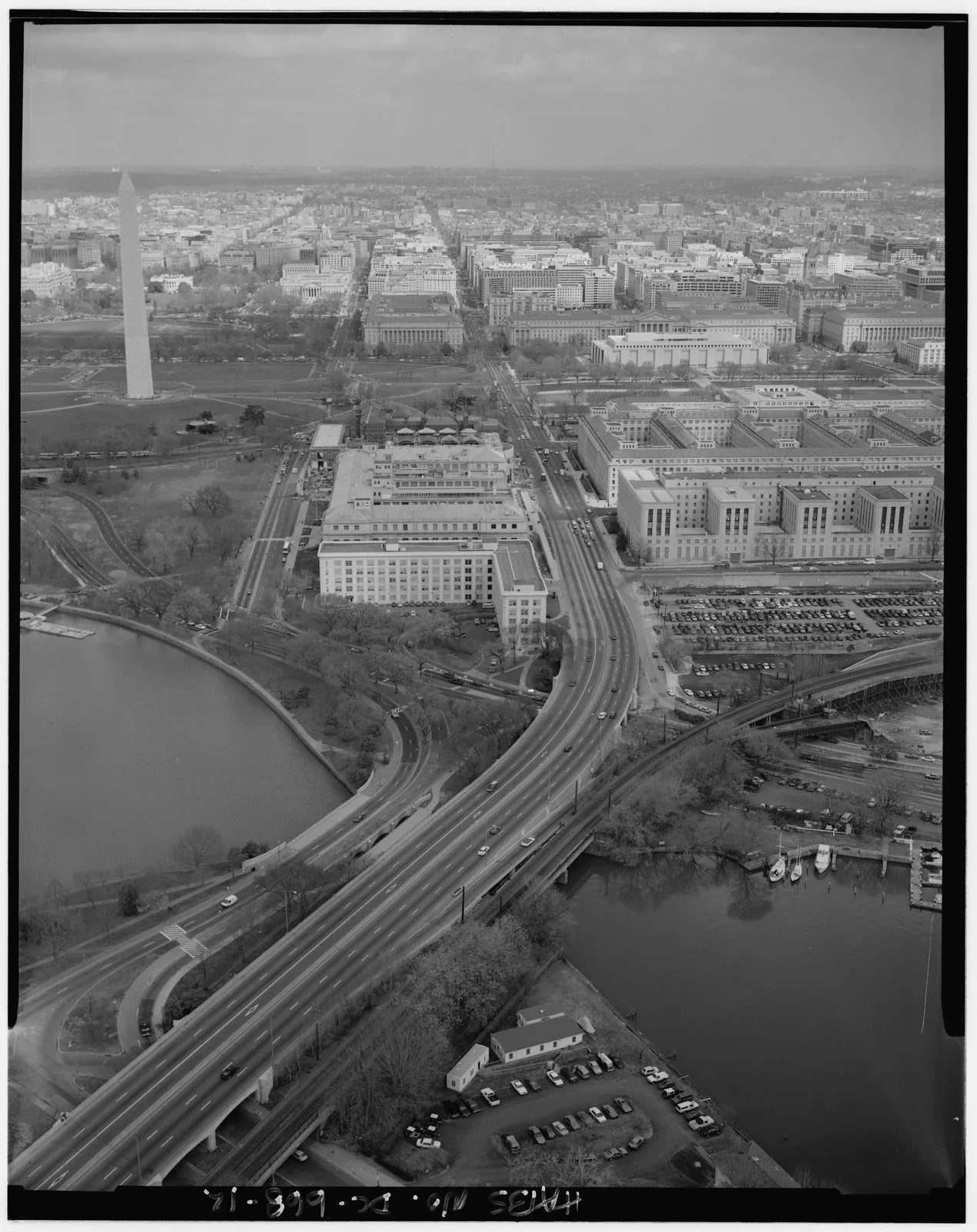 Aerial view looking north from above East Potomac Park toward the National Mall in Washington DC
Credit: Historic American Buildings Survey, public domain, via Wikimedia Commons.
What public land is for
Strip away the personalities and the dispute reduces to a philosophical question that every democracy must answer: what is public land for? The American answer, embodied in the National Park Service, has traditionally been access — the idea that the most democratic thing a government can own is something everyone can use. East Potomac's $29 rounds are that ideal made concrete: a beginner, a retiree, a kid with borrowed clubs, all welcome on the same grass.
The championship vision is not the opposite of that ideal, exactly — a great public course can host great tournaments — but the plaintiffs' fear is well founded. Tournament-grade conditioning, tournament-grade security perimeters and tournament-grade pricing have a way of filtering who feels welcome. When the regulars say they fear being priced out, they are describing a familiar gentrification, applied to a fairway. International coverage of the dispute has picked up on precisely this tension between public access and prestige development.
What happens next
The immediate future is procedural. The restraining order holds until at least 26 October, a further hearing is expected, and the Interior Department muddied the waters on Sunday night by filing that the Park Service has not completed its review and no final agency action has been taken to close the park — which raises the question of what legal basis the announced 15 November closure actually has. The disqualification motion against Reyes adds a wild card.
But whatever the courts decide, the episode has already revealed something. A president who describes a beloved public course as being "of no further use or effect" is telling you what he values: not the use ordinary people make of public things, but the effect those things produce on a grander stage. The golfers of East Potomac — the twice-a-week regulars, the $29 retirees — are the custodians of a quieter idea: that some things are valuable precisely because they belong to everyone. That idea now has its day in court. Follow more of our analysis as the case unfolds, and read about our mission on our about page.