In Short (TL;DR)Republican candidates are campaigning on "affordability" while playing down their ties to Donald Trump, whose economic pitch is failing with voters — 63% in one poll say the economy is getting worse. Florida's Byron Donalds, a Trump loyalist, delivered a stump speech that never mentioned the president; similar distancing has appeared in Texas and Iowa. Representative Maria Salazar went further, releasing an ad telling Trump directly that his immigration enforcement has "gone too far." Strategists warn the balancing act can look calculated — but with polls showing tariffs, the immigration crackdown and the Iran conflict all unpopular, candidates see little choice.
With the US midterms now in their final sprint — polling day is 3 November — Republican candidates find themselves performing an increasingly awkward balancing act. They cannot win without Donald Trump's base, but they are learning that they cannot win with his message either. The result is a party-wide tightrope walk: profess loyalty to the president while campaigning, in substance, against the core of what he is telling voters.
The tension is most visible on the economy. Trump has spent the campaign insisting that the American economy is booming and that inflation is beaten. Voters are not buying it. In a YouGov poll, 63% of respondents said the economy was "getting worse." AP/NORC polling has found his tariffs, his immigration enforcement and the war with Iran all unpopular. Jessica Taylor, a Senate analyst at the Cook Political Report, told Reuters that affordability had become the single most important issue for voters — and that there was "a general sense that the president is not focused" on it. Trump's approval rating has fallen to an all-time low in Reuters/Ipsos polling, with net disapproval running at nearly twice the level it was at the same point in 2018.
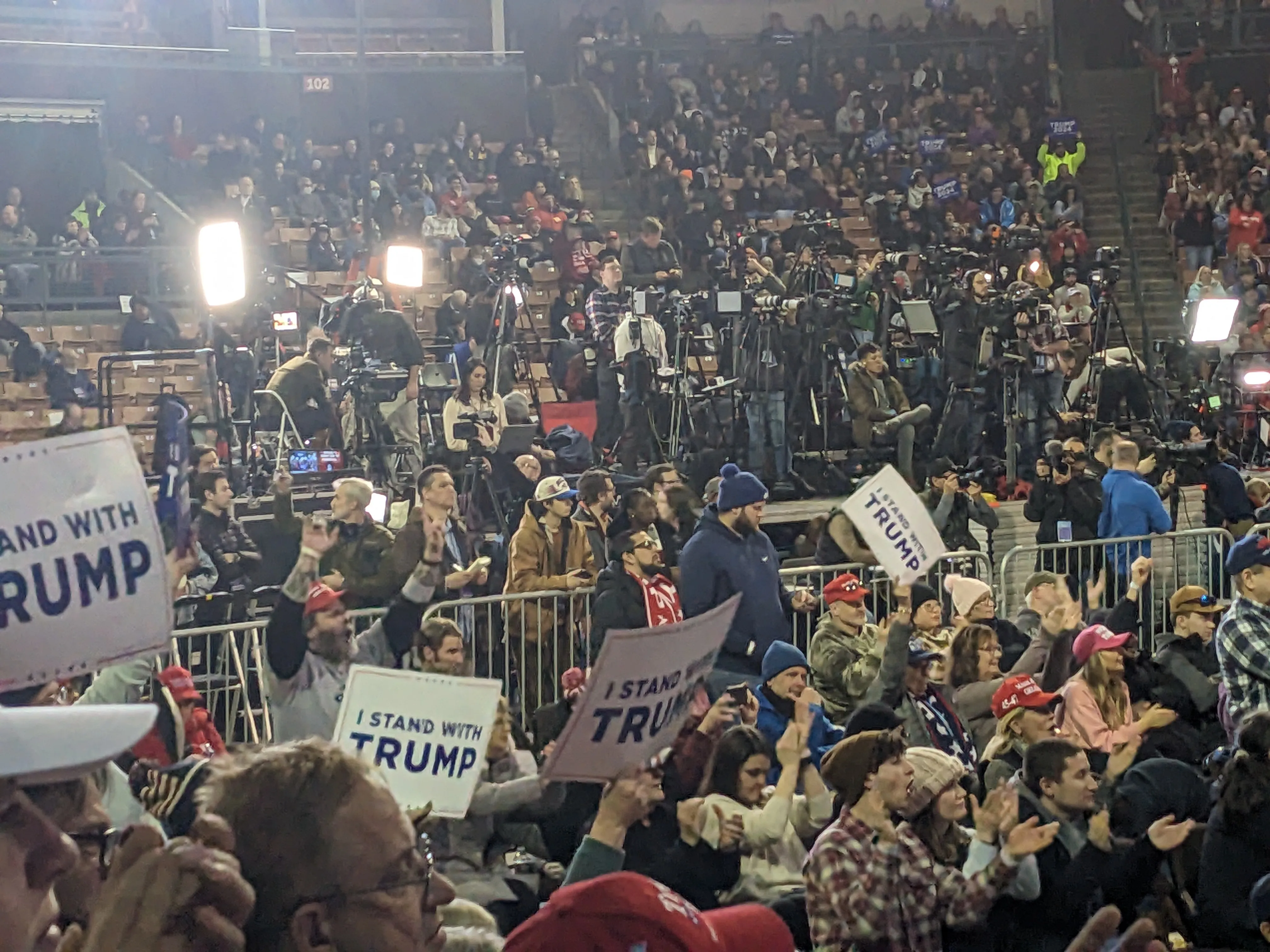
!Donald Trump speaking at a campaign rally
Donald Trump addressing a campaign rally in Manchester, New Hampshire, in January 2024. His endorsed candidates now face a choice between loyalty to him and distance from his message. Credit: Artaxerxes / Wikimedia Commons (CC BY-SA 4.0)
Nowhere is the bind clearer than in Florida, where Byron Donalds — one of the president's most loyal allies in Congress — is running for governor. Donalds has built his campaign around an "affordability agenda," telling voters that "success has gotten expensive." In a recent stump speech, he did not mention Trump at all.
That omission was noticed. When reports suggested daylight was opening between the candidate and the president, Donalds dismissed them as a "Fake Story." Trump, for his part, took to Truth Social to deny any rift angrily. The episode was revealing: even the denial had to be performed, publicly, at speed — a sign of how seriously both men take the appearance of distance.
Donalds is not alone in reaching for the affordability label. In Texas, Governor Greg Abbott held a "rural affordability" event. In Iowa, Ashley Hinson — while campaigning on household costs — also called for a "quick end" to the war in Iran, a conflict that polling shows is dragging the party down. The pattern is consistent: localise the message, talk prices, and keep the president's name out of it where possible.
!Official portrait of US Representative Byron Donalds
Representative Byron Donalds, the Trump loyalist running for governor of Florida on an "affordability agenda" that barely mentions the president. Credit: United States Congress / Wikimedia Commons (Public domain)
Representative Maria Salazar of Florida has gone further than most. In September she released the first TV ad of her general election campaign — a 30-second spot, produced in both English and Spanish, in which she speaks directly into the camera to the president who endorsed her: "Mr. President, some of your immigration enforcement efforts have gone too far."
In the ad, filmed outside the White House, Salazar argued that half of the people detained by immigration authorities in July had no criminal record, and warned that the Hispanic voters who helped Trump win in 2024 "feel betrayed" — a message detailed by NPR when the spot first aired. She was explicit that she was not asking for amnesty — she was asking, she said, for a "dignified life in this promised land."
Trump confirmed the next day that he had seen the ad. He disagreed with it, said Salazar had gone "a little bit soft on the border," and claimed she would not have won her seat without his endorsement. He is still backing her re-election. The two have since spoken, and Salazar described him as "very receptive." The rift, such as it is, has been papered over — but the ad remains on the airwaves, aimed at the majority-Hispanic voters of Florida's 27th district.
Not everyone in Republican circles thinks the balancing act is clever. The strategist Marc Short has warned that candidates attempting to "create separation" from the president risk looking "almost disingenuous" and "opportunistic" — trying to have it both ways with a base that prizes loyalty above almost everything.
There is a genuine risk here. Trump's supporters have a finely tuned radar for disloyalty, and a candidate caught triangulating can be punished from the right as easily as a candidate caught defending the indefensible can be punished in the centre. Salazar's Democratic critics have already accused her of playing both sides, pointing out that she voted for the funding behind the very enforcement drive she now criticises.
The president himself shows no sign of adjusting course. He has dismissed concerns about affordability as a communications failure, saying "the only thing we're doing badly at is public relations" — though he has also acknowledged doing a "very bad job" of explaining his economic record. He insists his name is "on the ballot" in November, yet warns that a poor midterm result would not reflect on him.
It is a curious posture: total ownership of the movement, total distance from the outcome. And it leaves his candidates with the harder half of the bargain — defending a record the president insists is splendid to voters who are telling pollsters, overwhelmingly, that their lives feel more expensive and less secure.
Fairness requires acknowledging the difficulty of the candidates' position. The midterm electorate historically punishes the president's party; the president's party has lost House seats in all but two midterms since 1938. Running against the headwind of an unpopular incumbent of your own party is one of the oldest problems in American politics. What is new is how public the attempted distancing has become — from scrubbed campaign websites to ads addressed, quite literally, to the president.
Whether the tightrope holds will be decided on 3 November. If Republicans keep Congress, the affordability pivot will be remembered as a masterstroke of message discipline. If they do not, the autumn of 2026 will be remembered as the season the party's candidates tried to run with Trump and from him at the same time — and discovered, too late, that the wire was thinner than it looked. For more opinion and analysis, follow Verity's midterm coverage.