A Friday-morning spark becomes an afternoon emergency
The Norte Fire began, as so many California disasters do, unremarkably. At around 11:30am Pacific time on Friday 16 October, a fire ignited in the hills near Portico Del Norte and Eminencia Del Norte in San Clemente, Orange County — one of about 13 wildfires burning across California that day (BBC report). Within hours it had become the most dangerous of them.
The conditions were near-textbook for a firestorm: fierce Santa Ana winds, bone-dry vegetation, temperatures in the mid-90s and very low humidity. The blaze grew with terrifying speed — roughly 50 acres by 12:30pm, about 250 by 2pm — and by Friday evening it had exploded to between 465 and 570 acres. By Saturday evening, the figure stood at 570 acres, just under a square mile, according to Cal Fire's incident page.
For the communities in its path, there was little time to think. Mandatory evacuation orders went out for hillside neighbourhoods in San Clemente and San Juan Capistrano, covering zones SJC04, SJC05 and SJC10 in San Juan Capistrano and SCL12 and SCL13 in San Clemente. At the peak, some 6,000 homes and around 16,000 residents were told to leave immediately.
Homes lost on Via La Mirada
The fire's toll on property became clear as Friday wore on. At least six homes were damaged or destroyed, including four off Via La Mirada in San Juan Capistrano, with structures also reported affected near Avenida Calita and Via De Agua. Video from the scene showed flames burning through rooftops as residents watched from behind road barriers.
One evacuee, John Zehren, was forced to flee twice in a single day — first while surfing near Camp Pendleton because of a separate fire near the base, then again when an evacuation text reached him at his home in San Juan Capistrano. Returning on a small white e-bike on Saturday morning to check a friend's house on Via La Mirada, he found the property still standing. His friend's reaction, he relayed: "I can't believe it. Thank God."
The Orange County Fire Authority reported seven homes "damaged or destroyed", while KTLA reported seven — a reminder that in the first hours of a fast-moving fire, even official tallies can differ. What is not in dispute is that several families lost everything in a matter of hours.
"Could have been a whole lot worse"
San Clemente Mayor Rick Loeffler captured the mood of a community that had narrowly avoided catastrophe: "Had these winds been a little bit stronger, a little bit different direction, this could have been a whole lot worse."
His point was underscored by the firefighters' own experience. Two firefighters were hospitalised with heat-related injuries; both were reported stable, and one was later released. There were no reported civilian injuries or deaths — an outcome that, given the fire's speed and the density of the neighbourhoods it threatened, officials treated as a significant success.
A hard closure of Interstate 5 was requested between San Juan Creek Road and Camino de los Mares, one of the busiest corridors in Southern California, as smoke and flames approached the freeway. Nine Capistrano Unified schools — including San Clemente High School and San Juan Hills High School — were dismissed early on Friday. Shelters opened at community centres in San Clemente and San Juan Capistrano, with a further shelter at the local Boys & Girls Club, and Orange County Animal Care in Tustin made space for evacuated pets.
The fight to contain it
Friday night's containment figure — zero per cent — told its own story. By Saturday morning, crews had scratched out 5%, and Saturday's calmer winds allowed a dramatic push: by Saturday evening, Orange County Fire Authority Chief TJ McGovern announced containment had reached 25%. Some 400 firefighters were assigned to the blaze, with 400 more on the way.
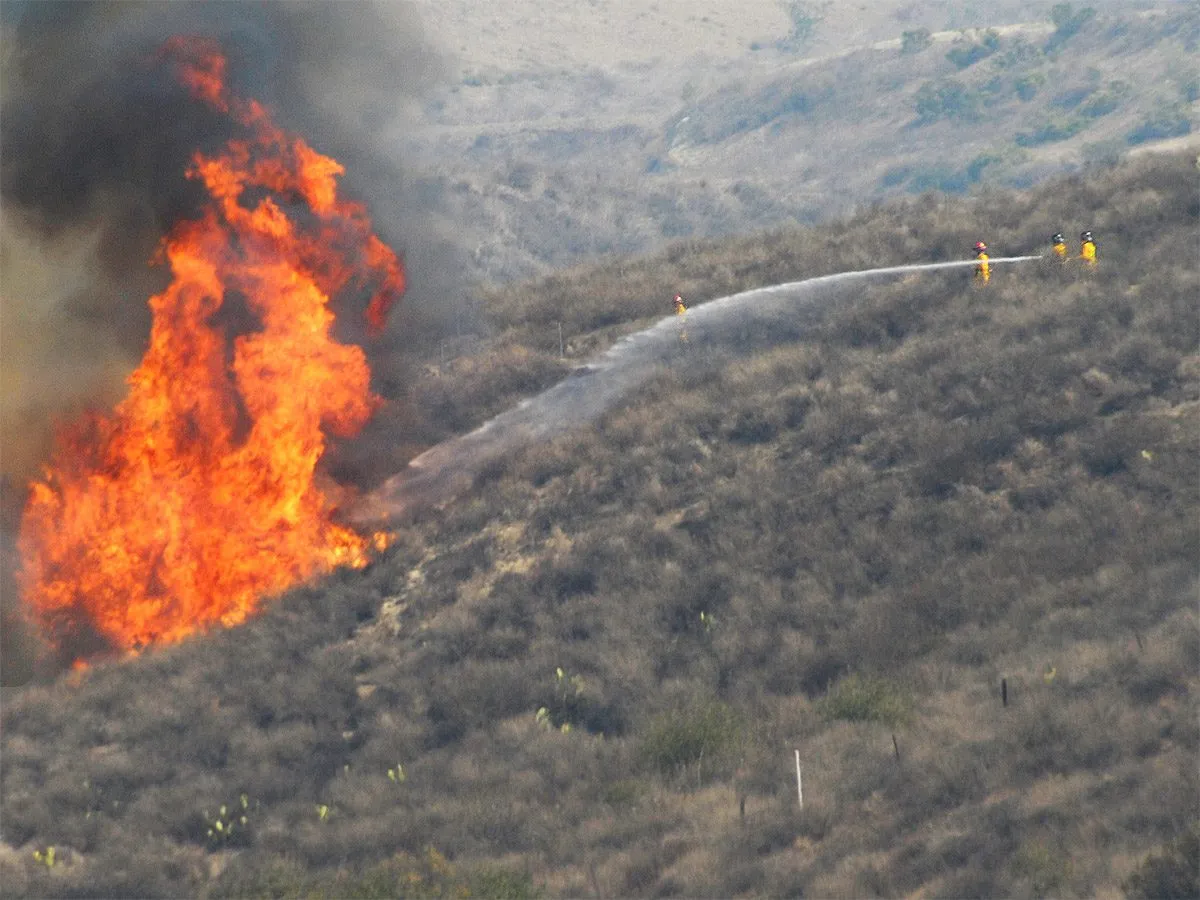
Firefighters battling a Southern California blaze, similar to the crews who fought the Norte Fire. Wikimedia Commons (CC BY 2.0).
Water-dropping aircraft joined ground crews as fire activity diminished on Friday evening, allowing firefighters to focus on homes still burning and on strengthening containment lines. A National Weather Service heat advisory remained in effect until 8pm Saturday for the Orange and San Diego county coasts, and red-flag conditions meant officials were cautious about declaring victory — OCFA spokesperson Steve Concialdi had said Saturday morning that containment was expected to grow "dramatically", a prediction the evening figure confirmed.
Even among the evacuees was a member of Congress: Representative Mike Levin, Democrat of San Juan Capistrano, was among the roughly 16,000 residents ordered out — a measure of how broadly the fire cut across the community.
Federal help arrives
On Friday, Governor Gavin Newsom announced that California had secured a Fire Management Assistance Grant from the Federal Emergency Management Agency, unlocking federal funding to help cover the costs of the firefight. The grant is a standard but significant step: it signals that the fire was judged a major enough threat to homes and infrastructure to warrant Washington's help.
The cause of the fire remains under investigation. What investigators will be examining is familiar territory in California: ignition sources — electrical equipment, vehicles, human activity — meeting the region's increasingly long and severe fire weather season.
A state on fire
The Norte Fire was not an isolated event. It was one of about ten to thirteen uncontained fires burning across California over the weekend, including the Bryson Fire in Malibu (147 acres, 52% contained), the Henderson Fire near Camp Pendleton (around 2,080 acres) and the Peak Fire near Azusa. October has become the cruelest month of California's fire year: the end of the dry season collides with the arrival of the Santa Ana winds, and climate trends — also tracked in wildlife and ecosystem reporting — are stretching that window wider.
The human disruption extended beyond the fire lines. Friday night's highly anticipated high-school football showdown between Mission Viejo and San Clemente — a nationally ranked matchup — was cancelled as evacuations spread. For the teenagers of San Clemente High, one of the schools dismissed early, the weekend's defining memory will be smoke rather than sport.
What comes next
Saturday evening brought the news residents had been waiting for. At 6pm, a Cal Fire update lifted evacuation orders across San Clemente and San Juan Capistrano, allowing thousands to begin returning home. Repopulation was staged: San Clemente's Zone 13 was fully cleared for return, while parts of San Juan Capistrano's Zone 10 reopened in stages, with only a single San Clemente street remaining under orders.
The returning residents will find a changed landscape: scorched hillsides, destroyed homes, and the acrid reminder of how fast a Friday morning can turn. OCFA's Greg Balta had warned residents to respect the active fire line even as winds eased — a fire at 25% containment is three-quarters uncontrolled.
For Orange County, the Norte Fire will be remembered as a near-miss that still cost six families their homes. For California, it is another entry in a lengthening record of autumn fires arriving earlier, burning faster, and reaching further into communities that once considered themselves safe. The investigation into its cause continues. The reckoning with the conditions that made it possible will take longer.
Follow Verity's US news coverage and science desk for continuing coverage of the fire season — and read about our reporting standards.