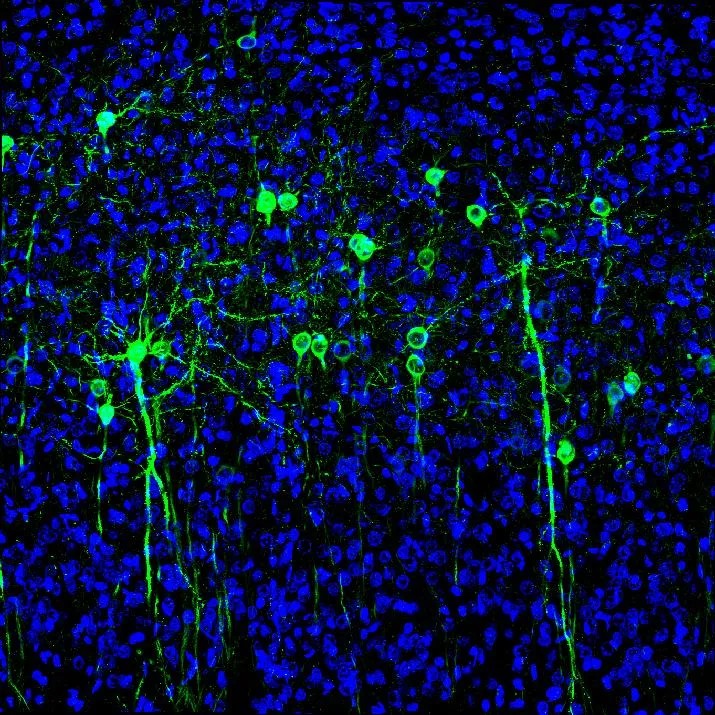
In Short (TL;DR)Karl Deisseroth (US), Peter Hegemann and Georg Nagel (Germany) won the 2026 Nobel Prize in Physiology or Medicine for "discoveries concerning light-gated ion channels and optogenetics." Announced at the Karolinska Institute in Stockholm, the trio share 12 million Swedish crowns (around £900,000). Optogenetics uses light and the algal protein channelrhodopsin to activate or silence individual neural circuits in a living brain, letting researchers probe memory, fear, addiction and movement. The breakthrough grew from 1990s research into how pond algae sense light, through the discovery of channelrhodopsin-2, to the first demonstrations in animal nerve cells in 2005. Clinical trials are taking first steps toward restoring vision in retinitis pigmentosa, with hopes the approach could one day help treat Parkinson's disease and epilepsy.
The human brain contains roughly 86 billion neurons, wired together in circuits of almost incomprehensible complexity. For most of scientific history, researchers studying that wiring faced a maddening limitation: they could watch the brain work, but they could not reach in and flip individual switches to see what each circuit actually did. On Monday, the Nobel Assembly at Stockholm's Karolinska Institute honoured the three scientists who changed that forever.
Karl Deisseroth, a 54-year-old American psychiatrist and neurologist at Stanford University, and Germans Peter Hegemann, 71, of Humboldt University of Berlin, and Georg Nagel, 73, of the University of Würzburg, were awarded the 2026 Nobel Prize in Physiology or Medicine for their "discoveries concerning light-gated ion channels and optogenetics." The trio will share 12 million Swedish crowns — around £900,000 — and, the committee noted with warmth, were "surprised and delighted" to learn they would receive the honour together.
"This method makes it possible to switch on, or off, the activity of individual nerve cells in a living brain," said Thomas Perlmann, secretary-general of the Nobel Assembly, at the announcement. "This method is now being used in laboratories around the world to reveal the brain's mysteries."
The road to Stockholm began, improbably, with pond scum. In the early 1990s, Peter Hegemann was studying Chlamydomonas, a single-celled green alga that swims toward light with extraordinary speed — reacting in about half a millisecond. Such swiftness, Hegemann reasoned, could not be explained by a conventional chain of chemical signals. He proposed something bolder: that a single protein in the alga's eye-spot both detected light and acted as an ion channel, letting charged particles flood across the cell membrane the instant photons arrived.
It was Georg Nagel who proved him right. By inserting the alga's genes into frog egg cells, Nagel isolated the molecule responsible: channelrhodopsin-2, a light-sensitive ion channel — essentially a molecular gate that swings open when struck by blue light. In 2003, the pair published landmark results showing the protein could be introduced into human and hamster cells, allowing researchers to generate electrical signals in those cells using nothing but light.
But a protein that works in a dish is not yet a tool for neuroscience. That final leap came from Karl Deisseroth at Stanford, who in 2005 demonstrated the technique in the nerve cells of living animals — genetically instructing chosen neurons to manufacture channelrhodopsin, then firing those precise circuits with pulses of light delivered through hair-thin optical fibres. The method was christened "optogenetics" in 2006, and neuroscience has never been the same since.
What makes optogenetics revolutionary is its precision. Older techniques could stimulate broad regions of the brain, like flooding a city with light to find one house. Optogenetics is the address book: by targeting the protein to specific cell types, scientists can activate or silence a single class of neurons — and only that class — while an animal behaves, learns or remembers.
The results have been extraordinary. Researchers have used the technique to "bring memories to life," reactivating the exact neural ensembles that encoded a remembered experience. They have mapped the circuits governing fear, addiction, reward and movement, and traced how those circuits go wrong in neurological and psychiatric disorders. As Per Svenningsson, chair of the Nobel committee, put it: "Optogenetics provides opportunities for mapping the brain in a way that we could once only dream of." Anna Wedell, a genetics professor on the committee, added that a new era in neuroscience had opened — but it was only the beginning. "For the first time we can actually start to understand how the brain processes information and how different neurons interact across the brain," she said.
!Labelled diagram of a neuron showing dendrites, axon and synapses
A detailed illustration of a neuron, the brain cell type at the heart of the 2026 Nobel-winning optogenetics breakthrough. Illustration: Doctor Jana / Wikimedia Commons, CC BY 4.0
The technique began as a research tool, but it is already taking its first steps toward the clinic. In trials for retinitis pigmentosa — a degenerative condition that destroys the retina's light-sensing cells — researchers are introducing light-sensitive proteins into the surviving cells of the eye, then using light-emitting glasses to stimulate them, effectively building a biological workaround for blindness.
The principle could travel further. Scientists hope optogenetic approaches might one day allow cochlear implants to stimulate the auditory nerve with far greater precision than today's electrical devices, restoring richer hearing to the deaf. And because the method can selectively quiet overactive circuits, researchers are exploring whether its descendants could contribute to future treatments for Parkinson's disease and epilepsy — conditions defined by misfiring neural networks.
These are early days, and the Nobel Assembly was careful not to oversell clinical timelines. But the trajectory is clear: a discovery that began with an alga's swim toward sunlight now points toward therapies for some of humanity's most stubborn neurological afflictions.
The physiology or medicine prize traditionally opens Nobel week, and this year's announcement sets a high bar. Prizes in physics, chemistry, literature, peace and economics will follow in the coming days, with the 2026 Nobel Peace Prize to be announced on Friday.
The medicine prize has a habit of honouring discoveries that reframe entire fields — from Alexander Fleming's penicillin to the mapping of the immune system's self-tolerance, recognised just last year. Optogenetics belongs firmly in that lineage: not a single drug or device, but a new way of asking questions about the most complex object in the known universe.
The full announcement is published by the Nobel Prize organisation, with in-depth scientific background from Nature's optogenetics coverage and the BBC's report from Stockholm.
For more on the frontiers of research, browse our Science section — including how memory survives hibernation in mice and what warming seas mean for marine life — plus space and deep-tech stories, our Health coverage, and the day's top stories on our homepage.