Japan has launched a historic mission to collect the first-ever samples from one of Mars' moons, in a bid to settle one of planetary science's longest-running mysteries, as the BBC reported.
The Martian Moons eXploration (MMX) spacecraft lifted off aboard an H3 rocket before dawn from the Tanegashima Space Center in southwestern Japan at 4:41am local time on Tuesday. About 71 minutes later, JAXA confirmed the spacecraft had separated from the rocket and was on its planned trajectory toward the Red Planet, as Reuters reported from the launch site.
If all goes to plan, MMX will return at least 10 grams of material from the surface of Phobos — the larger of Mars' two moons — to Earth in 2031. It would be the first mission in history to bring back a sample from the Martian system.
A mission decades in the making
The five-tonne spacecraft is expected to reach the Martian system in August 2027, roughly a year after leaving Earth. It will then spend about three years studying Phobos and its smaller sibling, Deimos, before making the journey home.
The return capsule is slated to land in the Woomera desert in South Australia in 2031, echoing the touchdown sites of Japan's earlier asteroid sample-return missions. Those missions — Hayabusa to the asteroid Itokawa and Hayabusa2 to Ryugu — gave JAXA the hard-won expertise in deep-space sampling that MMX now builds upon.
The mission, reported to cost about $578 million, was formally approved in 2020 and slipped from an original launch target of 2024. Tuesday's liftoff also marked the first interplanetary mission for Japan's H3 rocket, the country's flagship launcher. The H3 suffered a high-profile failure on its inaugural flight in 2023, when its second-stage engine failed to ignite, but has since completed a series of successful launches.
"The Martian moon Phobos remains an unexplored frontier for humankind," MMX project manager Kawakatsu Yasuhiro said in a statement, adding that the mission aimed to reveal how the moons formed, how Mars evolved, and where the water and organic materials found on the terrestrial planets came from.
Why Phobos matters
Phobos is among the most enigmatic bodies in the solar system. It measures roughly 27km by 22km by 18km, has a lumpy, potato-like shape, and orbits just 6,000km above the Martian surface — circling the planet three times a day. Its proximity to Mars is part of its appeal: scientists believe the moon may have accumulated debris ejected from the planet by ancient meteorite impacts, preserving a record of Mars' evolution over billions of years.
But the moon's origin has been debated for more than a century. Its dark, cratered, asteroid-like appearance suggests it could be an asteroid pulled in by Mars' gravity. Yet its orbit is almost perfectly circular and lies nearly exactly in Mars' equatorial plane — a path that would be highly unlikely for a randomly captured asteroid, and which points instead to formation alongside Mars, perhaps from debris thrown up by a giant collision.
MMX is designed to settle the question. Bringing home at least 10 grams of Phobos regolith will allow laboratories on Earth to make isotopic measurements that are impossible from orbit, finally distinguishing between the captured-asteroid and giant-impact theories. As Astronomy magazine and Physics World have reported, there has not yet been a successful mission to visit Phobos and bring a piece of it back — and this is the attempt to change that.
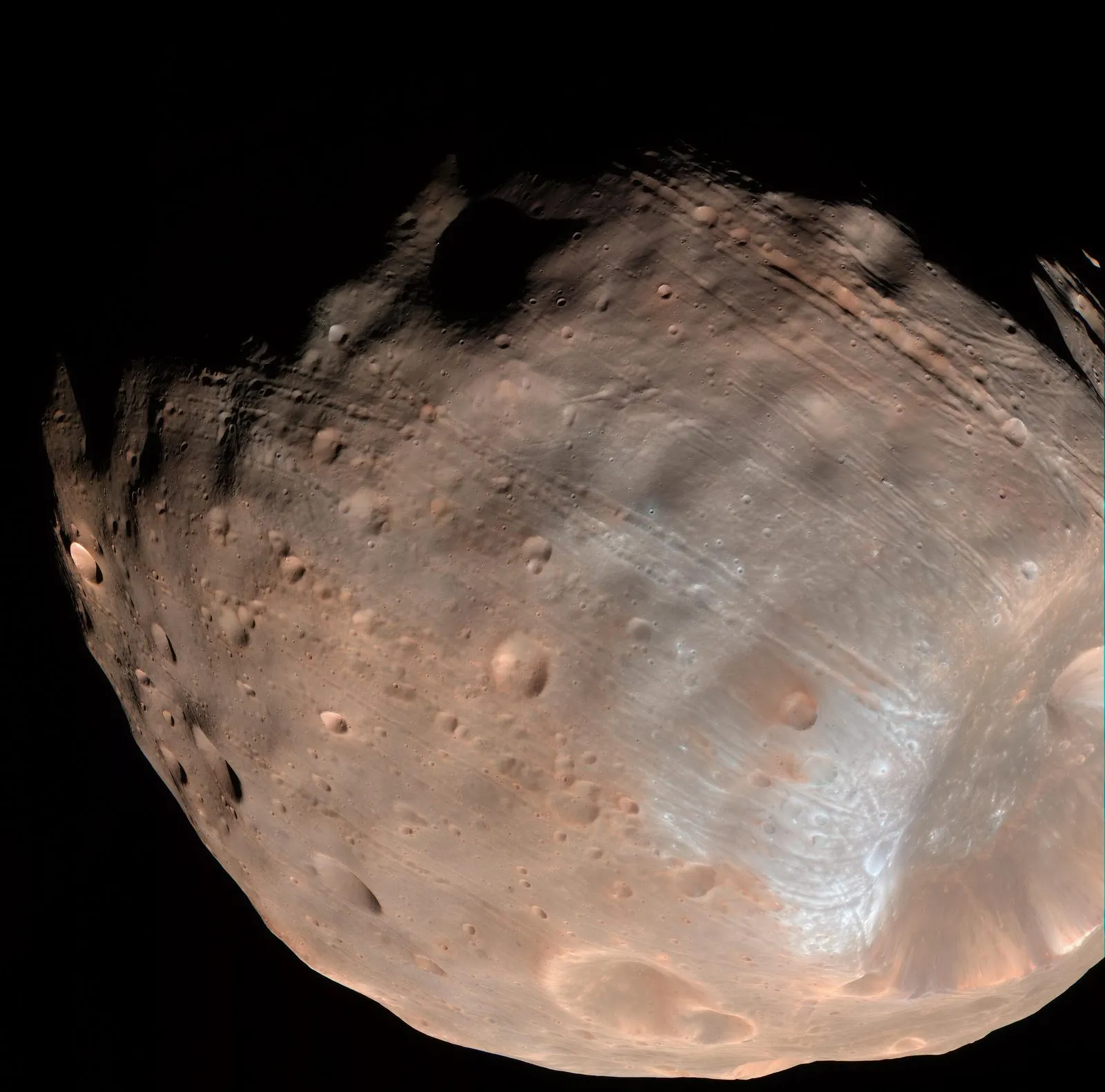 The Martian moon Phobos, a lumpy, potato-shaped body about 22km across, imaged by NASA's Mars Reconnaissance Orbiter.
Credit: NASA/JPL-Caltech/University of Arizona, public domain, via Wikimedia Commons.
A two-rover sampling strategy
Landing on Phobos is no easy task. The moon's gravity is extraordinarily weak — a tiny fraction of Earth's — while it sits right next to the much stronger gravitational pull of Mars. Touching down precisely, and then leaving again, is one of the mission's greatest technical challenges.
MMX carries two independent sampling systems to maximise its chances. A robotic arm will deploy a coring sampler to collect material from below the surface, reaching at least two centimetres down, while a NASA-supplied pneumatic sampler will fire pressurised gas to loft surface dust into a container.
Before the main spacecraft attempts its landing, a small French-German rover called Idefix — built by France's CNES and Germany's DLR and weighing under 30kg — will touch down first to assess the terrain and help scout a safe landing site. The mission also carries seven scientific instruments, including NASA's MEGANE neutron and gamma-ray spectrometer, which will map the moon's composition, while the European Space Agency has supplied deep-space communications hardware and tracking support.
The road home
Before any of that, MMX must first get there. The year-long cruise to the Martian system will be followed by a carefully choreographed arrival in August 2027, after which the spacecraft will spend roughly three years in orbit around Mars — mapping Phobos, studying Deimos from afar and selecting a landing site.
Only then will the riskiest phase begin: the descent to Phobos' surface in its faint gravity, the sampling operations and the departure back toward Earth. If every stage works, the return capsule will parachute into the Woomera desert in South Australia in 2031 — eleven years after the mission was approved — carrying a few grams of another world into the hands of waiting scientists.
A stepping stone to Mars
Beyond the science, MMX is a technology proving ground for humanity's wider ambitions. The mission will test the surface landings, sample collection and long-distance return techniques needed for future exploration of Mars itself — including, eventually, human missions.
"The Martian moon Phobos remains an unexplored frontier," project leaders have said, framing the mission as part of a step-by-step approach to the Red Planet. Success would give Japan a flagship achievement in deep-space exploration and scientists their first laboratory samples of a world beyond the Moon, Mars' neighbourhood and the asteroid belt.
Phobos itself is not expected to last forever: astronomers predict it will continue spiralling inward and eventually either crash into Mars or be torn apart into a ring in around 39 million years. MMX may be humanity's only chance to touch the moon before it is gone.
More coverage of space exploration continues on Verity, including the physics breakthroughs recognised in this year's Nobel prizes and students flying the flag for space science. You can also follow the latest science headlines and learn about our reporting on the about page.