Sixteen days out, the picture is coming into focus
With 16 days until Americans vote on 3 November, the Senate debates of the past few weeks — analysed by the BBC here — have done what debates are supposed to do: they have revealed what this election is actually about. Strip away the spin and three themes keep surfacing — the cost of living, the long shadow of Donald Trump, and a style of political combat that keeps sliding from argument into insult. And hovering over all of it is the race that refuses to debate at all.
Thirty-five Senate seats are in play — 33 regular elections plus two specials, per the Senate's own records — and Democrats need a net gain of four to take the chamber from its current 53-47 Republican hold. It is a steep climb that has suddenly started to look plausible: prediction markets now give Democrats a 62% chance of winning the Senate, according to Kalshi's Senate control market, a remarkable position for the out-of-power party in a midterm year. The debates help explain why.
Theme one: affordability, affordability, affordability
If you watched only one moment from this debate season, make it the Michigan exchange that distilled the entire election into a single question. Democrat Abdul El-Sayed, contesting an open seat against Trump-backed Republican Mike Rogers, turned to the camera and asked voters: "Can you afford your gas? Can you afford your groceries under this guy who's going to rubber stamp everything Donald Trump tells him to rubber stamp?"
It worked because it named the thing voters actually talk about. Across every competitive debate — Michigan, Georgia, Maine — candidates kept circling back to the price of gas, groceries, housing and healthcare. In Georgia, Democrat Jon Ossoff repeatedly pressed Republican Mike Collins to justify his support for Trump's global tariff policies, which Ossoff said had "crushed Georgia families" and "strangled" economic growth. In Maine, where heating oil costs are a visceral winter issue, the Democratic challenger Jackson hammered pocketbook themes while incumbent Susan Collins pointed to the $50bn rural health transformation fund attached to Trump's signature tax-and-spending bill.
Both parties have internalised the lesson, which is why the fights are so bitter: this is the terrain on which the election will be won. Notably, in Michigan, both El-Sayed and Rogers ended up supporting a suspension of the fuel tax — a rare moment of agreement that tells you how completely affordability has captured the agenda. El-Sayed went further, arguing that the Iran war, which has driven up gas prices, needs to end — a striking instance of foreign policy being debated purely through the lens of the petrol pump. For more on the economic backdrop, see our news coverage of the slowing jobs market.
Theme two: the Trump tightrope
The second theme is the one Republican candidates least want to discuss: their relationship with the president. Trump's approval ratings have sagged amid voter anxiety over living costs, and a Reuters analysis found that roughly two-thirds of Republican candidates in competitive House and Senate races have distanced themselves from him on at least some issues — a pattern summarised in recent debate coverage. The debates have become a stage for performing that distance with maximum calibration.
Nobody has walked the line more explicitly than Susan Collins in Maine. Seeking a sixth term in an increasingly difficult race, she has cited her voting record alongside President Biden and her numerous votes against Trump administration positions — a separation so thorough it amounts to running as a check on her own party's president. In Iowa, Congresswoman Ashley Hinson chose the subtler variant: breaking with Trump on a specific policy, the proposed fuel import agreement with Russia, while maintaining broader loyalty. It is distancing as precision surgery rather than amputation.
The strategy is rational — Trump's base remains essential in primaries and turnout, while his unpopularity is toxic with swing voters — but it carries a visible cost. Every calibrated break invites the question of what the candidate actually believes, and Democrats have been happy to ask it. Ossoff's taunt in Georgia — "Let's see if he has the courage to explain his votes" — was aimed as much at the tightrope as at the tariffs. Our politics section has tracked how Republicans are walking this tightrope across the map.
Theme three: when argument becomes insult
The third theme is the least edifying. Again and again, debates that began on policy have collapsed into personal combat. In Michigan, Rogers questioned whether relatives of El-Sayed — who would become the first Muslim senator if elected — might be on a watchlist, in one of the debate season's ugliest exchanges. El-Sayed responded by calling Rogers weak and dependent on the Trump administration. In Georgia, Ossoff and Collins traded insults in an argument that began, of all things, over data centre developers; pressed over social media posts by his son-in-law, Collins said he condemned racism, antisemitism and hate "regardless of source."
There is a temptation to dismiss this as the background noise of modern campaigning. That would be a mistake. The personal turn is doing real work: it crowds out the policy argument, it energises the already-converted, and it makes the debates unwatchable for the persuadable voters both sides claim to want. When Rogers called El-Sayed "bought off" by billionaire George Soros, Hamas and Hezbollah — "We cannot afford Abdul, and we cannot risk his ideology" — he was not making an argument about the Senate. He was making an argument about who belongs in American public life. That is a darker current than the affordability debate, and it is flowing strongly.
The debate that never happened
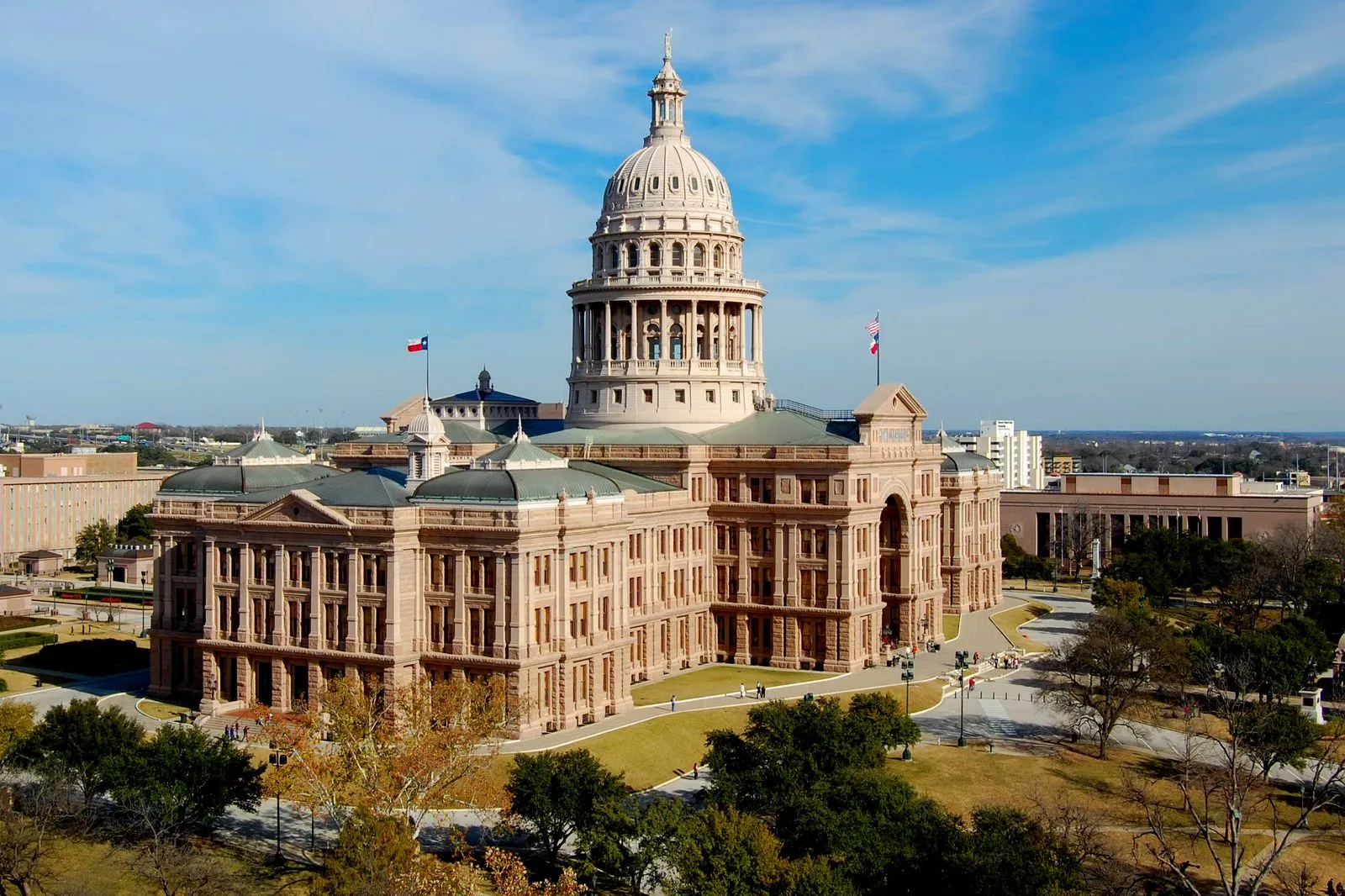
The Texas State Capitol building in Austin, Texas.
LoneStarMike / Wikimedia Commons (CC BY 3.0)
Which brings us to Texas — the most important Senate race in the country, and the one with no debate at all. Of the 35 seats being contested, 21 have no debates scheduled between the main candidates, according to ABC News — a striking democratic deficit documented here. The absence is most glaring in Texas, where Democrat James Talarico has accepted four invitations and Republican Ken Paxton has accepted none, despite his campaign saying in July that he would participate and despite Trump himself urging a debate.
Paxton's calculation is not mysterious. Polls suggest Talarico could win in the Republican-leaning state — a result that would go a long way toward the four Democratic gains needed for a majority — and Paxton, the state attorney general, has more to lose from 90 unscripted minutes than to gain. But the refusal is itself a statement about the state of democratic accountability: the frontrunner in the bellwether race has decided that facing his opponent is optional. Talarico has tried to turn the empty chair into a character issue. Whether voters punish the absence or simply shrug will be one of the most instructive results of the night.
What to watch on election night
So what should you watch for on 3 November? Start with the math: Democrats need four net gains, and the path runs through a specific sequence of states. Early signals will come from races where the debates gave Democrats momentum — Michigan, where El-Sayed's affordability framing landed cleanly, and Maine, where Collins's survival strategy is being tested. Then the late deciders: Texas, where the no-debate gamble meets the voters, and the specials in Ohio and Florida.
Analysts are split on how the night ends. Bob Cusack, executive editor of the Washington Examiner, told a recent No Labels briefing that Democrats were favoured to flip the House and had roughly a 60% chance of taking the Senate — arguing that Trump's low approval, the Iran war's effect on prices, and affordability concerns had created a brutal environment for Republicans even in once-safe states. Cusack also offered the counterfactual that defines the Republican lament: without the Iran war's drag on gas prices and inflation, he estimated, the party would have about a 65% chance of holding the Senate.
That is the debate season's real lesson, and it is an ironic one. For all the shouting about watchlists and data centres, the election is likely to be decided by the price at the pump — the one subject on which every debate, in every state, kept landing. The candidates spent weeks telling us what mattered. On 3 November, voters will tell us whether they were listening. Follow our continuing opinion coverage through election night, and read about Verity's mission on our about page.