Nikon has disqualified the winner of its 2026 Small World in Motion competition after ruling that the prize-winning microscopy video was produced with generative artificial intelligence — a decision that closes one of the most heated rows to hit the world of scientific imaging this year.
The winning entry, submitted by Dr Ning Xu of Tsinghua University in China, purported to show the "abnormal beating of airway cilia from a child with primary ciliary dyskinesia (PCD)" — a genetic disorder affecting respiratory function. The short film, vividly colourised, beat 346 other entries from 40 countries to take the $3,000 (£2,250) first prize, according to the BBC, which first reported the backlash from the microscopy community.
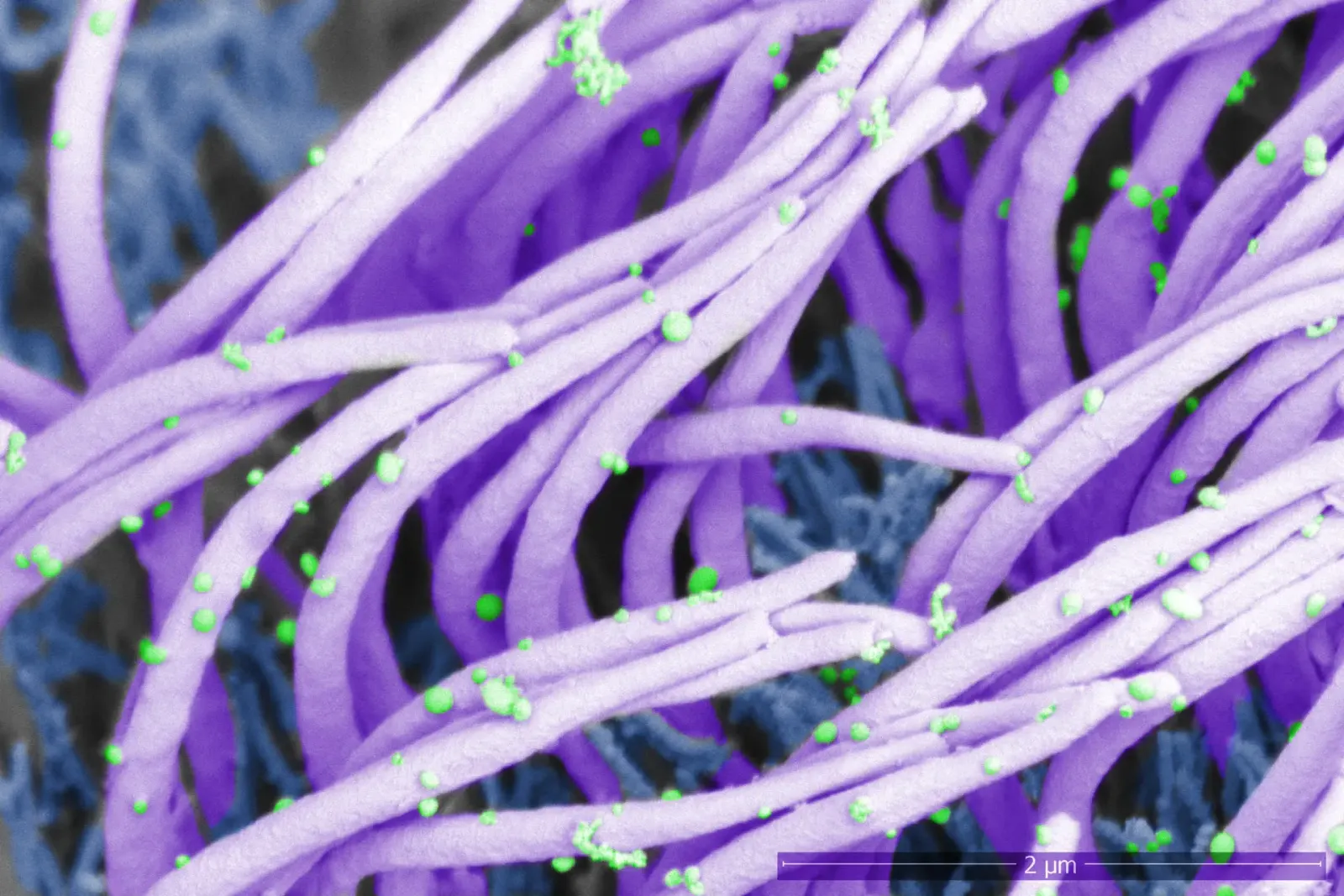 Scanning electron micrograph of cilia on human nasal epithelium
Credit: Phage1990, via Wikimedia Commons (CC BY 4.0)
That backlash has now forced Nikon's hand. The camera company confirmed it had concluded the video was AI-generated, stripping Xu of the win and announcing a review of the rules governing the contest, which has been running in various forms for more than 50 years. The ruling makes the Small World dispute the most prominent example yet of how generative AI is testing the integrity of scientific competitions.
How the row began
The trouble started almost as soon as the winner was announced. Scientists watching the video spotted things they said did not add up. The tiny hair-like structures called cilia appeared too large for their supposed subject. Nuclei seemed to behave in ways "that do not occur in biology." Structures seemed to disappear and reappear between frames.
Edward Phelps, an associate professor at Florida University, commented on Nikon's social-media post that some structures "pop in and out of existence" and that the cilia "appear from nowhere." Then Ian Donovan, an MD/PhD student at UT Southwestern Medical Center, said he had run the video through Google Gemini and detected an invisible Google SynthID watermark — the kind of hidden marker indicating at least some of the footage had been AI-generated.
The criticism snowballed. PetaPixel's report documented growing unease across the microscopy community, while USA Today reported that researchers including Valentin Dunsing-Eichenauer of the Berlin-based research company Der Simulierte Mensch accused Xu of misusing AI in bioimage post-processing. Dr Robert Hirst, who leads NHS diagnosis for primary ciliary dyskinesia, and two former competition judges also raised concerns, lending clinical and institutional weight to the complaints.
What the winner said in his defence
Xu has consistently denied cheating. He did not respond to the BBC's request for comment, but posted online defending the entry — though those LinkedIn comments, and later his entire LinkedIn profile, disappeared.
In his public statements, Xu did not dispute that AI had been involved in processing the video, but insisted it had been used only on already-captured data. "AI was not used to generate the experimental movie, the cilia, or their motion," he wrote, adding that it was applied "to distinguish and visualize features in the reconstructed grayscale images."
Colourisation is common — and permitted — in microscopy, where samples are often stained and dyed to make structures visible. The competition's rules do allow some forms of AI-assisted processing. The dispute hinged on where processing ends and generation begins: whether AI merely revealed details already present in the raw video, or fabricated features that had never been captured by the microscope at all.
That distinction mattered to Nikon. Its rules state plainly that "AI-generated videos are not permitted." Scientists argued the issue could be settled quickly if Xu shared his raw grayscale video; he instead supplied "detailed technical documentation outlining the microscopy equipment, imaging methods, and processing techniques used." Nikon initially said Xu was "respectfully complying" with its review and that it did not see any rule violation — before its latest assessment reversed that position.
Why it matters beyond one prize
For the people who enter these contests, the money is almost beside the point. Dr Patrick Hickey, who placed fifth in the 2026 competition for a video of mitochondria and chloroplasts in turtle vine leaf cells, told reporters that "if you spend a lot of your time in a dark room looking down a microscope, it's really nice to be able to show people and to show the public." The prize, he said, was the recognition — "there's an interesting fusion between science and art."
That fusion is precisely what AI generation threatens. If viewers cannot trust that what they are seeing was actually captured through a microscope, the contest stops being a celebration of the microscopic world and becomes just another gallery of synthetic imagery. Sarah Goetz, a scientist commenting on the row, put it bluntly: "If it's AI... there is something profoundly cynical and sad about using synthetic images to cheat in a contest that is supposed to be about how beautiful and cool biology is."
The affair also exposes how thin the line has become between legitimate enhancement and impermissible fabrication. Modern microscopy already involves extensive processing — deconvolution, denoising, colour mapping — and AI tools are increasingly embedded in that workflow. Drawing the line between "AI-assisted" and "AI-generated" is becoming a definitional problem for every scientific imaging competition, and Nikon's published competition rules are now due for a rewrite.
A wider pattern of AI trust crises
The Small World row is one episode in a broader reckoning over synthetic media. In our technology coverage we have tracked everything from Italy's move to trademark politicians' voices against AI deepfakes to the safety rows over chatbots that recently saw OpenAI researchers fired over mishandled information. Each case asks the same underlying question: in a world of convincing synthetic content, how do we verify what is real?
Scientific institutions are beginning to answer with process. Requiring raw data alongside entries — the step scientists demanded of Xu — is one obvious safeguard. Another is the use of provenance technology, such as invisible watermarks like SynthID, which ironically helped expose this case in the first place.
What comes next for the competition
Nikon says it will review the rules of the contest ahead of future editions. The 2026 competition received 347 entries from 40 countries, and entry for the next edition runs through 30 April 2027, according to current timelines. Observers expect stricter guidelines on AI processing, mandatory raw-data submission, and clearer definitions of what counts as generation versus enhancement.
For Dr Xu, the episode is a professional catastrophe: a career-making prize turned into an international cautionary tale. For the microscopy community, it is a reminder that in science, the beauty of an image is inseparable from its honesty.
Readers can follow our science coverage in the science section, browse the latest stories on our homepage, or learn more about our reporting standards on the about page.