Two nights of disruption
For two evenings in a row, Jersey Airport could not bring its late flights home. Unauthorised drones entered restricted airspace around the airfield on Friday, October 30, and again on Saturday, October 31, forcing controllers to stop inbound aircraft from landing. Flights were diverted back to the United Kingdom, one was sent to Paris, and others were cancelled outright.
The first report came in at about 8:20 p.m. on Friday, and drone activity continued until about 10:30 p.m., according to States of Jersey Police. Three inbound flights from the United Kingdom were turned back: a Loganair service from Southampton, a British Airways service from London Heathrow and an easyJet service from London Gatwick. The easyJet aircraft later landed in Jersey at about 11:45 p.m., after the airport stayed open late.
Saturday brought a repeat. At 8:05 p.m., Jersey Airport reported disruption affecting inbound flights as a result of further drone activity in the vicinity of the airfield. The airport later confirmed that four flights were not able to land as scheduled. A charter flight from Madeira was diverted to Paris Charles de Gaulle. Loganair's 8:30 p.m. flight from Southampton was cancelled, and London services were cancelled or heavily delayed. One British Airways flight from Heathrow, BA1356, was forced to return to London, according to flight tracking data reported by Metro.
Inspector Rob McCallum told the BBC that police believed two or three drones had entered restricted airspace on Saturday, and that the activity was not thought to be linked to terrorism. No operator had been identified when the latest reports were published, and there were no reports of disruption on Sunday evening.
Passengers left stranded
Behind the flight numbers were people whose plans fell apart. Pacific Basirwe went to the terminal to welcome his wife and young son arriving from London Heathrow, only to learn the flight would not come. He told the BBC the repeated incidents were frustrating and that those responsible should be prosecuted, saying the situation should be regulated and that it had now happened two days in a row.
Jersey RFC, the island's rugby club, also felt the impact. The team's flight home from Southampton was cancelled after the aircraft had taxied and then returned to the stand, where it remained for several hours before the cancellation was confirmed at around 9:30 p.m. The club said the disruption would cost it thousands and thousands of pounds, including unexpected hotel expenses.
Taxi drivers waiting at the airport told the BBC they were frustrated too. For an island community, the airport is not one travel option among many. It is a lifeline for business, healthcare, family visits and holidays. When evening arrivals stop, there is no late train or alternative route to fall back on. Passengers were left to rebook, wait for the next available service or find a hotel for the night, while airlines arranged alternative travel directly with those affected.
The timing added to the frustration. The disruption fell during the half term holiday period, when families were travelling, and it struck the same evening pattern twice. A single night of drone sightings can be dismissed as a reckless individual. Two nights in a row looks deliberate, and that is how Jersey's government described it.
A deliberate and unlawful act
Senator Lyndon Farnham, Jersey's chief minister, condemned what he called the deliberate and unlawful operation of drones in the vicinity of Jersey Airport over the past two evenings. He said the government was treating the incidents with the utmost seriousness and was working closely with UK authorities and specialist agencies to explore additional operational support, enhanced detection capability and counter-drone technology.
"Operating a drone close to an airport is not a prank or a harmless hobby," Farnham said. "It puts public safety at risk, disrupts critical transport infrastructure and can have significant consequences for hundreds of travellers and businesses. To those responsible, the message is clear: if you are identified, you should expect to face the full consequences of the law."
The response on the ground involved States of Jersey Police, the Honorary Police, Channel Islands Air Search, the Government of Jersey and Ports of Jersey staff. Searches were carried out in the west of the island, including St Peter, La Pulente, Watersplash, El Tico, L'Etacq and Jubilee Hill. Police appealed for dashcam, doorbell, CCTV and mobile phone footage, and asked anyone who sees a drone being flown near the airport to call 999, noting the location and any vehicle details, rather than approaching the operator.
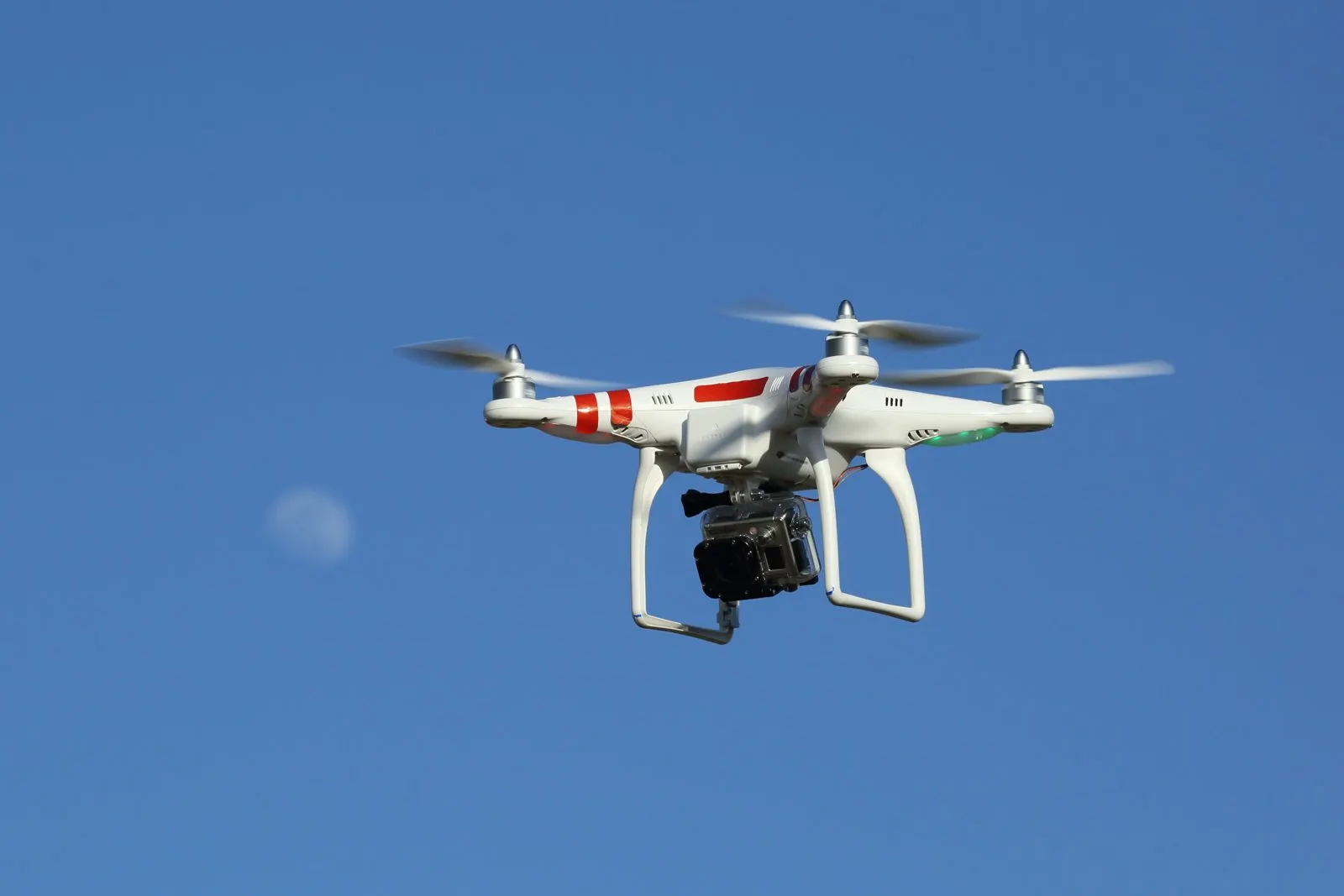 A quadcopter drone with a camera mounted underneath
Illustrative image of a camera drone. Source: Wikimedia Commons.
Later reporting said the Royal Air Force had deployed to Jersey under a Military Aid to Civil Authorities request, with the Department for Transport leading counter-drone measures. That step underlines how seriously the disruption was taken, even though no drone operator had been found and no device had been recovered when reports were published.
Readers following aviation and transport stories can find more in our Technology coverage and our News coverage, while our World coverage carries the wider picture on drone incidents elsewhere.
Calls for severe deterrents
With no arrests announced, attention has turned to what should happen to whoever is responsible, and how to stop a third night. Residents have called for severe deterrents, according to BBC reporting on the follow-up to the incidents. The demand reflects a sense that the existing rules, however strict on paper, only work if offenders believe they will be caught and punished.
Jersey has its own aviation rules. Under the Air Navigation (Jersey) Law 2014, drone pilots may not fly within an aerodrome traffic zone without permission from air traffic control. Anyone found to have endangered the safety of an aircraft could face a fine or up to five years in prison. In the United Kingdom, endangering an aircraft in flight carries a maximum sentence of five years under the Air Navigation Order 2016, and police can require a drone to be landed, seize the device and issue fixed penalty notices for certain offences.
Those penalties are severe already. The problem is enforcement. A small drone at night is hard to see, harder to track and easy to pack away before officers arrive. That gap is why residents are asking not just for punishment after the fact, but for deterrents that work beforehand: better detection, faster response and a realistic prospect of being identified. Counter-drone technology, from radar and radio frequency sensors to cameras and jamming systems, is designed to close that gap, but it is expensive, needs trained operators and must be used without interfering with legitimate airport systems.
For context on the official rules, see the UK Civil Aviation Authority and the UK National Cyber Security Centre. Our recent coverage of security and infrastructure includes Gaza strikes leave eight killed, hospitals say and Neocloud firms face AI bubble debt fears.
Why a small drone stops a whole airport
To people on the ground, stopping all flights for a drone that may weigh less than a bag of sugar can seem like an overreaction. To pilots and controllers, it is the only safe choice. An aircraft on final approach is low, slow and has very little room to manoeuvre. A collision with a drone could damage an engine, crack a cockpit window or injure someone on board. Until controllers are sure the airspace is clear, they cannot safely let aircraft land, and aircraft circling overhead quickly burn through their spare fuel and must divert.
The most famous example is Gatwick Airport in December 2018, when reported drone sightings shut the airport on and off for three days, affecting about 1,000 flights and roughly 140,000 passengers. No operator was ever successfully prosecuted over that incident, and the memory of it shapes every airport's response today. Caution is cheaper than a collision, but it hands a small number of reckless operators the power to disrupt thousands of people.
That is the dilemma Jersey now faces. Doing nothing risks safety. Stopping flights protects safety but rewards the disruption. The long term answer lies in detection and identification: knowing quickly where a drone is, where it came from and who is flying it, so that flights can resume sooner and offenders can be prosecuted. Until that capability is in place, the island's best defence is the public. Police have asked residents in western Jersey to check their recordings from Friday evening and to report anything unusual, including vehicles, take-offs or landings.
For readers interested in how island communities handle transport shocks, our Business coverage looks at the cost of disruption to local firms, and our Politics coverage follows government responses to infrastructure threats.
What happens next
The police investigation continues, and Jersey's government says it is exploring enhanced detection and counter-drone technology with UK authorities. No new equipment or start date had been announced when the latest reports were published, and no operator had been identified. Passengers travelling through Jersey Airport have been advised to check with their airlines before travelling.
The incident also raises a question that goes beyond one island. Drone use keeps growing, for photography, farming, delivery trials and recreation, while the rules and the enforcement tools struggle to keep up. Most drone pilots fly responsibly. The Jersey incidents show how much damage a small minority can do, and how quickly public patience runs out when the same disruption happens twice.
If those responsible are caught, they will face a court that can impose a fine or a prison sentence of up to five years for endangering an aircraft. If they are not, the calls for severe deterrents will only grow louder, and the pressure to install detection systems at smaller airports will grow with them. Either way, Jersey's two lost evenings have become a test case for how a small island protects the air link it depends on. Follow developments on our homepage, and learn more about our coverage on our about page.
Further reporting
The BBC's original report on the disruption is published at BBC News. Further reporting on the same incidents includes DroneLife's account of the two nights, Gulf News' report on stranded passengers and sUAS News on the military assistance request.