Apple has told shoppers and investors that it does not know when supply of its first foldable iPhone will catch up with demand, a warning that lands right in the middle of the Christmas shopping season. The device, called the iPhone Duo, went on sale in late October and sold through its early stock quickly. Buyers placing new orders online have since been shown delivery dates in January, according to reports on Apple's store listings.
The message from Apple is blunt in its uncertainty. Chief executive John Ternus said the phone is constrained at present and that the company is working hard to get it to as many customers as quickly as possible, but that it is not able to predict when supply and demand will be in balance. That single admission matters because Christmas is a hard deadline for gift buyers. A phone promised for January is, for many shoppers, a different purchase from a phone promised before 25 December.
For readers following the wider technology market, the story is also a reminder of how a launch can succeed and still disappoint. Strong demand is good news for a manufacturer. It becomes a problem when the factory ramp, the parts supply and the store stock cannot keep pace, and when every new order pushes the queue further out.
A launch that sold out fast
The iPhone Duo is Apple's most expensive smartphone, priced at 1,999 dollars in the United States. Reports on the launch say pre-orders opened on 16 October and sold out within minutes, with online delivery estimates moving to late January for later buyers. The phone reached stores on 23 October, but walk-in stock was also reported to be very tight.
Apple itself described pre-order demand as extraordinary, according to reporting of a company statement. That demand is easy to understand. The Duo is Apple's first folding phone, a product category rivals have sold for years, and it arrived after a long wait from Apple customers who wanted a larger screen that still folds down to pocket size. Reports describe a 5.4 inch outer screen and a 7.6 inch inner display, although Apple buyers should check the official specification for their own market before ordering.
The BBC report on the shortage sits alongside a wider set of earnings coverage. One summary of the earnings call notes that Ternus told Reuters the Duo is supply constrained with no end date, and that new orders show January delivery estimates. Another report on the shortage records the same warning and notes that Apple cited component shortages and rising production costs.
For shoppers, the practical point is simple. If the online store shows January, that date is the working plan unless Apple pulls it forward. Store pickup may offer a faster route in some places, but reports suggest that route has also been tight, and Apple has not promised December availability for new online orders.
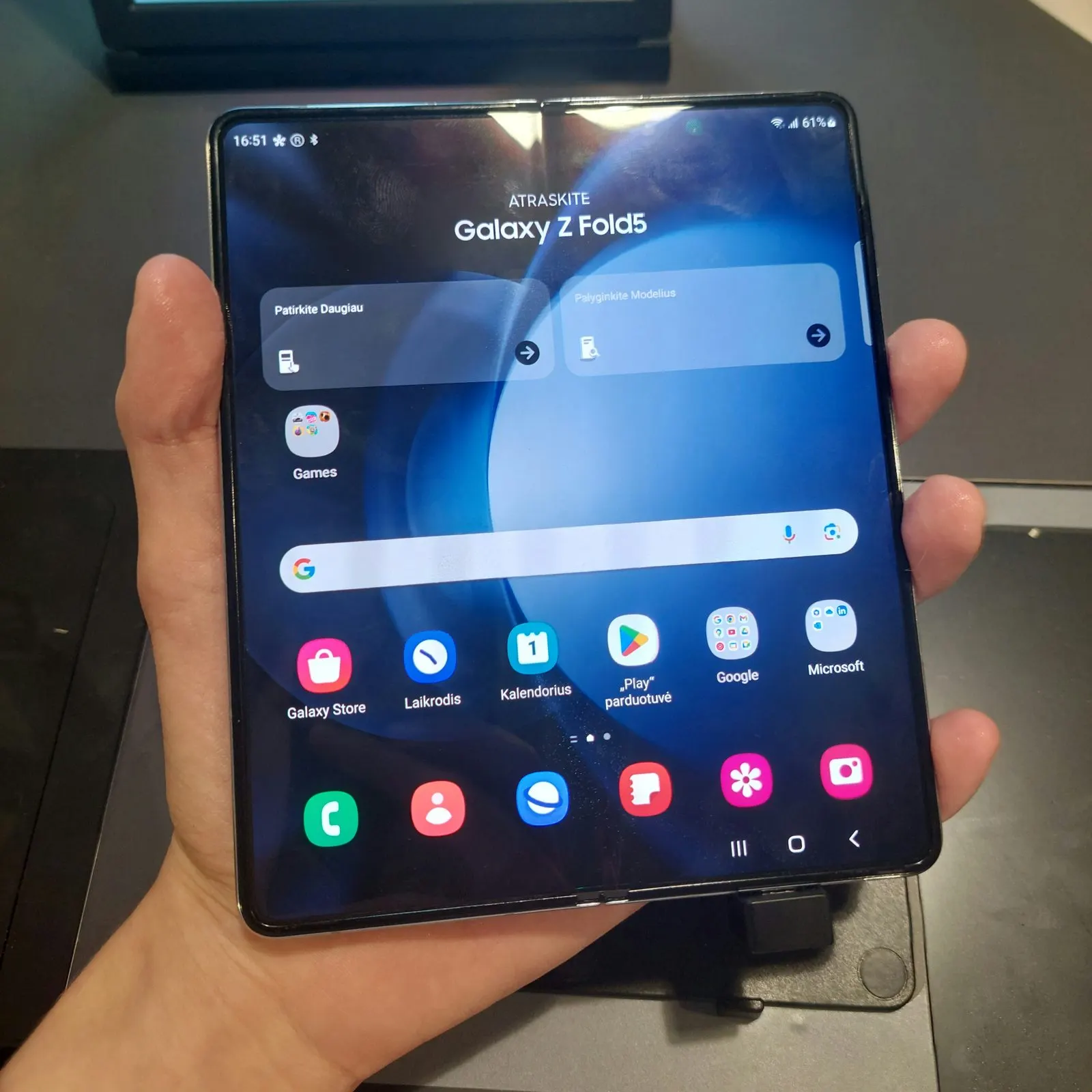 A foldable smartphone shown partly folded on a plain background. Illustrative image, not the Apple iPhone Duo.
Credit: Vasonesiku, Wikimedia Commons, CC BY-SA 4.0. Illustrative image of a foldable phone, not an Apple product.
Why Apple cannot give a date
Supply problems rarely have a single cause, and Apple has pointed to more than one pressure. Ternus highlighted rising component prices, particularly memory chips, and described the increase in memory costs as unprecedented. The reason, as reported, is growing competition for semiconductor resources as artificial intelligence companies expand their data centre infrastructure. In plain terms, many buyers want the same scarce parts at the same time.
Chief operating officer Sabih Khan added a second strand. He said the company was prioritising deliveries to customers despite production difficulties, and explained that most Apple devices continued to face supply restrictions, partly because of limited access to advanced microprocessors. Apple relies heavily on Taiwan-based TSMC for production of advanced chips, according to the same reporting, which makes any bottleneck at that end of the chain hard to work around quickly.
The Duo also faced an early manufacturing question. Apple said a very small percentage of units had been returned after reports of cracking along the inside fold, and that it is replacing affected devices. That issue, on the reported scale, does not by itself explain a months-long backlog. It does add to the pressure on a new production line that was already ramping up, because replacement units, quality checks and customer confidence all draw on the same limited early output.
None of this means Apple has stopped making the phone. Ternus said the production ramp is going well. The problem is the gap between a ramp that is going well and demand that is running ahead of it. Until the weekly output rises above the weekly order rate for a sustained period, the backlog will not clear, and Apple is not willing to name the week when that happens.
What this means for Christmas buyers
For a buyer who wants a Duo under the tree, the options are now narrow. Ordering online, on current reported estimates, points to January. Checking store pickup availability may help in some locations, but it is not a guarantee, and stock can change during the day. Waiting is also a choice, but waiting carries its own risk if the January date slips further.
That choice will feel different for different buyers. Someone replacing a broken phone may settle for another model that is in stock. Someone buying a specific gift may prefer to wait, or to buy a different present and order the Duo for the new year. Retailers and carriers may hold separate stock from Apple's own store, so it is worth checking those channels, while remembering that reported shortages have affected the wider market, not only one storefront.
Shoppers should also watch the price of the wider market. When a popular device is scarce, resale listings can appear at prices well above the official price. Reports on the Duo launch noted resale listings far above 1,999 dollars. Paying a large premium to a reseller brings risks around warranty, returns and authenticity that do not apply to a direct purchase, and buyers should weigh those risks before paying over the odds.
The homepage carries the latest coverage across categories for readers tracking holiday shopping stories, while our business section follows the earnings and supply chain effects in more detail.
Macs and iPads face pressure too
The shortage is not limited to the folding phone. On the earnings call, Khan said that for the December quarter Apple expects constraints on Mac and iPad, primarily driven by memory, as demand has been higher than expected. That warning matters for Christmas buyers of laptops and tablets as well as phones, because it suggests the same memory squeeze could affect delivery times across the range.
Apple also warned that memory prices will keep rising into 2027, according to the earnings summary, and it expects its gross margin to fall to between 45 percent and 46 percent, mostly because of memory costs. For buyers, that could mean less discounting, or slower restocking, in the months ahead. For investors, it is a sign that even a company with Apple's buying power cannot fully insulate itself from a tight component market.
The wider world economy story is relevant here too. Memory is used in phones, computers, servers and cars, and demand from artificial intelligence infrastructure has added a large new buyer to a market that was already cyclical. When one large buyer class expands fast, prices rise and smaller allocations follow, and consumer devices feel the effect first at launch time, when demand is highest.
A strong quarter, before the Duo arrived
It is important to place the shortage in its financial context. Apple reported a September quarter record of 114.5 billion dollars in revenue, up 12 percent, for the three months ending 26 September. IPhone revenue reached 57.6 billion dollars, up from 49.0 billion dollars a year earlier, and services hit a record 31.6 billion dollars, according to the company's filing as reported.
Those figures do not include the Duo, because the phone went on sale after the quarter closed. That detail matters for two reasons. First, it means the record quarter was achieved without the new folding phone, which shows the strength of the existing range. Second, it means the Duo's contribution, and its shortage, will show up in the December quarter instead, which Apple expects to be its best revenue quarter ever, with growth of 7 percent to 10 percent.
Ternus presented these results in his first financial results since taking over from Tim Cook. Reports note that Cook's successor took over on 1 September, and that the Duo was unveiled at Ternus's first keynote as chief executive on 9 September. The shortage is therefore an early test for the new leadership: a popular product, a tight supply chain, and a Christmas deadline that cannot be moved.
Readers who want background on the company can find it on our about page, and our news section covers the wider consumer impact of supply shortages.
What to watch next
Three signals will show whether the position is improving. The first is the online delivery estimate. If January dates start pulling forward week by week, the ramp is catching up. If they stay fixed or slip, the backlog is still growing. The second is store availability. A steadier flow of pickup slots would suggest production is stabilising, even if online dates lag. The third is Apple's next update on memory costs and on Mac and iPad supply, which will show whether the December quarter warning was cautious or the start of a longer squeeze.
Analysts quoted in launch coverage have suggested Duo shipments could grow sharply next year, with one estimate pointing to growth of about 70 percent and a leading share of the foldable market. Those are projections, not promises, and they depend on the same supply chain that is constrained now. They do, however, explain why Apple is unlikely to treat the Duo as a one-off experiment. A folding phone that sells out in minutes is a product line worth scaling, even if scaling it takes months.
For now, the honest answer for Christmas shoppers is the one Apple gave: the company cannot say when supply and demand will balance. That is frustrating for buyers, but it is more useful than a date that later slips. Shoppers who need a phone before Christmas should plan around a device that is actually in stock. Shoppers who specifically want the Duo should plan around January, and check the store estimate again before paying, because in a fast-moving launch, the estimate is the closest thing to a promise Apple is willing to give.
One earlier report on pre-order demand noted that every model was listed as shipping in late January, while a further launch report recorded the same January pattern across configurations. Together with Apple's own warning, the picture is consistent: demand outran supply at launch, and Christmas buyers face a wait.