The blast at Wainwright
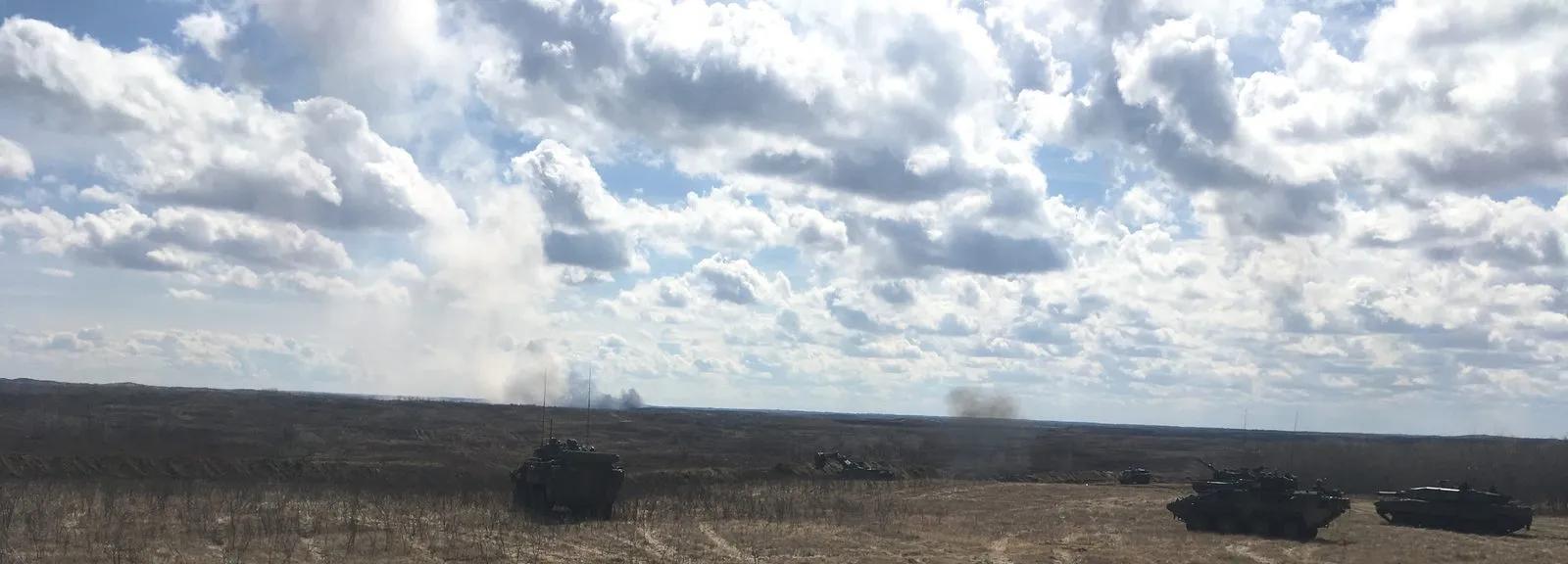
One of the deadliest incidents in recent Canadian military history unfolded on Saturday afternoon at Canadian Forces Base Wainwright, one of the country's busiest training installations, when an explosion ripped through the base's training area during a live-fire exercise.
Multiple military sources told Global News that at least seven people were killed and dozens more injured when the exercise struck a natural gas line or well at around 16:00 local time, triggering a blast that ignited a massive fire. The Canadian Armed Forces have not officially confirmed the cause, and the death toll remains unconfirmed by the authorities — a caveat that matters, because no official casualty figure had been released even as emergency crews worked through the night.
What is confirmed is that there were both fatalities and injuries. "I'm saddened to share that there have been both fatalities and injuries as a result of an incident on the base," Defence Minister David McGuinty told reporters on Saturday. The defence department added that there were no indications of terrorist activity.
A fire fanned by fierce winds
The explosion was only the beginning. Gusts of up to 100 km/h seized the flames and drove them rapidly across the training grounds and, within hours, beyond the base's own perimeter fence into the surrounding rural area, the Municipal District of Wainwright said. Follow our News coverage as the emergency response continues.
Firefighters from several jurisdictions joined the effort to contain the blaze, which raged through the evening before crews managed to bring it under control. The fire started inside the base's training area at around 4 p.m. local time and crossed the fence roughly three hours later, local authorities said.
The base sits about 200 kilometres southeast of Edmonton, and the speed with which the fire spread left emergency planners racing to move casualties to hospitals further afield.
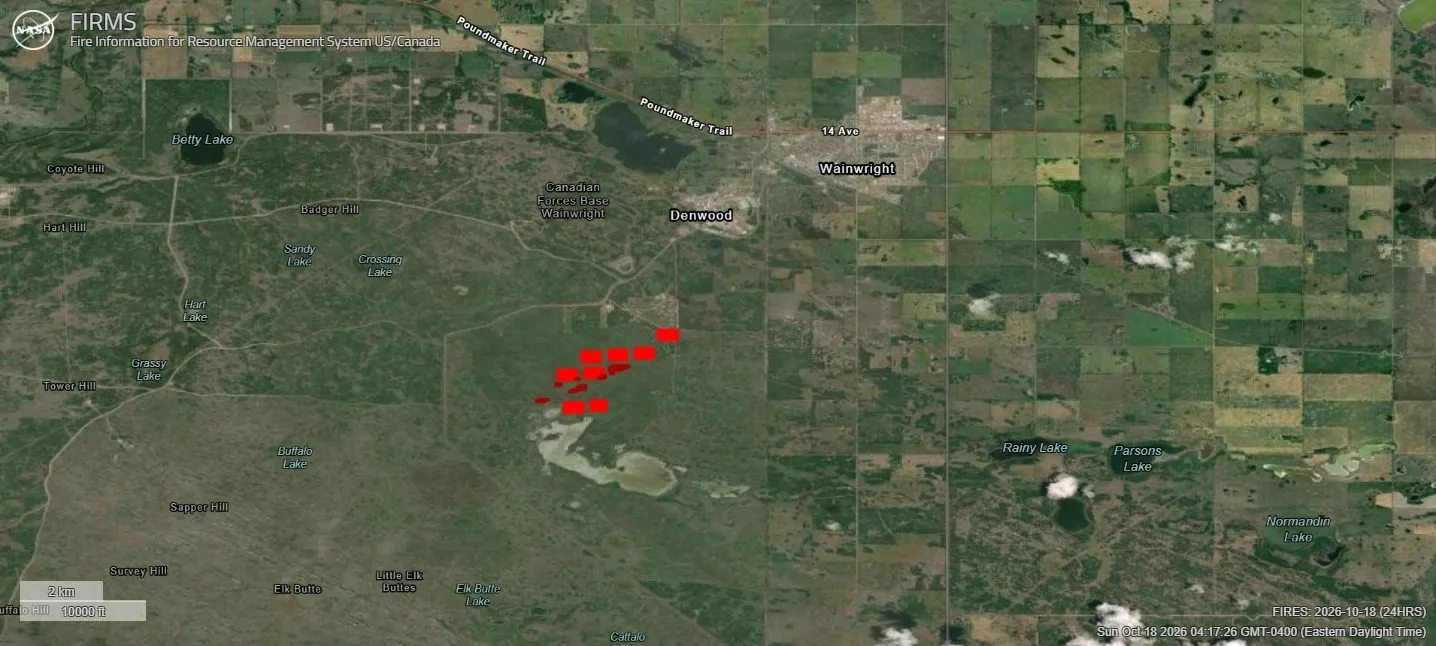 NASA FIRMS satellite fire-detection map showing hotspots from the blaze at CFB Wainwright on 17-18 October 2026
Image: NASA FIRMS (public domain), uploaded 18 October 2026
Hospitals overwhelmed
The scale of the casualties quickly swamped local medical facilities. Hospitals in Edmonton, around 180 kilometres from the base, activated a Code Orange mass-casualty protocol to cope with the influx of patients, and the public was urged to avoid emergency departments unless absolutely necessary.
Dr Warren Thirsk, an emergency physician at Edmonton's Royal Alexandra Hospital, told the CBC that facilities around Wainwright had been "completely overwhelmed" by the number of people needing care. "It is more patients than any of us want to count right now. It's a disaster. It's a one in every 15 to 25-year disaster," he said.
"This number of patients would overwhelm the city of Edmonton," he added, describing a scene in which ambulances and medical helicopters ferried the injured from the base to hospitals across the city.
Ambulances also converged on Wainwright High School, where a staging area was reportedly set up, according to local eyewitness accounts — though authorities had not confirmed that detail at the time of writing. The Times reported that medical facilities near the base were completely overwhelmed by the number of patients requiring care.
What officials are saying
Prime Minister Mark Carney described the episode as a "serious incident creating a major fire", writing on social media that his thoughts were with "all the brave women and men affected".
McGuinty, the defence minister, said he "cannot recall an incident like this in recent memory" and called the situation "very, very active and delicate", promising more information "in the coming hours and days". The chief of the defence staff, General Jennie Carignan, described it as a "profoundly difficult moment" for the armed forces.
Alberta Premier Danielle Smith called the fire "significant and tragic", saying it was affecting many military personnel, while the mayor of Wainwright, Bruce Pugh, said it had been a "heavy day" for the town and described the incident as likely the largest mass-casualty event the community had ever seen. The premiers of Saskatchewan and British Columbia, Scott Moe and David Eby, offered resources and support, and opposition Conservative leader Pierre Poilievre said he had spoken to Carney and McGuinty to offer his backing.
The Canadian Armed Forces, working with federal, provincial and local authorities, said they were coordinating the emergency response and investigating how the incident began. Canada's military accountability procedures will be under scrutiny in the days ahead, much as they were when a shooting at Fort Hood drew international attention to base safety in the United States.
Canada's busiest live-fire base
CFB Wainwright is described by the CBC as the "principal base for live fire training exercises" in Canada, and it was a hive of activity on the day of the disaster. On a typical day, around 690 military personnel and some 300 civilian workers are on site, the broadcaster said, though it was not immediately clear how many were present when the explosion occurred.
In a dramatic sign of how stretched the response was, footage shared by Global News correspondent Jeff Semple showed more than a dozen Royal Canadian Air Force personnel parachuting into the base on Saturday night to join the response — a measure of the emergency's severity reported by the New York Post.
The town of Wainwright itself, home to about 7,000 residents, has rarely seen anything like it. Al Jazeera's reporting noted that local authorities were working alongside the military as the response stretched into Sunday.
Investigation and unanswered questions
With the fire contained and the wounded in hospital, the hardest questions are only beginning. Why did a training exercise intersect with a gas line or well? What safety procedures governed the range that day? And why has the official casualty count still not been released?
The defence department has said only that there are no indications of terrorist activity and that the situation remains delicate. Ynet's account, citing the same military sources, described winds reaching 100 km/h that carried the fire past the base's fences — a reminder that even a contained range can become uncontrollable in extreme weather.
For now, Canada's military community is in mourning, and a country unaccustomed to peacetime disasters of this scale is waiting for answers. See Verity's homepage and our World section for updates as the investigation develops.