Every autumn, British politics holds its breath for a single speech. On 28 October, John Healey will stand at the despatch box and deliver his first Budget as Chancellor — Labour's first Budget of this parliament, and, by most accounts, one of the most tightly constrained fiscal statements in living memory. This is an explainer of what the Budget actually is, an analysis of what Healey can plausibly do within his constraints, and a guide to what to watch for on the day. More of our opinion and analysis is published daily.
What the Budget actually is
Strip away the theatre — the red box, the posed photographs, the frantic briefing wars — and the Budget is a mechanism. Once a year, the Chancellor tells Parliament how the government will raise money and where it will spend it. The Treasury publishes line-by-line costings of every measure. Alongside it, the independent Office for Budget Responsibility publishes its verdict on the economy: growth forecasts, borrowing projections and, crucially, whether the Chancellor is on course to meet his own fiscal rules.
Those rules are the invisible architecture of every Budget. Set by former chancellor Rachel Reeves and retained by the new leadership, they require no borrowing for day-to-day spending by the end of this parliament, and public debt falling as a share of national income over the same horizon. The gap between the forecast and the rule — the "headroom" — is the Chancellor's margin for error. In March, the OBR put it at £23.6 billion. Analysts now expect it to have shrunk to somewhere between £12 billion and £20 billion, according to estimates from KPMG and the Institute for Fiscal Studies cited in BBC-based briefing. A smaller buffer means less room to absorb shocks — and this autumn has supplied plenty, with this week's ONS figures showing inflation at 3.5% and September borrowing at £24.5 billion.
The Chancellor's impossible triangle
Healey's problem is geometric. He faces three binding constraints that pull in different directions. First, the manifesto lock: Labour promised before the 2024 election not to raise income tax, National Insurance or VAT — the three taxes that raise the most money. Second, the fiscal rules described above, which forbid borrowing for day-to-day spending. Third, the spending pressures: household support as energy bills are projected to rise by £276 in January, defence commitments (with a reported £4.7 billion shortfall), and the political cost of doing nothing.
Something has to give, and Healey has been strikingly candid about the difficulty. Speaking from the IMF meeting in Bangkok on 15 October, he said: "it's a tough time… we have to make sure that we can pay for them within the budgets that we've got." The Times' analysis describes his aim as a "steady as she goes" Budget — a deliberate contrast with the large tax-and-spending packages of his predecessor. Our business desk will be watching whether steadiness is enough.
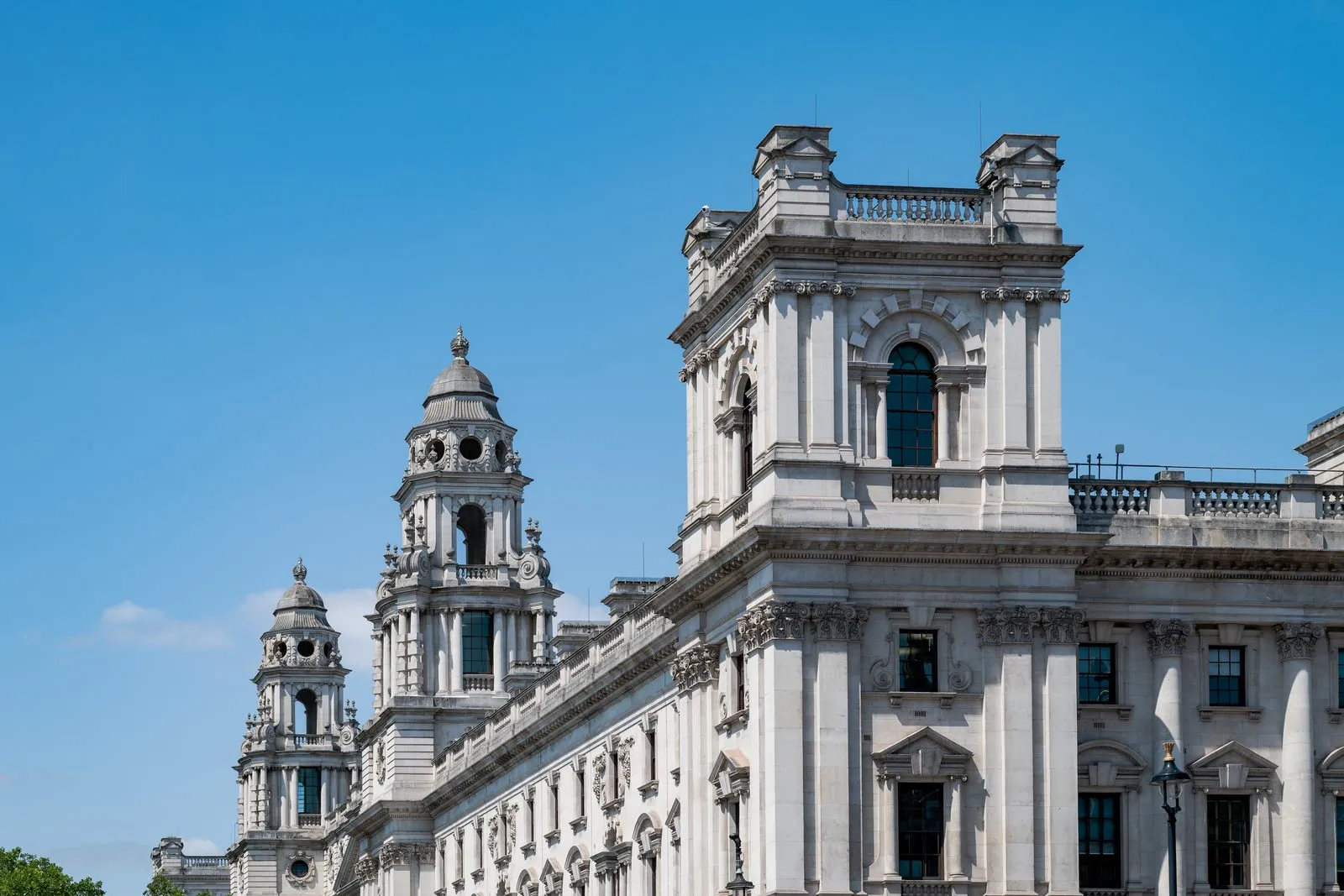 HM Treasury's New Government Offices on Whitehall in London, where Budget measures are prepared
Credit: Tilman2007, CC BY-SA 4.0, via Wikimedia Commons.
The bank tax: the Budget's biggest bet
If there is a single measure expected to define this Budget, it is a tax raid on the banks. Senior banking executives have told the BBC they expect their sector to face higher taxes, and The Times reports the bank tax will be the Budget's largest revenue-raiser, funding targeted, temporary cost-of-living support.
The mechanics are well trailed. Former Conservative chancellor Jeremy Hunt cut the surcharge banks pay on corporation tax from 8% to 3% in 2023; Healey is reportedly considering restoring it to 8%, which could raise more than £2 billion a year. An increase to the separate bank levy — a small charge on banks' balance sheets — is another option. The politics are tempting: the big four banks — HSBC, Barclays, Lloyds and NatWest — made around £15 billion in profit in the first half of 2026, and unions have demanded the sector contribute more.
But the economics are contested, and this is where the analysis gets interesting. The banking lobby, UK Finance, argues that "further increases in bank taxes would weaken competitiveness, discourage investment and job creation". Hunt himself warned such a move would mean "less investment, lower growth and fewer jobs". British banks have faced higher taxes than the rest of the private sector for around 15 years — a legacy of the 2008 financial crisis — and there is a genuine debate about whether the City can keep absorbing levies without investment drifting elsewhere. Healey is betting that voters will applaud taxing bumper bank profits; the risk is that the revenue disappoints if the sector retrenches. It is the classic chancellor's gamble, and the whole Budget's arithmetic may rest on it.
Closing the online VAT gap
The second big reported revenue-raiser targets online marketplaces. Under proposals reported by The Times, platforms such as Amazon and eBay would be required to collect VAT at source on sales by third-party sellers with annual turnover above £90,000, regardless of where the seller is based. The measure could raise up to £1 billion, largely by catching foreign sellers accused of abusing lax enforcement — and the revenue is earmarked for cutting business rates for high-street shops.
As Which?'s Budget preview notes, this is industrial policy disguised as tax administration: a transfer from online platforms to the high street, dressed up as fairness. It is also administratively ambitious — making platforms liable for their sellers' tax is a significant compliance burden — but it is the kind of measure a constrained chancellor loves: it raises money, pleases a sympathetic constituency (struggling high streets), and punishes almost nobody who votes.
Help for households — and its limits
On the spending side, expect targeted rather than universal help. The Times reports energy-bill support for poorer households and measures to cut energy costs for manufacturers, alongside a previously announced 20% business-rates reduction for qualifying hospitality venues from April 2027.
The flagship household policy is likely to be the extension of "Your First Home", which would let buyers in England secure a new-build home with a 2.5% deposit, topped up by a government loan worth 20% of the property's value. It is easy to see the appeal: deposits are the binding constraint for most first-time buyers. But demand-side subsidies have a well-documented side effect — they can inflate the very prices they are meant to tame, with the benefit capitalised into sellers' asking prices rather than buyers' pockets. Whether this scheme escapes that trap will determine whether it is remembered as a ladder or a mirage.
What will not be in the Budget, reportedly, is a rise in capital gains tax. Healey has ruled it out despite pressure from cabinet colleagues, after warnings it could cost the Exchequer money if wealthy individuals deferred sales or left the country — a decision Verity covered in our report on Healey ruling out the CGT rise. A reported plan to lower a mansion-tax threshold from £2 million to £1.5 million has also reportedly been dropped. The pattern is consistent: the Chancellor is avoiding measures that might spook mobile capital, and leaning on banks and platforms instead.
What "steady as she goes" really costs
There is an underappreciated risk in Healey's strategy. Cutting headroom from £23 billion to around £15 billion — as The Times reports he intends — buys short-term flexibility at the price of resilience. Headroom is insurance against forecast error, and forecasts have a habit of erring: inflation linked to the war in Iran, energy price spikes, or weaker growth could wipe out a £15 billion buffer uncomfortably fast. A chancellor who arrives at the next fiscal event with no headroom faces an unpalatable choice between breaking his rules and emergency tax rises.
The opposition smells blood. Conservative leader Kemi Badenoch is expected to use a pre-Budget speech to accuse Healey of "burying his head in the sand" on spending, arguing that Labour has "increased spending by more than £100bn in just two and a bit years". Her attack line — that the government's economies are fictional — will get its real-world test in the OBR's numbers on the day. With job vacancies at a five-year low and businesses already cutting jobs ahead of tax rises, the economic backdrop gives her plenty of material.
What to watch on 28 October
Three numbers will tell you whether this Budget worked. First, the headroom figure: how much insurance has Healey left himself? Second, the bank tax details: surcharge, levy, or both — and whether the revenue projections survive contact with the City's response. Third, the OBR's growth forecast: everything else is arithmetic built on that foundation.
Beyond the numbers, watch the politics. A "steady as she goes" Budget is a bet that competence is enough — that voters will reward a chancellor who balances the books without drama. But steadiness is not the same as safety, and in an economy with 3.5% inflation, record debt interest and shrinking fiscal buffers, the most dangerous thing a chancellor can do is assume the sea stays calm. Follow more of our coverage on Budget day, and read about our mission on our about page.