A reward, a claim, and a week to go
President Donald Trump is offering a reward of one million dollars to anyone whose report of voter fraud in the United States leads to a conviction, as he steps up claims that cheating in American elections is widespread. The offer comes one week before the midterm elections on 3 November, in which control of Congress is at stake and millions of voters have already cast ballots early.
Trump has argued in recent weeks that postal voting is riddled with cheating and that people who are not citizens are casting ballots in large numbers. Researchers who study American elections say the available evidence does not support that characterisation. This article sets out the claim, the evidence, and the policy debate that sits between them, so readers can judge the gap between the two.
The president's focus on postal voting is not new. For years he has claimed, without presenting supporting evidence, that voting by mail opens the door to widespread abuse. At the same time, he has urged Republican voters to use postal ballots in the midterms, and has said he has voted by post himself. That tension, between warning about a system and encouraging supporters to use it, has been a feature of his election messaging for years.
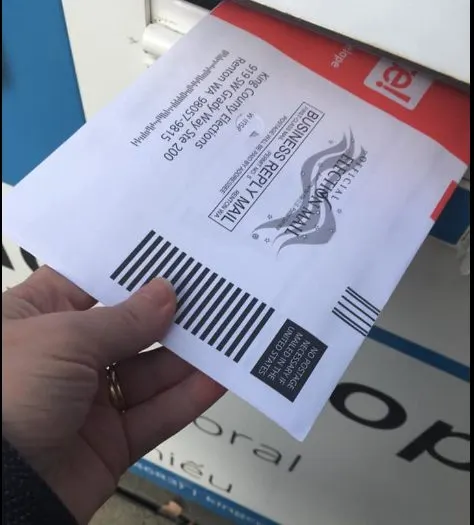 A voter casting a ballot at a polling place.
Credit: ShanaKFriend, via Wikimedia Commons, CC BY-SA 4.0.
What the postal ballot evidence shows
Every state checks postal ballots against the information it holds on file for the voter, and most also compare signatures. Studies covering several recent election cycles have repeatedly found confirmed cases of postal ballot fraud to be very uncommon.
A Brookings Institution analysis of the 2016, 2018, 2020 and 2022 elections found an average of roughly four cases of fraud for every ten million postal votes cast. The Brookings analysis drew on a database maintained by the Heritage Foundation, a think tank that has often aligned itself with Trump, which records electoral fraud cases ending in conviction. A review of that database over twenty years turned up 325 convictions involving the fraudulent use of postal ballots.
A 2020 study by the American Statistical Association examined eight states, research our Science pages have followed closely, that send postal ballots to all eligible voters and found no sign that voting by mail raised the overall risk of fraud. For example, according to the study, Oregon recorded 40 fraud cases between 2000 and 2020, having sent out more than 100 million postal ballots over that period.
None of this proves that fraud never happens. It does show that the confirmed cases researchers can document are small in number relative to the hundreds of millions of ballots cast, and that the pattern holds across studies using different methods and different data sources, including a database maintained by a think tank sympathetic to the president.
The non-citizen voting claim
Trump has also claimed that voting by non-citizens is common, arguing before the 2024 election that Democrats were admitting large numbers of migrants so that they could vote. Voting in federal elections is illegal for non-citizens, and the penalties can include prison, a fine and deportation.
The numbers here are also small. The Heritage Foundation database identified 24 convictions for non-citizen voting between 2005 and 2025, while a 2026 Reuters analysis of federal court cases found 129 people charged over thirty years and 73 convictions. A senior fellow at Brookings argued that the illegality of non-citizen voting is itself a powerful deterrent, and that the numbers have never been large enough to sway an election.
State-level checks tell a similar story. An audit of Georgia's voter rolls over thirty years identified 432 possible non-citizens. In Nevada, a list of 185 names supplied by the Department of Homeland Security as suspected non-citizens turned out, on checking, to consist entirely of citizens. In New Jersey, a software error registered about 6,600 non-citizens to vote between June 2023 and June 2024, though officials say fewer than 400 actually cast ballots and all have now been removed.
The Justice Department asked California not to count 20,000 postal ballots from people it described as likely non-citizen registrants, but an appeals court rejected that request. The department has charged 28 people it says are non-citizens who registered illegally. California authorities have said the state's protections against non-citizen voting are strong and have described the Justice Department's claims as based on questionable data.
The executive order and the courts
Last year Trump signed an executive order that would have directed the Postal Service to deliver ballots only to voters appearing on government-compiled lists of citizens, and that sought a uniform envelope style for postal votes. The Supreme Court rejected those changes, describing them as arbitrary and capricious so close to an election, while leaving open the possibility of revisiting the question later.
The legislation Trump has championed would go further. It would require voters to show government-issued photo identification before casting a ballot, to prove citizenship when registering, and to undergo continuing citizenship checks. Supporters argue that such measures are common sense protections for election integrity. Critics warn that they could depress turnout, because some eligible voters do not hold a passport or another accepted form of photo identification.
A 2023 survey by the Brennan Center for Justice estimated that about 21.3 million voting-age American citizens, roughly nine percent, do not have documents proving citizenship readily at hand. Others note that existing voter identification laws do not appear to have produced a measurable effect either way, a reminder that the debate is as much about perception as about measured outcomes.
The Brennan Center has counted 21 restrictive voting laws enacted since the 2024 election, most of them in states run by Republicans. That legislative trend, rather than any single claim, may be the most durable consequence of the fraud debate: rules written in response to alleged cheating that researchers say is rare, but that many voters believe is common.
Why the gap between claim and evidence matters
The debate, covered in our Opinion section as well as in news reporting, is unlikely to end with the midterms. Trump has signalled that he will keep pressing for tighter voting rules, while researchers and voting-rights groups argue that the evidence points the other way: that fraud is rare, and that the bigger risk lies in rules that make it harder for eligible citizens to vote.
There is a legitimate question underneath the rhetoric. Elections must be both secure and trusted, and trust depends on more than statistics. A system that researchers describe as safe can still lose public confidence if prominent voices repeatedly describe it as corrupt, and confidence, once lost, is hard to restore with a spreadsheet.
But the reverse is also true. Rules designed to reassure can themselves damage confidence if they are seen to exclude eligible voters, and the evidence on that point is contested rather than settled. The honest summary of the current state of knowledge is this: confirmed voter fraud, by post or by non-citizens, is documented in very small numbers, while the effects of stricter rules on turnout remain a subject of genuine disagreement.
Voters heading to the polls on 3 November will decide control of Congress, a contest with consequences far beyond the United States. They will do so in a system that checks ballots against voter records, compares signatures in most states, and prosecutes the rare cases of fraud that are found. Whether they trust that system may depend less on the evidence than on whose account of it they believe.
Sources and further reading
- The BBC's original BBC Verify report is the primary source for this article: Trump says US voter fraud is 'rampant', evidence suggests it is extremely rare.
- The Brookings Institution analysis of postal ballot fraud across the 2016 to 2022 elections, and the Heritage Foundation election fraud database it drew on.
- The American Statistical Association 2020 study of voting by mail in eight all-mail states.
- Reuters reporting on federal non-citizen voting cases and on the California ballot dispute.
- The Brennan Center for Justice survey on citizenship documentation and its count of restrictive voting laws.
- The US Election Assistance Commission publishes guidance on election administration and voter registration.
Read more from Verity: our Politics coverage, our Opinion section, the latest News, World reporting, and Business stories. You can also visit our homepage, learn more on our About page, or get in touch via our Contact page.