A milestone reached without much noise
There was no single day when the world stopped to mark the change. No ribbon was cut, and no ceremony was held. Yet somewhere in the numbers for 2025, one of the biggest shifts in modern energy history took place. Solar power, which supplied only about 1 percent of world electricity a decade earlier, moved ahead of nuclear power as a source of generation.
The finding comes from Ember, a UK think tank that tracks electricity systems around the world. Its data show solar generation passing nuclear generation globally in 2025. Over the 12 months to September 2026, solar produced 13 percent more power than nuclear, according to the figures reported by the BBC. In 2026, solar is expected almost certainly to reach 10 percent of world power.
That pace is striking because nuclear power has changed very little for a long time. Nuclear generation has stayed roughly flat since 2000, held back by long build times, high costs and political disputes in many countries. Solar, by contrast, has grown by a factor of about 2,700 over the same period. The contrast explains why a technology that once looked marginal now sits at the centre of the electricity system.
Readers who follow Verity Science will know that energy stories often arrive with bold claims. This one is different because it rests on generation, the power actually produced, rather than on promises about future plants. Solar did not just add capacity on paper. It produced more electricity than an established, large scale source.
Why 2025 mattered
The year 2025 was important for a simple reason. Solar did not only grow fast in its own terms. It supplied three quarters of the growth in world electricity demand that year, making it the fastest growing source of new electricity in history, on the reported figures.
That matters because electricity demand keeps rising. Homes, offices, factories, data centres and transport all draw more power each year. When demand grows, the question is which source meets the extra need. In 2025, the answer was solar far more often than any rival.
The scale of that growth also helps explain why the crossover with nuclear happened when it did. Nuclear plants take many years to plan, approve and build, and few new reactors come online in a typical year. Solar projects can be built in months, and millions of small installations add up quickly. One roof at a time, one field at a time, the total moves.
For context on how energy systems are changing, including UK policy covered by GOV.UK, readers can also explore Verity Technology, where new storage and grid tools are covered alongside generation. The story of solar is not only about panels. It is about a system learning to use them at scale.
The price fall that changed everything
Cost is the main reason solar moved from the margins to the mainstream. Solar became the cheapest electricity in history in 2020, on the assessment reported in the BBC account, and prices have since fallen further in many markets.
A large part of that fall came from China. Chinese factories now make solar modules at enormous scale. When supply ran ahead of demand, prices dropped to record lows, with a particularly sharp fall in 2023 and 2024. Cheaper modules made projects viable in places where they had previously looked too costly, and they encouraged developers to build bigger.
That price effect rippled through the whole chain. Installers became more efficient. Banks became more willing to lend. Governments found that supporting solar cost less than expected. Households found that a roof installation could pay for itself faster than before.
None of this means solar is free, or that it works the same way everywhere. Cloudy climates, land limits and grid rules still shape what is possible. But the direction of travel on cost has been clear for years, and it has removed the main barrier that once held solar back.
The International Energy Agency tracks these trends closely, as do analysts at Carbon Brief and the UK system operator National Grid, and its outlook points in the same direction. The agency expects solar generation by 2030 to double its 2025 level and to pass hydro power as the third largest electricity source in the world.
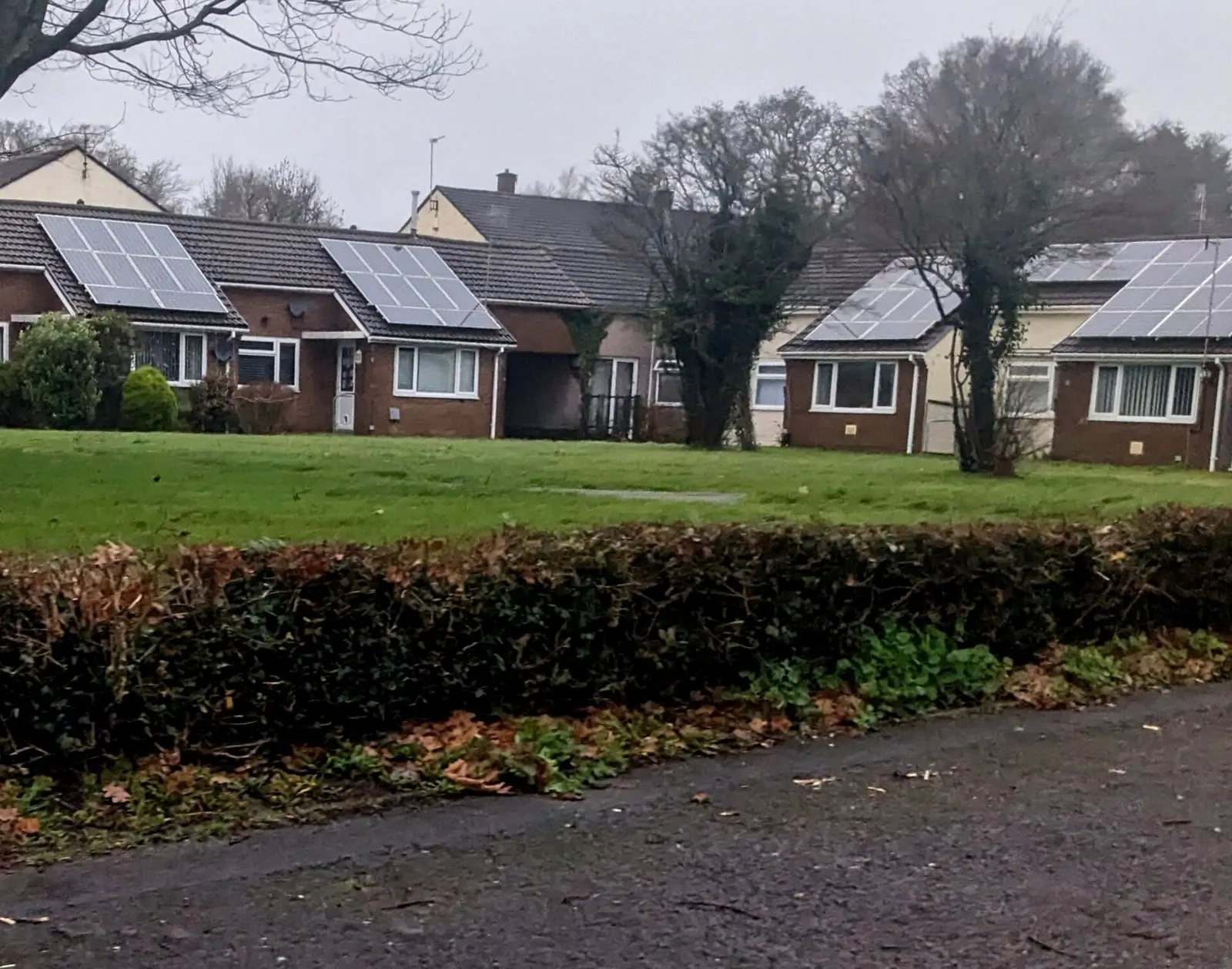 Solar panels fitted to the roof of a house in Wales
Credit: Jaggery, via Wikimedia Commons, CC BY-SA 2.0.
China leads, and others follow
China is by far the biggest solar power in the world, both in manufacturing and in installed generation. Its factories supply much of the global market, and its own buildout dwarfs that of most other countries combined.
The United States ranks second for installations. It now has enough solar capacity to power more than a third of households, according to the figures cited in the BBC report. That growth has come from large solar farms in sunny states, from rooftop systems on homes and businesses, and from projects paired with batteries.
Australia offers a different kind of example. More than four million homes there now have rooftop solar, a level of household adoption unmatched in most large economies. For many Australian families, solar is not an abstract energy policy. It is a set of panels on the roof and a lower bill at the end of the month.
Pakistan tells a still more dramatic story. Solar rose there from under 2 percent of electricity in 2019 to 24 percent now, according to the reported figures. That shift happened quickly, driven in large part by households and businesses seeking a cheaper and more reliable supply than the grid could offer. It shows how solar can spread even without a single national programme, when the economics make sense for the people buying it.
These examples sit in very different climates and economies, which is part of the point. Solar is no longer a technology for one region. It is being adopted for different reasons in different places, and that breadth is what makes its growth hard to reverse.
Solar after sunset
One long standing criticism of solar power was simple. The sun sets, but people still need light, heat and power in the evening. If solar could not help after dark, critics argued, it could never carry a large share of the system.
Batteries are changing that argument. In California, solar and batteries together met on average more than a quarter of demand between 19:00 and 21:00 in the first half of 2026, according to the reported figures. That evening window is one of the hardest parts of the day for grid operators, because demand stays high while daylight fades.
Storage does not solve every problem. Batteries can shift power by hours, but they do not yet provide cheap seasonal storage for winter months in colder climates. Grids still need other sources, better connections between regions, and smarter ways to manage demand.
Even so, the California example shows that solar plus storage is no longer a theory. It is already doing real work at the times when it is most needed. That changes how planners think about reliability, and it weakens the claim that solar can only help in the middle of the day.
Readers can find more background on the site's main page at Verity and in the About section, which sets out how Verity covers science and technology stories.
What nuclear still offers
Passing nuclear does not mean nuclear has become unimportant. Nuclear plants still provide large amounts of steady, low carbon electricity, and many countries plan to keep existing reactors running for decades. Some are building new ones, often with state support, because they value power that does not depend on weather or fuel imports.
Nuclear also has a record that solar cannot match on one point. A single reactor can produce a huge amount of electricity from a small site, day and night, for many years. For dense cities and heavy industry, that concentration of power remains attractive.
The crossover is therefore best read as a change in momentum, not as a verdict on either technology. Solar is growing faster and is now producing more. Nuclear is stable but not expanding at anything like the same pace. Both will shape the low carbon system, but solar is now the larger of the two in generation terms.
That distinction matters for policy. Governments that want to cut emissions quickly tend to favour technologies that can be built fast and at falling cost. On that test, solar currently has a clear advantage. Governments that want long term, steady output may still back nuclear, but they must accept longer waits and higher upfront costs.
What happens next
The outlook for solar remains strong. The International Energy Agency expects generation to double by 2030 from its 2025 level. If that happens, solar would pass hydro power and become the third largest source of electricity in the world, behind coal and gas in many current rankings, but closing fast.
Whether that forecast holds will depend on grids, planning rules and storage. Panels are now cheap. The harder work is connecting them, storing their output, and making sure power reaches homes and factories when it is needed. Countries that solve those problems will get the most from the solar boom. Countries that do not may find that cheap panels alone are not enough.
There are also questions about manufacturing concentration. Much of the world depends on Chinese supply chains for modules and parts. That brings cost benefits, but it also creates risks if trade disputes or supply shocks disrupt deliveries. Diversifying production is now a priority for the United States, Europe and India, among others.
For now, the milestone stands on its own. A technology that supplied 1 percent of world power a decade ago now supplies about 10 percent, and it has passed nuclear along the way. It did so quietly, panel by panel, roof by roof and field by field. The next decade will show whether that quiet rise becomes a lasting transformation of the whole electricity system.
More coverage of global developments can be found in Verity World and Verity News.