A first chance to leave in more than four years
Residents have begun leaving the Russian occupied town of Oleshky under a temporary humanitarian ceasefire, boarding buses for a long and indirect journey out of a frontline town that has endured years of hardship. The evacuation, which began on Friday 30 October, is the first structured opportunity for civilians to leave for Ukrainian controlled territory since Russian forces captured the town in early 2022.
Oleshky sits in Kherson Oblast, across the Dnipro River from the Ukrainian controlled city of Kherson. Before the war it had a population of around 24,000. Estimates of how many people remain vary between sources, with Ukraine's foreign minister reporting about 1,700 people still in the town on 17 October, while other reporting has put the figure at around 1,500 to 2,000. Whatever the exact number, those who stayed have faced severe shortages of food and medicine, with no safe evacuation route available until now.
Ukrainian Parliament Commissioner for Human Rights Dmytro Lubinets announced that the main phase of the humanitarian mission began on 30 October after crews completed demining designated routes, clearing the way for a convoy to deliver aid to the town. Lubinets made a joint statement to the press with Russian Human Rights Commissioner Yana Lantratova in Russian occupied Armyansk, in Crimea, where they were coordinating the next steps. Ukrainian negotiator Davyd Arakhamia also confirmed that evacuation and aid distribution had begun, and officials from both sides travelled to Oleshky to oversee the operation.
The long route out
Evacuees are not crossing the Dnipro directly to Kherson. That route was ruled out because the river delta is heavily mined and subject to ongoing artillery and drone fire, and because it forms an active front line. Instead, those wishing to return to Ukrainian controlled territory must take a circuitous route through Russia and Belarus.
According to Ukrainian officials, residents first travel by bus south from Oleshky to the Russian city of Anapa. From there they fly to Belarus aboard a Russian Defence Ministry military transport aircraft. Only from Belarus are they able to enter Ukraine, where they will undergo additional medical examinations in Chernihiv and Kyiv Oblasts, receive initial medical care, and be provided with clothing, hygiene supplies and other essentials at first.
Authorities prepared 25 buses with a combined capacity of 750 passengers, along with ambulances for people with limited mobility. Residents wishing to leave were told they could do so until 2pm on 30 October, after which aid distribution would begin. Lubinets said everyone who wishes to leave Oleshky will have the opportunity to depart safely, and those who have decided to stay may do so and will receive all the humanitarian assistance they need.
There is one important uncertainty that officials have not resolved. It remains unclear whether Russia plans to subject Oleshky residents to filtration screening along the evacuation route, a process that has caused fear in previous evacuations from occupied territory. Reporting on 30 October noted that residents who had expressed a wish to leave had begun receiving calls from Russian representatives confirming addresses, and that some people were frightened because neither side had explicitly guaranteed there would be no filtration screening. That concern should be stated plainly, because it may affect who chooses to travel.
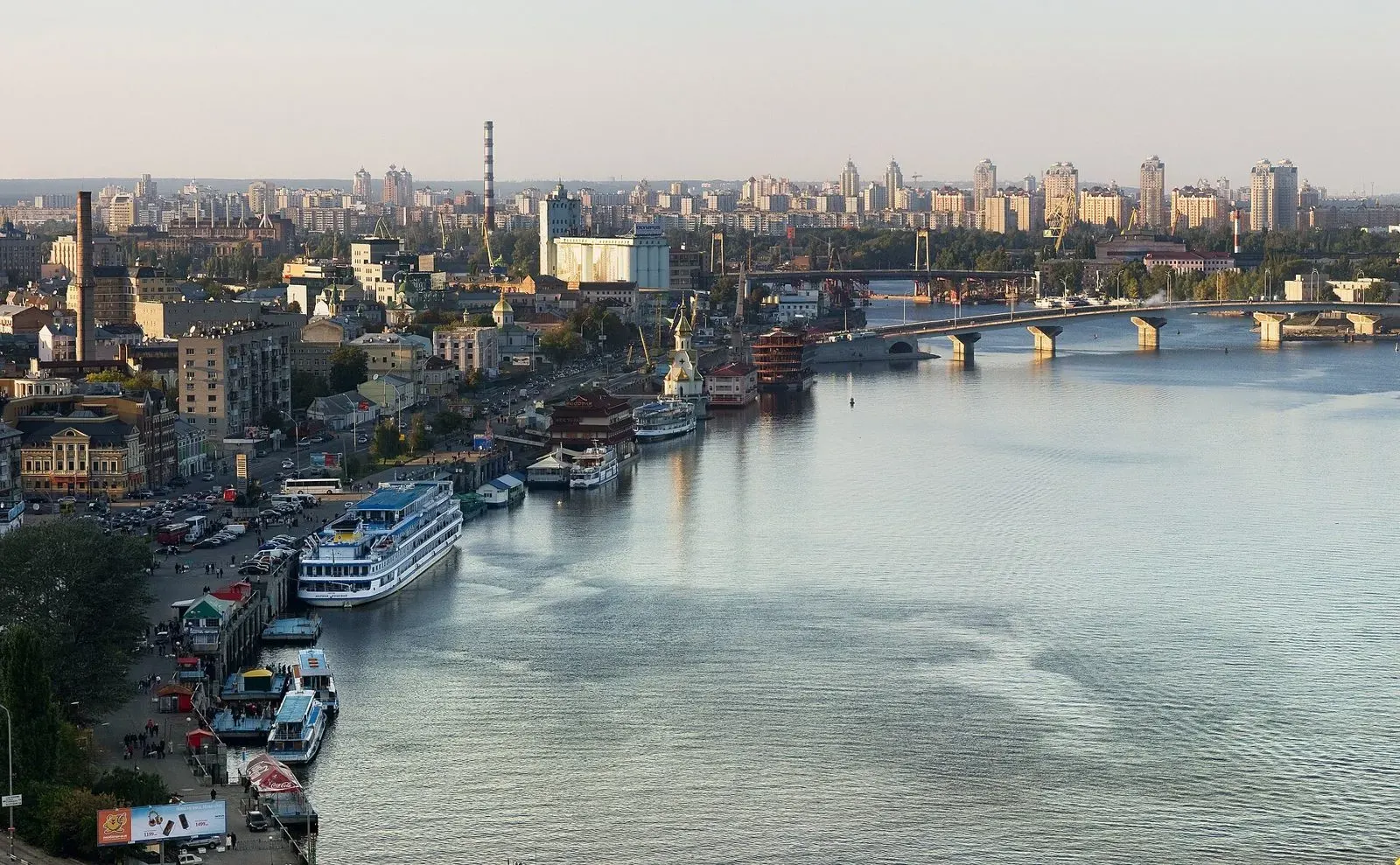 A wide view of the River Dnieper in Kyiv, Ukraine
. Credit: Wikimedia Commons, freely licensed.
A number that changed during the day
Readers following this story on Friday will have seen a figure that later changed, and it is worth explaining why. During an address to parliament on 30 October, Ukrainian Prime Minister Serhiy Koretskyi initially said that 527 residents planned to return to Ukrainian controlled territory and that accommodation had been prepared for them in various regions. Later the same day he corrected that statement, apologising and saying he had mistakenly reported the number, that numbers were still changing, and that official information would be available only once the evacuation is over.
That correction matters for honest reporting. The figure of 527 should therefore be treated only as the initially reported figure, subsequently withdrawn as an exact total, not as a confirmed count of evacuees. The operation was still ongoing when the correction was made, and the final number may be higher or lower. What is confirmed is that buses were prepared, that residents began boarding on Friday, and that a Ukrainian delegation travelled with evacuees towards Anapa as part of the agreed route.
Those who stay behind
Not everyone is leaving. The BBC reported that several hundred people decided to stay in the frontline town despite the lack of gas, electricity and running water. Ukrainian officials have said those who stay will receive humanitarian aid, and aid distribution was due to begin once the departure window closed.
It is easy to read a decision to stay as a mystery from the outside, but there are many ordinary reasons people remain in such circumstances. Some are elderly or unwell and fear a long journey through unfamiliar territory. Some do not want to leave homes, relatives or graves behind. Some distrust promises made by either side after years of war. Some may hope that staying preserves a claim to return later, or simply feel that the known hardship of home is less frightening than an uncertain journey. Reporting should not assume a single motive, and should not present staying as either defiance or surrender. It is, in most cases, a personal calculation made under extreme pressure.
The condition of the town itself helps explain why this evacuation has drawn attention. Oleshky has suffered extensive damage during the war, and residents have endured months of shortages of food, water and medicine. Former residents have told reporters that some people were forced to hunt and eat pigeons, a detail that, while stark, illustrates the level of deprivation rather than serving as a graphic account. Residents have been seen waiting outside their homes with bags of belongings, ready to leave, while officials from both countries have said some people will choose to remain even if fighting resumes.
A ceasefire with a deadline
The evacuation is taking place under a local ceasefire that took effect at 3am Kyiv time on 27 October and is scheduled to remain in effect until 10.59pm on 1 November. The White House announced on 23 October that US First Lady Melania Trump had secured the local ceasefire in Oleshky, where a humanitarian disaster was unfolding, and Pope Leo XIV had also called for a humanitarian ceasefire earlier in October.
Reporting has described this as the longest pause in fighting along any part of the front line since Russia launched its full scale invasion of Ukraine in 2022, now in its fourth day at the time evacuations began. That description should be treated with care: it refers to a local pause in a specific area, not to a general ceasefire across Ukraine, and fighting continues elsewhere. The deadline also creates pressure. A window that closes on Sunday evening leaves little room for delay, for second thoughts, or for complications along a route that already passes through two other countries before reaching safety.
What happens after the window closes is also unclear. If fighting resumes around Oleshky, those who stayed will again be cut off, and the humanitarian aid delivered during the pause may be all they receive for some time. If the pause is extended, further evacuations might follow. Neither outcome can be assumed from the reporting available on Friday, and any update should be based on official announcements rather than speculation.
For now, the confirmed facts are these: a temporary ceasefire opened a rare corridor, buses and ambulances were prepared, evacuations and aid distribution began on 30 October, and residents are travelling via Anapa and Belarus to reach Ukraine, while several hundred others remain in a town without reliable gas, electricity or running water. The final count of those who left, and the longer term fate of those who stayed, will only become clear once the operation is complete and officials publish verified figures.
Read more world coverage in our World section, including the Russian drone attack on Dnipro train station, US bombers leaving RAF Fairford, the Jordan church funeral shooting, and the Paris shooting investigated as terrorism. You can also read our News section or return to the homepage.
The BBC's report on this story is available here: Residents leave devastated Russian-occupied Oleshky as evacuation corridor opens. Other reporting includes Ukraine begins Oleshky evacuations and aid distribution, evacuations begin under a US brokered ceasefire, residents set off for Belarus via Russian transit, Oleshky evacuation begins as residents leave through Belarus, and buses standing ready until 14:00 for the Oleshky evacuation.