A crowded platform in the morning
A Russian drone strike on a crowded railway platform in the Ukrainian city of Dnipro killed at least 14 people on Thursday 29 October 2026, according to Ukrainian officials, in what is reported to be the deadliest attack on a Ukrainian railway station since 2022. The state rail company Ukrzaliznytsia said a jet-powered Russian drone hit the platform at Dnipro's main station where a commuter train was preparing to depart for the nearby city of Zaporizhzhia.
President Volodymyr Zelensky described the attack as horrific. In comments reported widely, he said the strike hit a platform where a regular commuter train and a regular passenger train were standing, and he insisted that sanctions against Moscow and its war machine must not be eased for as long as the war continues. "These are deliberate strikes against civilians, brazen in their cruelty," he said in a post on Thursday afternoon, adding that Russia was carrying out the attacks even as a humanitarian operation unfolded in the southern city of Oleshky.
By early Thursday afternoon, Dnipropetrovsk regional governor Oleksandr Ganzha said the death toll from the strike had risen to 14. He said another 14 people had been wounded, six of them in a serious condition after suffering multiple shrapnel wounds. Among the seriously wounded, he said, were an 11-year-old boy and a man who had both legs amputated. Images released by Ukrainian emergency services showed bodies on the platform, rescuers helping victims to safety, and two burnt-out passenger trains with their windows shattered. Images posted by Zelensky showed bodies strewn across the ground as rescuers rushed the wounded away on stretchers.
The figures remain officials' provisional counts, and reports of the wounded total vary slightly between outlets, with some putting the wounded figure lower. That variation is normal in the hours after a mass casualty attack, as hospitals and emergency services reconcile their lists. What is not in dispute, on the reporting available, is the scale: a morning strike on a busy station, two trains standing at the platform, and a death toll that officials put at 14 and rising through the morning.
A wider day of killing across Ukraine
The Dnipro strike was not an isolated incident. Officials reported at least 19 people killed across Ukraine on Thursday, including the 14 at the station. In Chernihiv, in northern Ukraine, two 15-year-old girls were killed and others were wounded in a strike on a central street, according to regional head Vyacheslav Chaus. Reports described a man believed to be the father of one of the girls screaming beside their bodies, and put the wounded in Chernihiv at more than 20 people.
Elsewhere, further deaths were reported in Kremenchuk, in the Poltava region, where a strike on an apartment building killed people, and in Zaporizhzhia, in the south east, where one person died in an attack on public transport. The exact breakdown varies between reports, with Reuters reporting three people killed in Kremenchuk and other outlets reporting two, a reminder that early casualty figures in a war zone are often revised. The overall picture, however, is consistent: a day of daytime strikes on cities far from the front line, hitting stations, streets, homes, and transport.
Ukrainian Prime Minister Sergiy Koretskyi accused Russia of deliberately hunting civilians. "Russia is deliberately hunting civilians: on trains, at stations, in residential buildings," he said on Telegram. "There is no justification for this terror, and there never can be." French President Emmanuel Macron reacted with outrage, saying it was intolerable that Russia continued to reject proposals for an end to the war, choosing instead to pursue escalation and target civilians. He stressed the need for far more than a localised ceasefire.
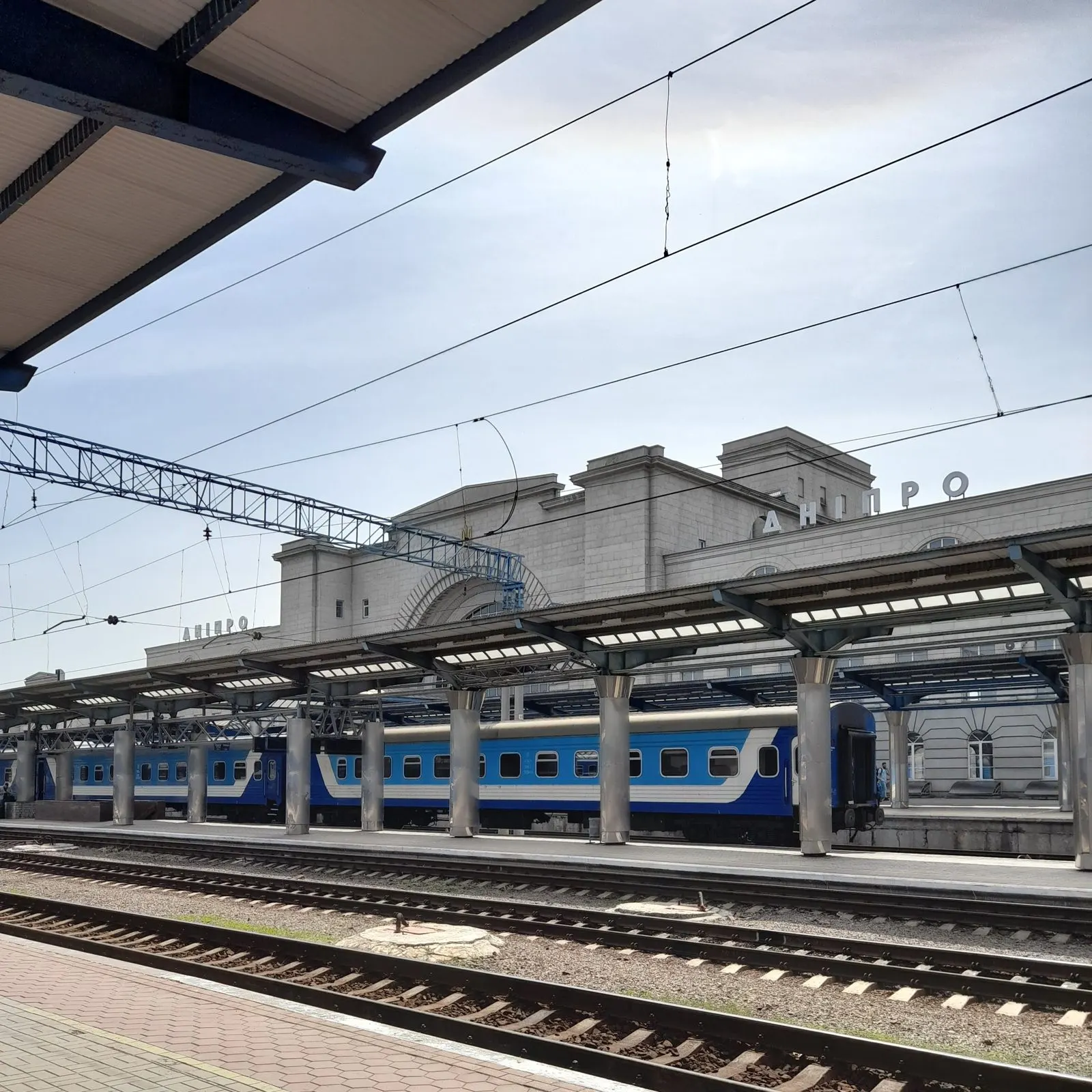 Platforms at Dnipro railway station
. Credit: Wikimedia Commons, CC BY 4.0
Railways as a target
Moscow has repeatedly targeted Ukraine's vast railway network, but denies deliberately hitting civilians and says its attacks aim at infrastructure used to move troops and military equipment. Russia's military did not comment publicly on the Dnipro strike, according to reports. That denial sits uneasily with the pattern documented by Ukraine's rail company and by journalists on the ground: stations, platforms, and trains carrying ordinary passengers have been hit again and again.
Attacks on Ukrainian railways have risen sharply, according to figures from Ukrzaliznytsia cited by AFP. Almost 60 percent of the 521 locomotives hit since the start of the full-scale invasion were struck this year, and attacks on railway facilities have climbed from 1,206 in 2025 to 1,700 so far in 2026. Those numbers help explain why a strike on a station matters beyond its immediate death toll. Railways are how millions of Ukrainians travel, how goods move, and how the country holds together under bombardment. Each attack on a station is also an attack on that lifeline.
Thursday's strike was, according to reports, the deadliest on a railway station since 2022, when more than 60 people died in an attack in Kramatorsk and 25 were killed in Chaplyne, a village not far from Dnipro, in the east of the country. That comparison gives a measure of how grave the Dnipro attack is, and how rare it is for a single station strike to kill so many people at once. It also underlines a grim continuity: stations have been among the most dangerous places in Ukraine since the earliest weeks of the full-scale invasion, precisely because they are where civilians gather.
A local truce, and a wider war
The strikes came even as Ukraine and Russia observed a local truce in the southern Kherson region, brokered with US help and intended to allow humanitarian relief to reach the Russian-held town of Oleshky, where residents have faced months of food, water, and medicine shortages. Moscow had made clear that the six-day humanitarian truce applied only to the Kherson region, and the truce was reported to be holding into its third day, with Ukraine's human rights ombudsman Dmytro Lubinets saying he had set out with the Ukrainian delegation towards Oleshky.
That contrast, a truce holding in one place while stations are bombed in another, was at the heart of Zelensky's message to allies. He urged international partners to apply appropriate pressure on the aggressor, and warned that Russia's signals were clear: it wants the war to continue. He also criticised a deal agreed earlier in October between Donald Trump and Vladimir Putin that eased some sanctions on Russia and allowed the US to import Russian diesel, and urged the United States, European countries, and the G7 to impose further sanctions on Moscow.
Overnight, Moscow's mayor said 613 Ukrainian drones had been launched towards the Moscow region, most of which were shot down, as the Russian capital hosted a Russia-Africa summit. That claim, like the casualty figures from Dnipro, comes from an official source with an interest in the narrative, and should be read as such. What it shows, at minimum, is that the air war is now two-way and large-scale, with both capitals reporting mass drone attacks even as diplomats talk about truces and humanitarian corridors.
The strikes also came just days after Steve Witkoff, President Trump's special envoy, told Putin that he was a humanitarian, a remark that drew criticism in Kyiv, and after Trump said this month that Russia had not been doing much on Ukraine. For Ukrainians burying their dead in Dnipro, Chernihiv, and Kremenchuk, those remarks will have sounded remote from the reality of a Thursday morning platform, two trains standing, and a jet-powered drone arriving without warning.
For the families of the victims, the diplomatic arguments matter less than the names and the funerals to come. For the wider world, Dnipro is a test of whether the language of truces and negotiations can survive contact with a war that continues to kill civilians in stations, on streets, and in their homes. Officials say at least 14 people died at Dnipro station alone. That figure, attributed to Ukrainian officials and reported across multiple outlets, is the provisional toll of a single strike on a single morning. It is also a reminder that behind every round number in a war report are people who were simply waiting for a train.
For more world coverage, see our World section, our report on the Ukraine Kherson ceasefire extension, our piece on a church funeral shooting in Jordan, and our report on drone strikes in Sudan. You can also visit the Verity homepage or read about us.
Further reading: the BBC story on the Dnipro train station attack, Al Jazeera on the Dnipro station deaths, The Citizen on the horrific strike, CNN on the Dnipro station strike, The Times on the rail station deaths, and Reuters reporting on the strike.