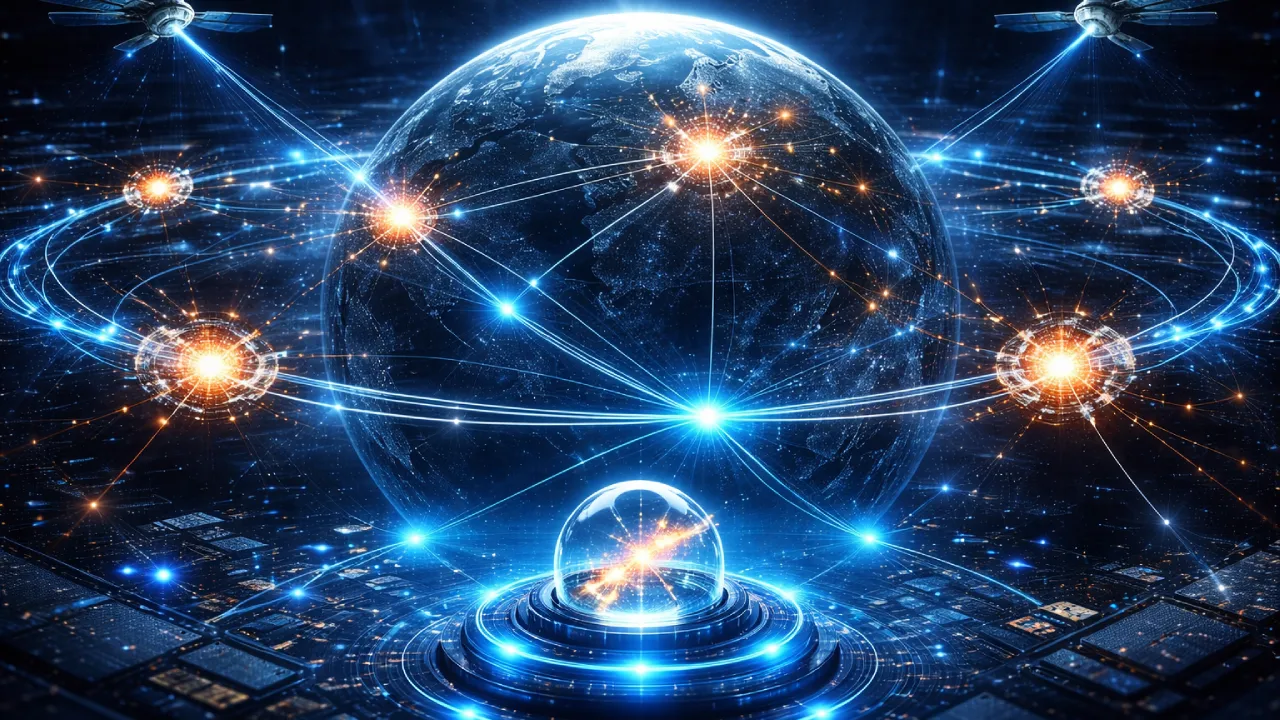
In Short (TL;DR)SUMMARY: The Quantum Internet is set to revolutionize global communication with virtually unbreakable security, quantum encryption, and next-generation networking technology. This represents a key global briefing verified by the VERITY newsroom.
Quantum Internet: The Next Revolution in Global Communication
The internet has transformed the way we communicate, work, learn, and share information. But scientists believe an even bigger breakthrough is on the horizon: the Quantum Internet.
Unlike today's internet, which transmits information using electrical or optical signals, the Quantum Internet will use the principles of quantum physics to exchange information in ways that are significantly faster, more secure, and nearly impossible to hack.
Although the technology is still under development, researchers worldwide are making remarkable progress toward building the internet of the future.
What Is the Quantum Internet?
The Quantum Internet is a new type of communication network that uses quantum bits (qubits) instead of traditional binary bits.
Unlike ordinary bits, which can only represent 0 or 1, qubits can exist in multiple states simultaneously through a phenomenon called superposition.
Another unique property known as quantum entanglement allows particles to remain connected regardless of the distance between them, enabling incredibly secure communication.
How Does Quantum Internet Work?
The Quantum Internet relies on several advanced scientific concepts.
Quantum Entanglement
Two particles become linked in such a way that changing one instantly affects the other, regardless of the distance separating them.
Quantum Key Distribution (QKD)
Encryption keys are transmitted using quantum particles. If anyone attempts to intercept the communication, the particles immediately change state, alerting both parties to the intrusion.
Quantum Repeaters
Since quantum signals weaken over long distances, quantum repeaters extend communication across cities and eventually around the world.
Why Is Quantum Internet So Important?
Scientists believe the Quantum Internet could transform multiple industries.
Unbreakable Cybersecurity
Quantum communication makes data interception nearly impossible, creating an entirely new level of online security.
Faster Scientific Collaboration
Researchers could securely exchange sensitive information and operate quantum computers remotely.
Improved Healthcare
Hospitals could safely share medical records while protecting patient privacy.
Financial Security
Banks and financial institutions could dramatically reduce cybercrime and fraud.
National Security
Governments could protect sensitive communications against increasingly sophisticated cyberattacks.
How Is Quantum Internet Different from Today's Internet?
Current InternetQuantum InternetUses binary bits Uses quantum bits (qubits)Can be hacked Nearly impossible to interceptStandard encryptionQuantum encryptionClassical communicationQuantum communicationVulnerable to future quantum computers Designed for quantum security
Which Countries Are Leading Quantum Internet Research?
Several nations are investing billions of dollars in quantum technology.
China
China has launched some of the world's first quantum communication satellites and continues expanding its quantum network.
United States
Major universities and technology companies are working on a national quantum infrastructure.
European Union
The EU has launched multiple quantum communication initiatives connecting research institutions across Europe.
Canada
Canadian researchers are among the pioneers in quantum networking and quantum cryptography.
Japan
Japan continues investing heavily in quantum computing and secure communication systems.
Can Quantum Internet Replace Today's Internet?
Not immediately.
Scientists expect the Quantum Internet to work alongside the existing internet rather than replacing it.
Traditional internet infrastructure will continue handling everyday activities like streaming videos, browsing websites, and social media, while quantum networks will be used for highly secure communication.
Current Challenges
Despite rapid progress, several technical hurdles remain.
High Cost
Quantum equipment is expensive and requires specialized hardware.
Fragile Quantum States
Quantum particles are extremely sensitive to environmental changes.
Limited Range
Maintaining quantum communication over long distances remains difficult.
Infrastructure
Building a global quantum network requires entirely new communication systems.
When Will Quantum Internet Become Reality?
Experts believe the first practical quantum networks will appear within the next decade.
Initially, they will connect:
Consumer applications may take longer, but progress is accelerating every year.
Final Thoughts
The Quantum Internet represents one of the most exciting technological advancements of the 21st century. By combining the principles of quantum physics with modern communication systems, scientists hope to create a network that offers unprecedented security and reliability.
Although widespread adoption is still years away, rapid progress in quantum research suggests that the future of secure global communication is nearer than ever.