Newborn babies in England are now being screened for spinal muscular atrophy (SMA) as part of a landmark NHS evaluation that doctors say could transform the outlook for children born with one of the most serious genetic conditions of early childhood.
The in-service evaluation, which began on 1 October, adds SMA to the routine newborn blood spot test — the heel-prick test offered to babies at around five days old — in participating areas. It marks the first time England's national newborn screening programme has tested for the condition, and clinicians describe it as a watershed moment for families affected by SMA.
Prof Tracey Willis, a consultant paediatric neurologist at the Robert Jones and Agnes Hunt Orthopaedic Hospital (RJAH) in Oswestry, Shropshire, said the launch was "a major step forward for babies and families affected by spinal muscular atrophy". Her message to parents is simple: "With SMA, every day matters."
Why the first days of life matter
SMA is a rare inherited condition that damages the nerves controlling the muscles. It causes progressive muscle weakness that can rob children of the ability to move, and in severe cases affects breathing and swallowing. The condition touches roughly 1 in 10,000 babies, with between 60 and 70 babies diagnosed each year in England.
The most severe form, type 1, develops within the first six months of life. Without treatment it can severely limit life expectancy, which is why doctors are so emphatic about timing. Screening offers the chance to identify babies who may have SMA before any symptoms appear and to connect them quickly with specialist assessment and, where appropriate, treatment.
That early window is everything. Modern treatments for SMA — including nusinersen, risdiplam and the one-time gene therapy Zolgensma — can alter the course of the disease, enabling children to reach milestones such as sitting, standing and walking that would once have been out of reach. But the evidence consistently shows that the best outcomes come when treatment starts before symptoms develop. As Prof Willis puts it: "The earlier you can start treatment, the better."
The science behind the condition explains the urgency. SMA is an autosomal recessive neuromuscular condition caused by a fault in the survival motor neuron 1 (SMN1) gene. The fault leads to a shortage of SMN protein, which spinal motor neurons need to survive. Deprived of it, the neurons progressively deteriorate and die, causing severe muscle wasting and weakness — often accompanied by the breathing and swallowing difficulties that make severe cases life-limiting. Catching the faulty gene in the first days of life, before that deterioration gathers pace, gives clinicians their best chance of changing a child's future. Readers wanting background on how the test itself works can find the details on the NHS newborn blood spot test page.
How the West Midlands is leading the rollout
The evaluation is being introduced progressively through seven newborn screening laboratories in England from October 2026, and Birmingham is the first to go live — serving families right across the West Midlands.
RJAH will work together with Birmingham Heartlands Hospital, the region's other participating site, to provide the specialist clinical pathway for babies whose screening result suggests they may have SMA. Depending on where a baby is born, the relevant specialist team will arrange an urgent assessment, confirmatory tests and consideration of the most appropriate treatment and ongoing care.
The initial phase, covering the seven laboratories already equipped to screen for SMA, is expected to reach an estimated 72 per cent of newborns in England, according to Muscular Dystrophy UK's analysis of the NHS England evaluation. The remaining six English laboratories are expected to join from October 2027, at which point every newborn baby in England will have access to SMA screening. The hospital's own account of its role in the launch is set out by Oswestry Life.
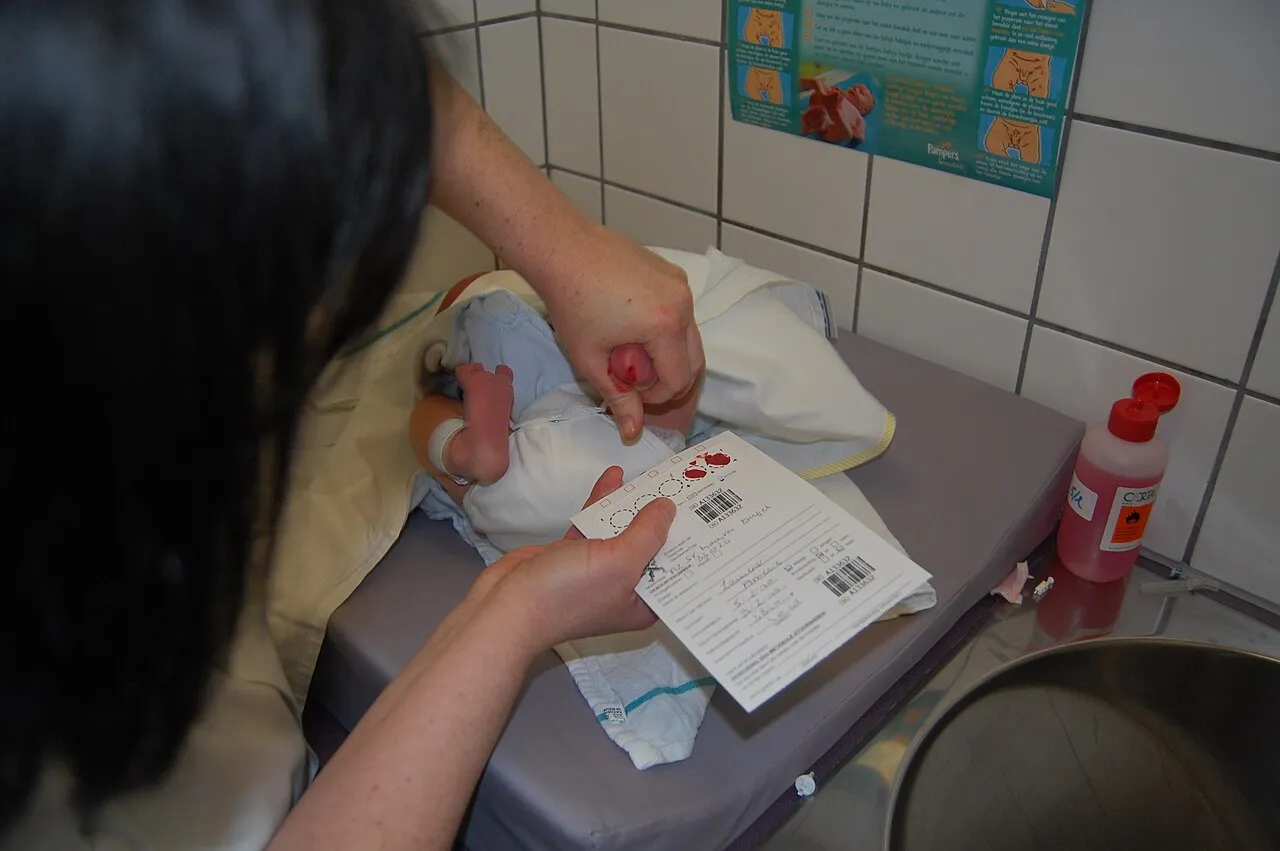
 A midwife performing a neonatal heel-prick test
Credit: Donald Trung / Wikimedia Commons (CC BY-SA 4.0).
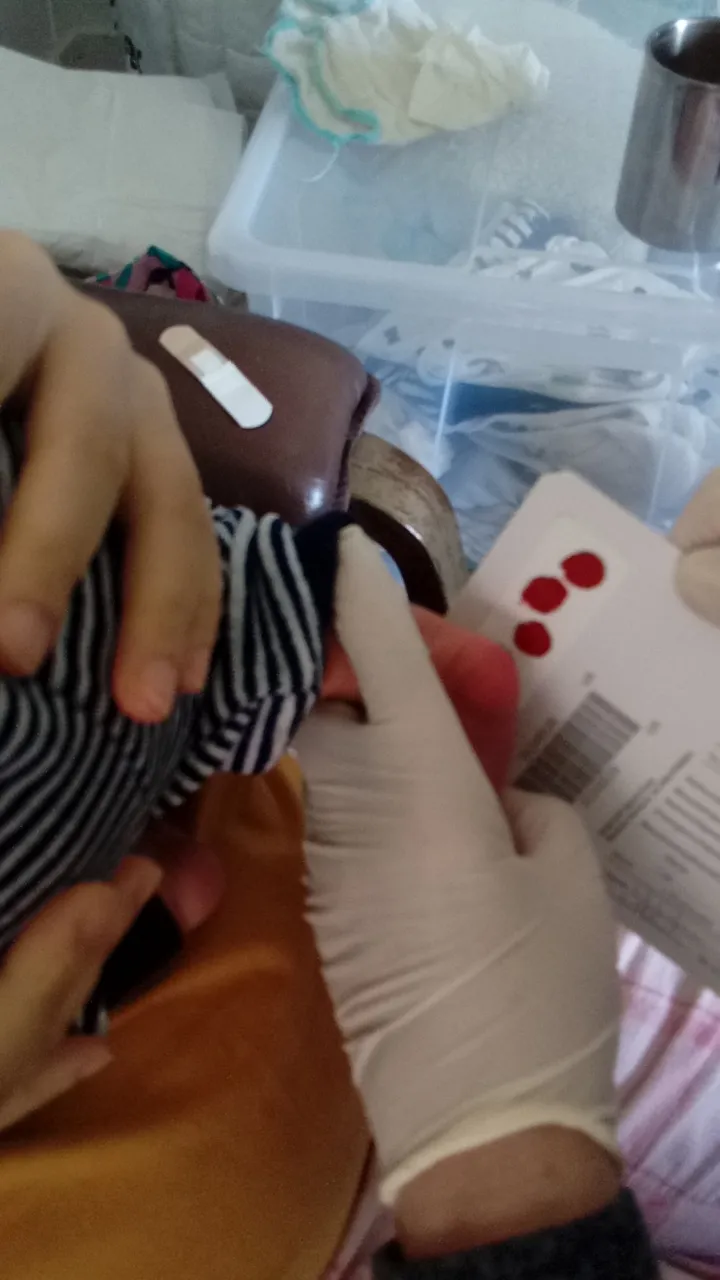
For parents in the region, the practicalities are reassuringly simple. No extra blood is needed and no additional appointment is required: the same heel-prick card collected by the midwife is used, and babies found to be affected are referred to a specialist paediatric team directly from the laboratory. Most families can expect to have all of their baby's screening results within the first six weeks.
The campaign that brought the timetable forward
The speed of the rollout owes a great deal to public campaigning — most prominently by former Little Mix singer Jesy Nelson, whose twin daughters, Ocean and Story, were diagnosed with SMA at six months old. Nelson has said her one-year-old girls were diagnosed too late for treatment to change their trajectory and are unlikely ever to walk by themselves.
Her intervention helped push the programme forward. The government committed to speeding up the rollout following a Westminster Hall debate triggered by an online petition that attracted more than 150,000 signatures, with the Department of Health and Social Care, NHS England and the National Institute for Health and Care Excellence announcing that laboratories would start screening from October 2026 — three months ahead of schedule.
Andy Fletcher, chief executive of Muscular Dystrophy UK, said the launch would "literally change lives" for families, crediting years of tireless campaigning by the SMA community. Rob Hastings, head of medical affairs at Novartis, which manufactures one of the SMA treatments, called the progress encouraging, saying the evaluation had the potential to give families and healthcare teams important information sooner. Nelson's story is a reminder of how powerfully personal experience can drive health policy — just as BBC presenter Maryam Moshiri's decision to speak publicly about her blood cancer diagnosis brought a difficult subject into the open.
Scotland got there first
England is not the first part of the UK to take this step. Scotland became the first UK nation to offer SMA screening as part of routine newborn checks, launching a two-year pilot in which all parents are offered the test through the existing blood spot check. One child in Scotland has already received treatment after having the gene mutation detected through the programme.
Scotland has also moved on treatment access: in September 2026, nusinersen was accepted for NHS use in Scotland for babies diagnosed with SMA before symptoms develop, having previously been available only after symptoms appeared. That decision means all three approved SMA treatments — nusinersen, risdiplam and Zolgensma — are now available right across the UK as options for babies diagnosed before symptoms start. Muscular Dystrophy UK's report on the Scottish decision sets out what earlier access means for families, and the background to the Scottish pilot is covered by the Progress Educational Trust.
The case for acting early is illustrated by the Thames Valley pilot that preceded the national evaluation. More than 30,000 babies were screened, and one child — Teddy — was identified with SMA before symptoms appeared. He now takes the medicine risdiplam every day and, at two and a half years old, is developing normally. His parents have said they knew very little about SMA before the diagnosis and described the news as devastating — but were relieved the condition had been caught before symptoms emerged.
Treatment options have never been better
The screening launch lands at a moment when the treatment landscape for SMA has been transformed. In May 2026, nusinersen and risdiplam were approved for permanent NHS use in England after several years of restricted access under managed access agreements, during which data on their effectiveness and value for money was collected. With Zolgensma, that makes three treatment options now routinely available — a remarkable change for a condition that, a decade ago, had no disease-modifying treatments at all. Muscular Dystrophy UK's analysis of the NICE decision explains how access has widened, including for people who are permanently ventilated.
For families living with SMA day to day, support and practical guidance remain essential alongside medical treatment. SMA UK publishes detailed information for families and emergency services on caring for a child with the condition, including emergency healthcare planning.
A postcode lottery remains
There is, however, an unfinished edge to the good news. The evaluation covers England only, and campaigners are already warning of a postcode lottery. Fletcher said it was "simply not acceptable" that babies with SMA in Wales and Northern Ireland do not get the same chance of early diagnosis as those in England and Scotland.
That disparity will now come under pressure. With England's evaluation under way and Scotland's pilot already delivering treatment to a baby identified through screening, the expectation among charities is that the evidence gathered — on medical benefits and potential cost savings — will make the case for UK-wide screening difficult to resist. A detailed medical overview of the English programme is available from Medscape.
Why early detection keeps winning
The SMA programme is the latest evidence of a simple principle running through modern medicine: finding disease early saves lives and prevents suffering. Screening programmes have a long track record — from the heel-prick panel itself to adult programmes — and campaigners continue to press for more, as Sir Chris Hoy has done in calling for better prostate cancer screening. The same preventive instinct drives wider children's health policy, from efforts to curb vaping among young people to surveillance of food-borne illness outbreaks that threaten public health.
For the families of the 60 to 70 babies diagnosed with SMA in England each year, though, the abstract principle is about to become intensely personal: a few drops of blood at five days old, and the chance of treatment before a devastating condition ever takes hold. More of our reporting on medical advances can be found in the Health section, and on the Verity homepage. About Verity.