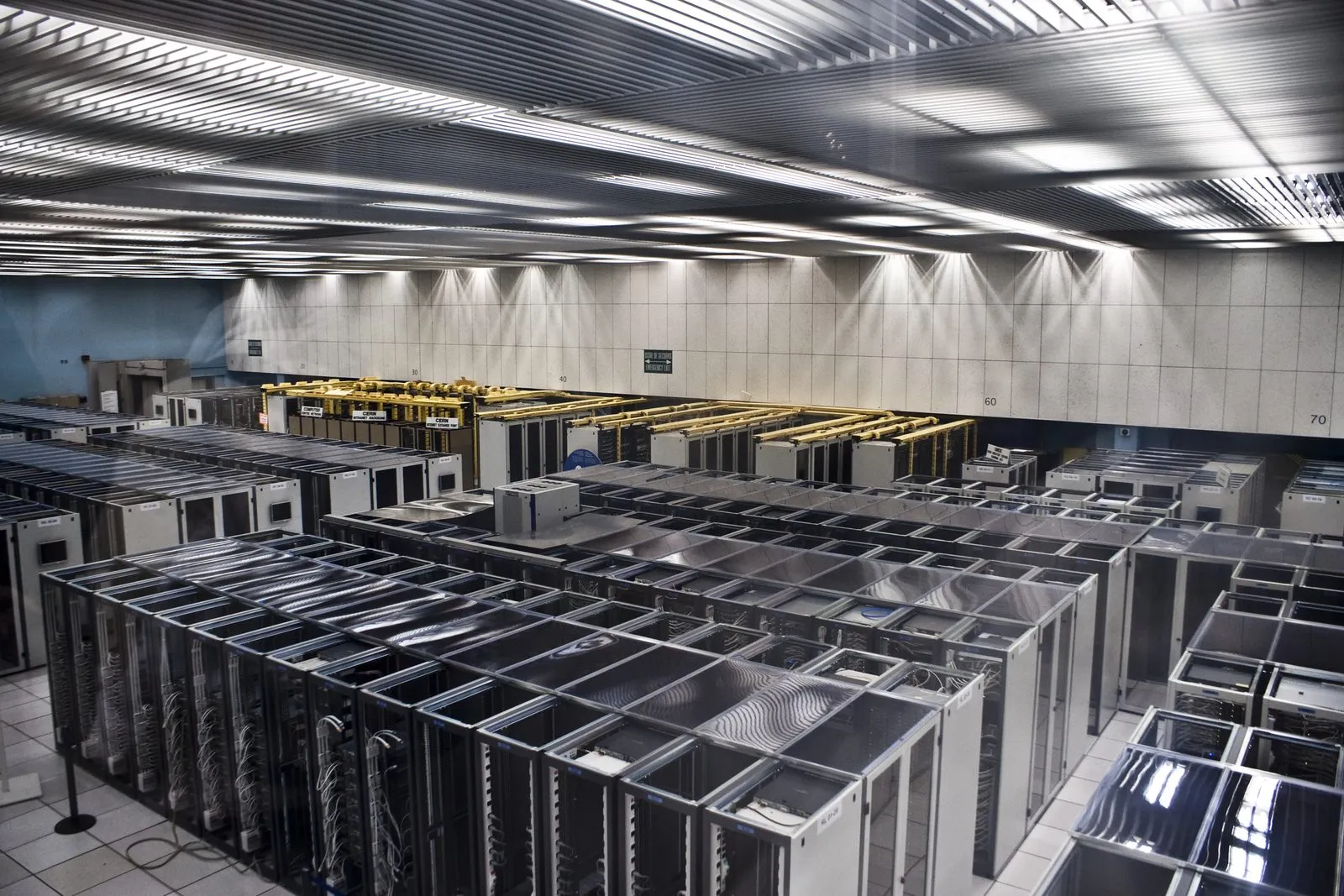
Microsoft has walked away from the flagship British AI data centre project it was meant to anchor, after the electricity needed to run it failed to arrive on time. The US technology giant has terminated its agreement with Nscale over the planned £2 billion data centre in Loughton, Essex — billed as the UK's largest AI data centre — because the grid connection required to power tens of thousands of Nvidia AI chips has reportedly been pushed into the 2030s.
The withdrawal, first reported by the Telegraph and confirmed on Monday, is an embarrassing setback for Britain's ambitions to become a global AI leader — and a case study in the gap between the country's data centre plans and the electricity grid that must sustain them.
A single site, a much bigger signal
Microsoft was expected to be the anchor tenant at Loughton, renting around 23,000 Nvidia GB300 graphics processing units — the chips at the heart of the modern AI boom — in a 50-megawatt facility with room to expand to 90 megawatts. The computing power was destined for Microsoft's Azure cloud services in Britain, with the first chips expected to be in place in early 2027.
Instead, the site has no power to run them. According to Reuters' reporting on the withdrawal, electricity grid officials told Nscale they did not expect to supply the site until the 2030s — roughly a decade later than the original plan, which had power arriving by the end of 2026.
"This decision relates to a single site," a Microsoft spokesperson said, stressing that the company remains committed to its partnership with Nscale on digital infrastructure and AI growth globally. Nscale echoed that line: "Our relationship with Microsoft remains strong and long-term, and this unfortunate London-wide grid issue has no impact on our other contracts," a spokesperson told Reuters. The two companies continue to work together in Norway, Portugal and the United States.
The power problem
The crux of the story is infrastructure, not appetite. Britain's data centre developers are queueing for grid connections that the existing transmission network cannot deliver on their timelines. Property Week's detailed account of the Loughton case reported that Nscale originally expected power for the 50-megawatt site by the end of this year but may now have to wait until the early 2030s, as the firm waits for upgrade works on the national electricity transmission network to be completed.
The distinction matters: Nscale holds an agreement to connect to UK Power Networks' distribution network rather than directly to the National Grid's transmission network. A UK Power Networks spokesperson told the Register it could not discuss individual connections, but added: "In general, many datacentres, whilst they can connect to our distribution network, are awaiting works on the national transmission network which we do not own." A source close to the situation insisted there had been no delay to the connection date formally agreed with Nscale — but the practical effect, as reported, is a site without timely power.
The scale of the queue is striking. Bottlenecks in grid connection queues are reportedly delaying UK data centre projects by as long as 13 years, and Britain's data centre grid connection requests now total about 73 gigawatts — an enormous pipeline of planned demand chasing limited transmission capacity.
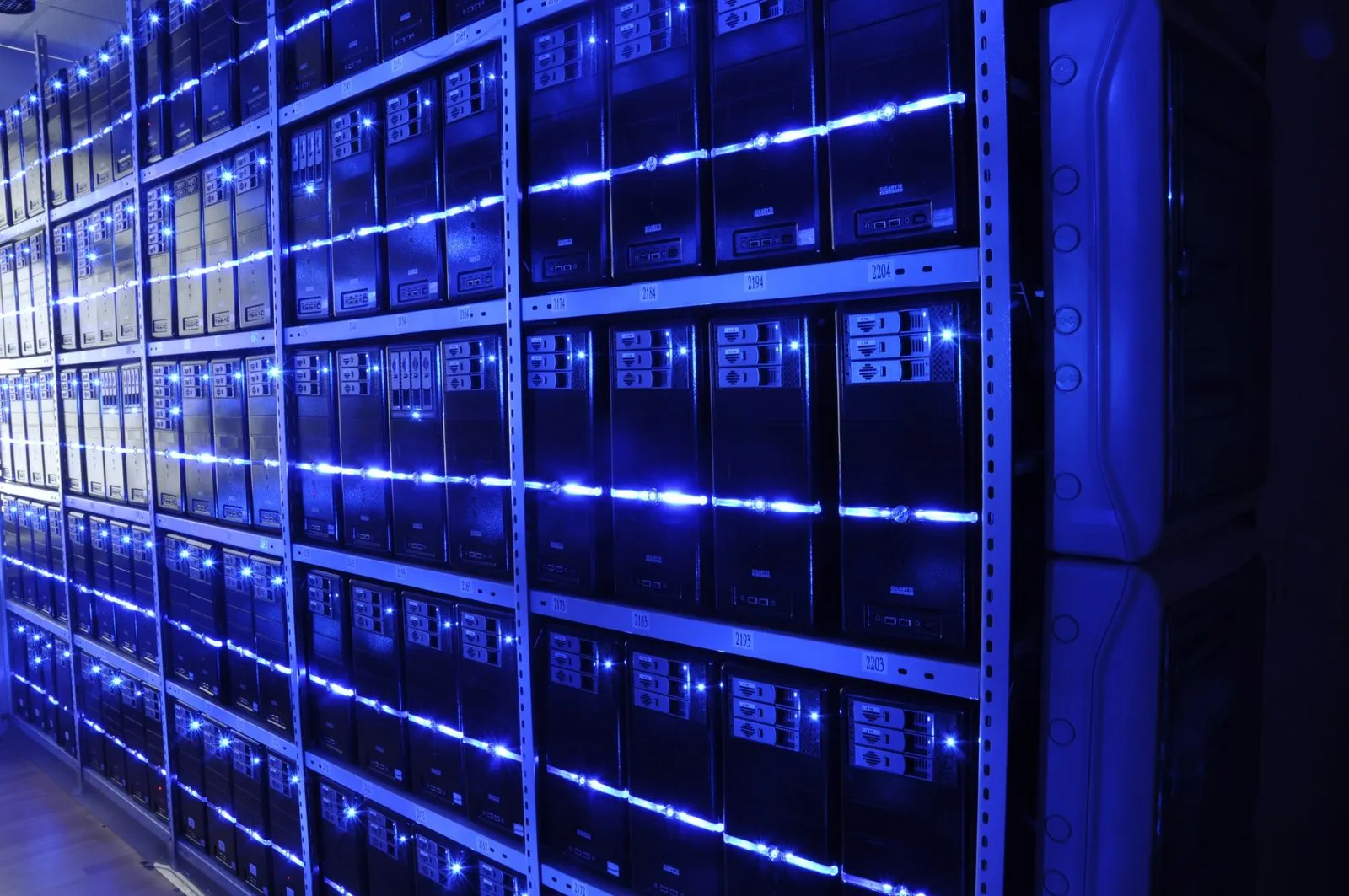 Inside a modern AI data centre: rows of server racks like the 23,000 Nvidia chips planned for Loughton.
What Nscale says happens next
Nscale, which announced the £2 billion Loughton investment in 2025, is not giving up on the project. "We remain committed to both the Loughton project and the UK, and we are exploring alternative power sources for the site, as well as other expansion sites in the UK," the company said in a statement carried by Devdiscourse.
The company, backed by Nvidia and grown out of the bitcoin mining business Arkon Energy, has repositioned itself as a provider of computing power to AI firms. It filed for a US initial public offering last month, with Microsoft and Anthropic expected to be among its major customers according to its prospectus, and it recently raised $3.36 billion through convertible loan notes in a round led by hedge fund Third Point.
The Telegraph reported that the withdrawal comes as Nscale prepares for a potential US stock market listing valuing it at up to $35 billion (£26 billion) — at a time when other AI infrastructure bets are facing turbulence, as Verity's Technology section has tracked: Nvidia-backed Firmus recently scrapped its IPO, Samsung posted record profits on the AI chip boom, and the UK announced £40m for new robotics hubs. QNC News' report noted that when reporters visited earlier this year, the Loughton plot was still being used as a working scaffolding yard — a reminder of how much work remains before it becomes the AI supercomputer it was billed as.
A blow to Britain's AI pitch
The timing is awkward for the government. The Loughton project was among the technology deals announced during US President Donald Trump's visit to the UK in September 2025, intended to showcase Britain's ambition to become a global AI leader. It formed part of Microsoft's broader £22 billion of UK investment commitments unveiled during that visit.
Microsoft's UK boss has said the company remains committed to its $30 billion UK investment plan despite the exit. But the episode underlines the financing and power pressures facing data centre developers — pressures that no amount of political goodwill can wish away. Britain wants to host the infrastructure of the AI age; its transmission grid is struggling to keep up with the requests.
The story fits a wider pattern that Verity has been tracking: the physical footprint of the AI boom is colliding with planning, power and public consent — even as OpenAI dismissed three researchers over mishandled information and the industry's growing pains mount. Our recent coverage of London's Charlton Riverside dilemma — homes versus data centres on the same stretch of riverfront — showed the same tension at the planning level. Loughton shows it at the power level.
Why data centres eat so much power
It is worth spelling out why a single building can need this much electricity. Modern AI data centres are not rows of ordinary computers; they are dense installations of specialised accelerators — in this case Nvidia GB300 chips — each drawing hundreds of watts and generating enormous heat. Training and running large AI models requires thousands of these chips working in parallel, around the clock, cooled by industrial systems that consume still more power. A 50-megawatt facility draws roughly as much electricity as a small town, continuously.
That is why the grid connection is the binding constraint. You can buy the chips, clear the site and sign the anchor tenant — but without transmission-level power, the building is just a very expensive warehouse. It is also why Nscale's talk of "alternative power sources" matters: developers across the industry are looking at on-site generation, battery storage and dedicated energy deals to bypass the grid queue.
What to watch
Three questions will decide how this story develops. First, can Nscale find an anchor customer to replace Microsoft at Loughton, or a power solution that makes the site viable on a credible timeline? Second, does the government accelerate transmission upgrades — the real bottleneck — to rescue the pipeline of 73 gigawatts of planned data centre demand? Third, what does Nscale's US listing, when it comes, reveal about the company's valuation and its investors' appetite for the UK market?
For now, the message of Loughton is simple and sobering: in the race to build the AI future, the limiting factor is not ambition, chips or capital. It is electricity — and the wires that carry it.