The BBC has confirmed one of the most significant retrenchments in its recent history: BBC Three, BBC Scotland and Radio 4 Extra will all disappear from linear broadcast schedules in spring 2027. The announcement, made to staff on Tuesday morning, was paired with news that BBC News will cut a net total of just over 100 roles — the latest step in a cost-cutting drive that will see up to 2,000 jobs go across the corporation.
The BBC's own reporting framed the move as part of a £500 million savings programme running to 2028, a target driven by a licence-fee settlement that has shrunk by around a quarter in real terms since 2017 and by audiences migrating steadily from scheduled television to on-demand viewing. More news coverage of Britain's media landscape follows on Verity.
What exactly is closing
The details, confirmed to staff by Director-General Matt Brittin, are precise. BBC Three and BBC Scotland will end their linear TV transmissions in spring 2027 and continue as online-only offerings on BBC iPlayer. BBC Scotland's programmes will also appear on BBC One and BBC Two in Scotland. Radio 4 Extra — the archive speech station — will close as a linear station entirely, with its programmes moving to BBC Sounds; The Daily Service will be available on BBC Sounds and local radio.
In a note to staff, Brittin said: "We need to make every pound work harder for audiences as we respond to the immediate cost pressures and reinvent the BBC for a changing world. We all know that means tough choices." He acknowledged the confirmation would be "hard for audiences and colleagues", while insisting that much of the affected content would still be found "where audiences already enjoy it on iPlayer and Sounds", according to the Radio Times.
A £500 million savings drive
The channel closures are only one element of a much larger restructuring. BBC News director Rachel Jupp told staff the news division would close a net total of just over 100 roles, saving an expected £5.5 million. But the division's savings target is far larger: it is expected to contribute at least £51 million to the corporation's overall plan, with only around £30.5 million identified so far, according to The Wrap's reporting.
Across the BBC as a whole, between 1,800 and 2,000 jobs are expected to go — nearly one in ten of the corporation's roughly 21,500 employees. The cuts land amid a brutal wider labour market for media and beyond; Verity recently reported on UK job vacancies falling to a five-year low and on 1,400 job cuts at Paddy Power's owner Flutter.
This is not the first round. In June 2026 the BBC announced 550 roles would go across news, nations and content, targeting £160 million in savings, and more than 30 BBC Sport jobs have already been axed. Cancelled programmes include RuPaul's Drag Race UK, Blankety Blank, Celebrity Mastermind and DIY SOS, while plans for a purpose-built studio for The Archers in Birmingham were scrapped. Jupp has warned staff to expect further savings proposals early in 2027.
BBC Three: a channel with two lives
Few parts of the BBC illustrate the corporation's digital pivot better than BBC Three. The youth-skewing channel was first removed from linear television in 2016 and moved online, before returning to TV screens in 2022. Since its return it has been behind some of the BBC's defining hits of recent years, including Fleabag, Normal People and Killing Eve.
Its programmes will now live on iPlayer and other platforms including YouTube — a recognition, the BBC argues, of where younger audiences already watch. The irony is not lost on critics: a channel once held up as the future of digital-first broadcasting is being sacrificed to pay for that same future. The BBC's recent ratings successes, such as Celebrity Traitors drawing more than 15 million viewers, show what the corporation can still achieve when its biggest brands land.
Scotland reacts with anger
The reaction in Scotland has been the angriest. Culture minister Mairi McAllan called the decision to move BBC Scotland online "wholly unacceptable", and a further 10 jobs will be lost in Scotland as a result of the changes. The channel, which currently broadcasts in the evenings and simulcasts BBC Radio Scotland during the day, will remain on iPlayer but lose its broadcast slot.
The Scottish Sun's coverage noted the political sensitivity: the BBC is funded by licence-fee payers across the UK, and the loss of a dedicated Scottish broadcast channel will be read by critics as a downgrading of the corporation's commitment to the nations. The BBC's counter is that the content will still be made and still be available — just not on a traditional channel number. Trade press summarised the restructuring as part of the broader £500 million savings programme running to 2028.
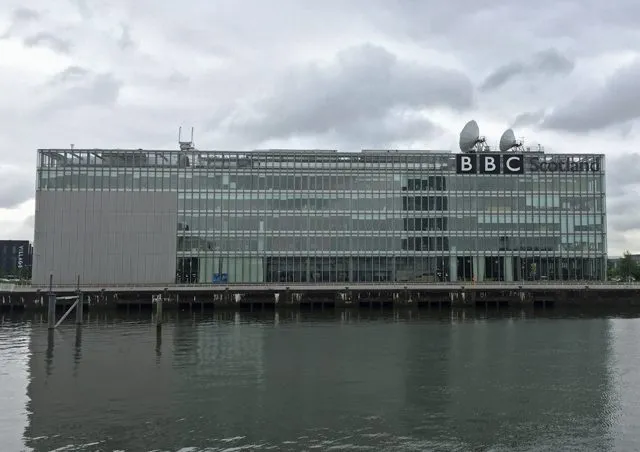 The BBC Scotland building at Pacific Quay in Glasgow; BBC Scotland's linear channel closes in spring 2027 and moves online-only
Credit: John Allan / Geograph Britain and Ireland via Wikimedia Commons (CC BY-SA 2.0).
Radio's quiet retreat
Radio 4 Extra's closure has attracted less political heat but marks a similar milestone. The station, home to archive comedy, drama and readings, will vanish from the dial, with its programmes folded into BBC Sounds. For an organisation that built its reputation on radio, the move underlines how far the on-demand shift has gone: even the BBC now treats linear radio as a legacy distribution method for archive material rather than a growth platform.
The leadership behind the cuts
The cuts are being carried out by a relatively new leadership team. Matt Brittin, the former Google executive who took over as Director-General earlier this year, is overseeing the biggest restructuring of the BBC in a generation. Rachel Jupp was appointed BBC News director only this month, after her predecessor stepped down amid a row over a misleading edit of Donald Trump in a BBC documentary last year — a controversy that damaged trust in the corporation's journalism and still shadows its newsroom.
Jupp is now reviewing costs across the news division, including how presenters are deployed across television, audio and digital, and how to extract more value from long-form journalism and commissioning. The BBC's documentary output remains one of its strengths — Verity recently covered the Queen Camilla reading documentary and the music of The Traitors — but prestige programming alone cannot close a £500 million gap.
What comes next
The BBC insists the closures are about following audiences, not abandoning them. Whether licence-fee payers accept that argument will shape the next charter debate, and the corporation's critics — from Holyrood to its own staff — show no sign of quieting down. With further savings due to be announced early next year and the news division still tens of millions short of its target, spring 2027 may not be the end of the BBC's shrinking. Follow more of our coverage as the story develops.