This is an analysis piece. The events described are drawn from reporting by the BBC, Sky Sports and others; the interpretation is the author's.
How the unthinkable happened in Copenhagen
There are moments in football when the symbolism overwhelms the sport itself. Cristiano Ronaldo — 41 years old, 146 international goals, 234 caps, the most famous footballer Portugal has ever produced — warming up on a touchline in Scandinavia, waiting for a call that never came. Then the private jet. Then the statement. Then the silence.
The facts, as reported by Sky Sports, are these. Ronaldo was an unused substitute in Portugal's Nations League win over Norway — the first time in 18 years he had sat out an entire match on the bench. New head coach Jorge Jesus, the man who coached him at Al Nassr, had told him in advance that he would not play against Norway or start against Denmark. At his press conference in Copenhagen, Jesus insisted the absences were part of a pre-planned physical management strategy and that "there was no incident whatsoever", as reported by the Daily Times. Jesus later admitted he had initially planned to bring Ronaldo on for the final half hour against Norway, with Gonçalo Ramos starting up front, but changed his mind as the match developed and sent on Francisco Trincão instead.
Ronaldo did not take it well. He completed individual gym work rather than full group training, and after Jesus's press conference in Copenhagen — at which the coach insisted "there was no incident whatsoever" — the captain announced he was leaving the camp. "Following the national team manager's press conference, and after a conversation with the President of the Portuguese Football Federation, I decided to leave the national team's training camp," he wrote. "In due course, I will tell the Portuguese people the truth about the reasons behind my departure from the national team, to which I have always been dedicated."
That final line — the promise of a "truth" yet to be told — is what has turned a selection dispute into a national drama. Portuguese FA president Pedro Proença reportedly flew to Copenhagen, landing at 02:30 in the morning, in a desperate attempt to talk Ronaldo round. He failed.
Two exits, two philosophies
What makes this moment so freighted is the contrast unfolding simultaneously on the other side of the Atlantic. Lionel Messi, 39, has retired from Argentina duty, with Tuesday's friendly against Benin marked as his farewell — a staged, celebrated goodbye, the kind of exit the sport's romantics dream of.
Messi's farewell
Messi's departure, as covered in our sports section, was choreographed as gratitude: a final bow in front of his own people, the narrative closed on his terms. Ronaldo's, by contrast, has been choreographed as grievance: a walkout, a cryptic statement, a promised revelation. One legend chose the door; the other appears to have had it shown to him, and cannot accept it.
It would be easy — and wrong — to treat this as mere ego. Ronaldo's entire career has been built on the refusal to accept diminishment: the extra training sessions, the physical reinvention across four leagues, the relentless pursuit of records. The same mentality that carried him to 979 career goals, now chasing an unprecedented 1,000, is the mentality that cannot process being an unused substitute. The tragedy is that the trait and the flaw are the same trait.
The numbers that sharpen the debate
Strip away the emotion and the tactical question is legitimate — which is precisely why this debate will not die down. Over the past nine years, Portugal's win rate without Ronaldo stands at 66 per cent, against 63 per cent with him. The sample is imperfect, the contexts vary, but the direction is uncomfortable for the romantic case: the team has, by the bluntest measure available, performed marginally better in his absence.
Portugal's next generation is already here
And the alternatives are not theoretical. Against Norway, Gonçalo Ramos — the man who started ahead of Ronaldo — scored. Portugal won 2-1 without their captain touching the ball, then beat Denmark 4-2. Jesus's argument, stripped of diplomacy, is the one every elite coach eventually makes about every ageing superstar: the team must be picked on current performance, not past achievement. As he put it, with the weary patience of a man who has answered the question a hundred times: "How many players warmed up today and didn't come on? How many? Is there going to be a problem with any of them? No."
The counter-argument — and it is a serious one — is that Ronaldo's value was never purely tactical. His presence bends opposition defences, lifts team-mates, and sells the very idea of Portugal as a footballing power. You do not discard 146 international goals because the win-rate spreadsheet wobbles by three points. As one report on the saga noted, Jesus himself conceded "Ronaldo was angry with me" — an admission that this was never just a routine squad rotation.
A divided nation
Portugal is split, and the split maps onto something deeper than football tactics. In Lisbon, billboards have appeared both celebrating and questioning the captain — a literal visualisation of a country arguing with itself. The media is divided between those who see a coach asserting necessary authority over a fading icon and those who see an institution humiliating its greatest servant.
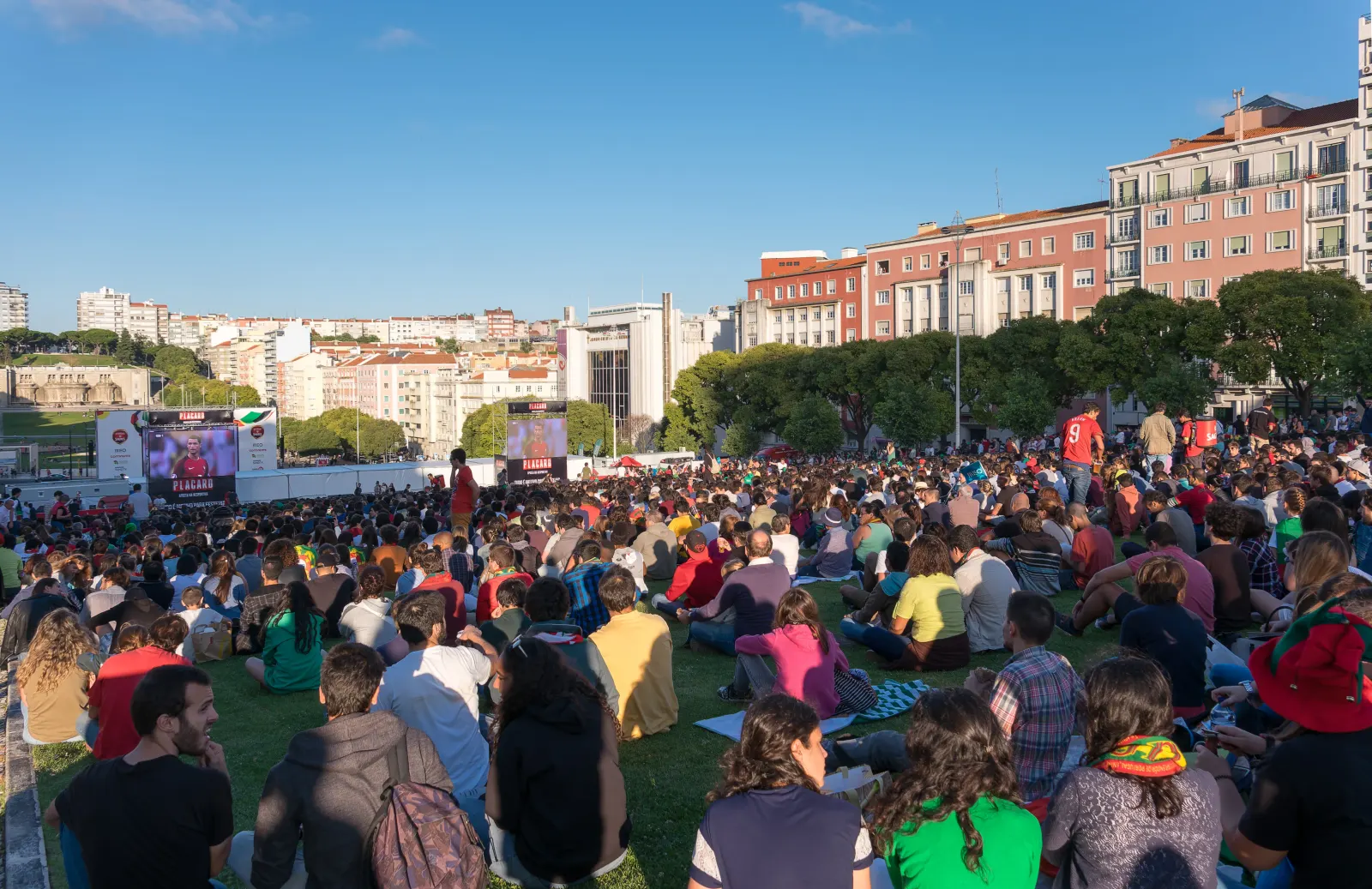 Portuguese fans in Lisbon watching Cristiano Ronaldo on giant screens
Portuguese fans in Lisbon. The country is split over whether its greatest player should continue with the national team. Credit: julesvernex2 / Wikimedia Commons (CC BY-SA 4.0)
This is the pattern of every late-career reckoning for the truly great: the nation cannot decide whether it is watching a hero being diminished or a team being liberated, because it is watching both. The BBC's analysis captured the essence — a country that owes Ronaldo everything, confronting the possibility that everything is no longer enough.
There is also a generational dimension that Portugal ignores at its peril. The players now carrying the team — Ramos, Trincão, the cohort that won without him in Copenhagen — need to know whether the hierarchy is settled or still hostage to one man's pride. Jesus understands this; it is why he has been so careful, even while being so firm.
What happens now
Jesus has left the door conspicuously ajar. "Cristiano Ronaldo will be called up for the next international break, if he wants to return," he said — an olive branch reported by The Sun — adding: "It's his decision. I am ready to call him if he will play with Al-Nassr." And then the line that will define this saga: "He's the one who should decide how he wants to end his time with the national team."
It is a masterstroke of man-management disguised as generosity — placing the entire weight of the decision on Ronaldo's shoulders, where it belongs. The subtext is clear: the team will go on with or without you; the choice of ending is yours.
The 1,000-goal question
For Ronaldo, the calculus is agonising. International football offers the stage his ego requires and the goals his legacy demands — he remains the world-record holder, and the march to 1,000 career goals is the last great statistical frontier. But every further snub risks the thing he fears most: the slow, public erosion of the myth. Messi read the moment and took the farewell. Ronaldo, characteristically, is still deciding whether the moment applies to him.
Whatever he decides, Portugal has already crossed a threshold. A team that wins without its talisman, a coach who benches him without flinching, a federation president who flies through the night and fails — these are the scenes of a transition, whether the protagonist accepts it or not. The nation is divided because both sides are right: Ronaldo deserves a better ending than a bench in Scandinavia, and Portugal deserves a future that is not held hostage to one man's refusal to end.
More football opinion and analysis in our opinion section and sports coverage, including our report on Messi's Argentina farewell. Start at our homepage or read about us.