In Short (TL;DR)- A 16-year-old suspect forced entry to Silver Rail Elementary School in Bend, Oregon, at around 12:59 local time on Thursday, shooting out locked doors.
- Three children — aged 5, 8 and 11 — and a teacher were killed in the attack.
- A bystander pursued the gunman into the school and confronted him; police arrived three minutes after the first calls.
- A 7-year-old child and a 54-year-old teacher are in critical condition; the suspect, an unnamed local boy, is in custody.
- Schools across the district are closed on Friday, and a vigil has been held at Drake Park in Bend.
Three children aged 5, 8 and 11, and a teacher, have been killed in a shooting at an elementary school in Bend, Oregon, in the latest deadly attack on an American school. The gunman, a 16-year-old boy, forced his way into Silver Rail Elementary School at around 12:59 local time on Thursday, shooting out locked doors to gain entry. Two more people — a 7-year-old child and a 54-year-old teacher — are in critical condition.
Police say the first emergency calls came in just before 1pm. What happened in the minutes that followed is now the subject of an active investigation, but the outline provided by officials describes a scene of chaos met with extraordinary courage: a bystander pursued the gunman into the school building and confronted him, and officers arrived on the scene three minutes after the initial calls. The suspect, described only as a local 16-year-old boy, was taken into custody. He has not been publicly named, and authorities have not disclosed any possible motive.
Silver Rail Elementary serves around 450 pupils with more than 40 members of staff — the kind of small, close-knit school where everybody knows everybody, and where news like this does not land as a headline but as a rupture in the fabric of daily life. Thursday began as an ordinary school day. By early afternoon, the building was a crime scene, its locked doors — the standard security measure of the modern American school — shot through by a teenager with a gun.
The details released so far are deliberately spare, and they should remain so out of respect for the families. What is known is the toll: three young lives — children of 5, 8 and 11 — and the life of a teacher, ended in the place where they should have been safest. A fourth child, aged 7, and a second teacher, aged 54, are fighting for their lives in hospital. Behind each of those numbers is a family that sent a child or a loved one to school on Thursday morning expecting them home by dinner.
In the accounts given by officials, one figure stands apart. Before police reached the school, a bystander — a member of the public whose name has not been released — pursued the armed teenager into the building and engaged him. Oregon's governor, Tina Kotek, said the bystander had "heroically intervened," a phrase that carries the weight of official gratitude and the suggestion, left carefully unstated, that the toll could have been worse.
Three minutes. That is how long it took officers to arrive after the first calls — a response time that speaks to the readiness of local law enforcement and to the terrible arithmetic of these attacks, in which minutes are measured in lives. The bystander's intervention in those first moments will inevitably become part of how Bend remembers this day: proof, amid the horror, that courage is not the sole property of uniforms.
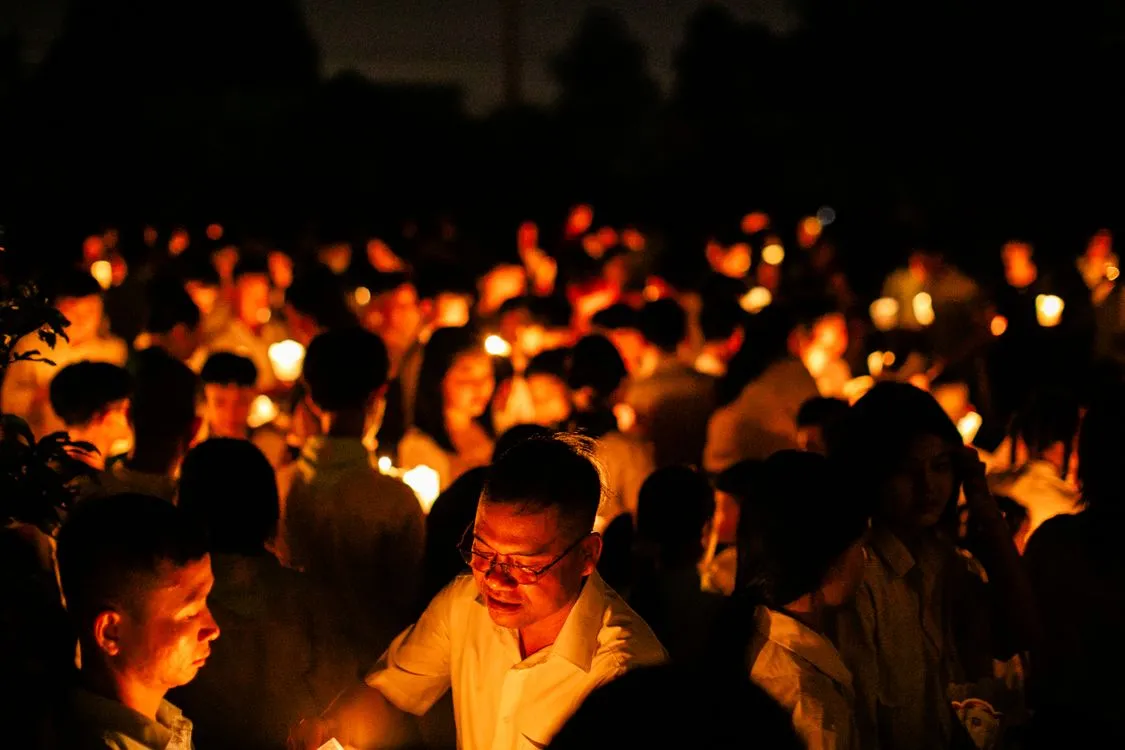
By Thursday evening, the focus had shifted from the school to the town. Residents gathered for a vigil at Drake Park in central Bend, holding candles against the dark in the now-familiar ritual of American communal grief. Schools across the district will remain closed on Friday — a decision that acknowledges the obvious: no child in Bend is ready to sit in a classroom today, and no teacher is ready to stand at the front of one.
A hand holding a lit candle at a peaceful vigil gathering
A hand holding a lit candle at a peaceful vigil gathering. Credit: Photo by David Dibert on Pexels (Pexels License)
Bend is a city of around 100,000 people in the high desert of central Oregon, better known for its outdoor lifestyle and craft breweries than for appearing in national headlines. Like every community that has endured a school shooting, it now joins a fellowship no town asks to enter. The practical machinery of aftermath is already moving — counselling services, victim support, the slow work of investigation — but the deeper wound, the one measured in sleepless parents and empty desks, will take far longer to address. Communities that survive other sudden tragedies know something of this long aftermath; the loss of young lives anywhere reverberates far beyond the immediate families.
For parents everywhere, the story lands with a particular force. The morning routine — the packed lunches, the waved goodbyes — is an act of trust, placed daily in an institution and a society. When that trust is broken so violently, the questions that follow are not only about security procedures but about the kind of country in which sending a five-year-old to school carries this risk. Verity has examined before how parenting itself feels under modern pressures; Thursday's events add a darker dimension to every family's calculations.
The shooting will inevitably renew debate about gun laws in Oregon and across the United States. The BBC's reporting notes the state's existing framework: Oregonians under 18 are prohibited from purchasing firearms, and the gun-control advocacy group Everytown for Gun Safety ranks Oregon 12th strictest in the nation for firearms legislation. Those facts will be cited, parsed and contested in the days ahead — as they are after every such attack — by those who argue the laws are insufficient and those who argue the laws are irrelevant to someone willing to break them.
What can be said with certainty is narrower and sadder. A locked door, the standard defence of the American schoolhouse, was defeated by gunfire. A teenager — legally barred from buying a gun — was nonetheless armed. And a community's ordinary Thursday became a date its residents will remember for the rest of their lives. The policy debate will run its course through legislatures and courts; the national conversation will move on to other subjects, as it always does. Bend cannot.
For now, the verified facts are these: the investigation continues, the suspect is in custody, two people remain critically ill, and a city is grieving. Anyone seeking to help can contact established relief organisations such as the American Red Cross; official updates will come from the State of Oregon and federal law enforcement via the FBI. Verity's News and World sections will carry further developments, and our homepage will update as the story develops. Tonight, though, the story belongs to Bend — to the vigil candles at Drake Park, the closed schools, and the families waiting by hospital beds.