In Short (TL;DR)Comedian Russell Brand, 51, is on trial at Southwark Crown Court facing seven sexual offence charges relating to six complainants between 1999 and 2009; he denies all charges. A complainant said he turned "monster-like" before an alleged 1999 rape. The trial is expected to last six weeks.
Editor's note: this article reports on an ongoing criminal trial. All charges described are allegations; Russell Brand denies them and is presumed innocent unless and until proven guilty.
The trial of Russell Brand began at Southwark Crown Court in London this week, with the 51-year-old comedian and actor facing seven sexual offence charges relating to six women over a ten-year period. Brand denies three counts of rape, three counts of sexual assault and one count of indecent assault, alleged to have taken place between 1999 and 2009. The trial is expected to run for around six weeks.
The case marks a stark reversal for a man who was once one of Britain's most recognisable entertainers — a prime-time television presenter, a national radio host and a Hollywood film actor, now sitting in the dock of a London courtroom as a jury weighs evidence spanning the decade in which his fame was at its height.
The prosecution's case, as opened before the jury, spans allegations from six separate complainants across ten years. The charges are among the most serious in English criminal law, and each will be decided individually by the jury — guilty or not guilty, count by count. That structure matters: the jury is not being asked to deliver a single verdict on Russell Brand the public figure, but to assess each allegation on its own evidence.
Court reporting of sexual offence trials in England and Wales follows strict rules. Complainants in such cases are entitled to lifelong anonymity, and nothing may be published that could identify them. Readers should be aware that the testimony described below concerns allegations of a sexual nature.
Among the first evidence heard was the account of a woman who told the court she met Brand at the Labour Party conference in Bournemouth in 1999. In testimony reported from the courtroom, she described a consensual social encounter that, she said, changed abruptly — telling jurors that Brand turned "monster-like" before allegedly raping her. The phrase, brief and vivid, is her characterisation of what she says happened; it is contested in its entirety by the defence.
Jurors have also been shown topless photographs connected to the case and have watched a recording of a police interview Brand gave in 2023, when the investigation that led to these charges was under way. The interview footage gives the jury a chance to assess Brand's own account in his own words — a standard but significant feature of the prosecution's presentation, since what a defendant told police years ago can become central to the questions the jury must answer now.
None of this evidence has yet been tested by the defence case, which will follow the prosecution's. In the adversarial system of the English courts, the accounts heard in the opening days are only half the story the jury will eventually weigh.
Brand's position is unequivocal: he denies all seven charges. His defence is led by Ian Winter KC, one of the country's most experienced criminal barristers, who has begun cross-examining the prosecution's witnesses — probing inconsistencies, challenging recollections and testing the reliability of accounts that in some cases concern events more than 25 years old.
The defence's task is complicated by the shape of the case. Six complainants, unknown to one another in the prosecution's telling, describing a pattern of behaviour across a decade, presents the classic structure of a historic sexual offences prosecution — the kind in which the Crown invites the jury to see corroboration in similarity, and the defence invites it to see coincidence, contamination or confabulation. How the jury navigates between those readings will decide the outcome. For readers unfamiliar with how English juries approach such decisions, our explainer on what verdicts a jury can consider sets out the options — and what happens if a jury cannot agree explains the consequences of a hung jury.
It is worth stressing what should not need stressing: in this jurisdiction, the burden of proof rests entirely with the prosecution, and the standard is proof beyond reasonable doubt. An acquittal is not a declaration of innocence; a conviction requires the jury to be sure. Those principles apply with full force whatever the defendant's fame.
For younger readers, the scale of Brand's former celebrity may need explaining. In the 2000s he was ubiquitous in British popular culture: the anarchic host of Big Brother's Big Mouth, a provocative presence on BBC Radio 2 and 6 Music, and then a Hollywood export with starring roles in films including Forgetting Sarah Marshall and Get Him To The Greek. At his peak he was less a comedian than a phenomenon — a walking collision of working-class Essex irreverence, literary pretension and tabloid notoriety.
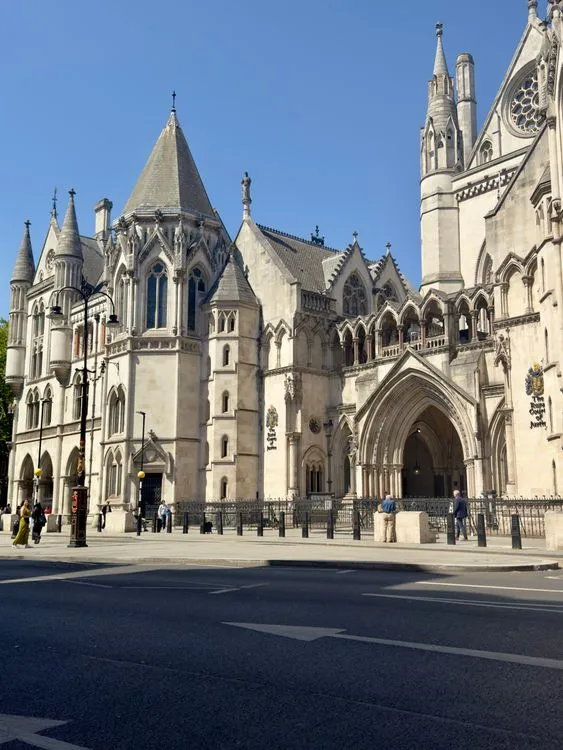
The statue of Lady Justice atop the Central Criminal Court (Old Bailey) in London
The statue of Lady Justice atop the Central Criminal Court (Old Bailey) in London. Credit: Photo by Joaquin Carfagna on Pexels (Pexels License)
The arc since has been long and strange: the controversies, the reinvention as a political commentator and online personality, the move to Florida, where he now lives. Celebrity legal battles have a way of transfixing the public, and this trial will be no exception — though the gravity of criminal charges sets it apart from the civil disputes that usually fill that genre. There is also the perennial question of what fame itself costs those who chase it — a question this trial poses in its darkest form.
The prosecution will continue to call its evidence in the coming weeks — witnesses, records, and the testimony of the remaining complainants — before the defence opens its case. Brand himself may choose to give evidence, though defendants are not obliged to. Then will come closing speeches, the judge's summing-up on the law, and the jury's retirement to consider verdicts.
Six weeks is a long time in a news cycle, and the temptation will be to treat each day's testimony as a verdict in itself. It is not. The only verdicts that matter will be delivered by twelve jurors in a deliberation room, applying the criminal standard of proof to each count. Until then, the presumption of innocence is not a courtesy extended to the famous — it is the foundation of the system trying him.
The official framework for that system is public: the Judiciary of England and Wales explains how Crown Court trials work, the Crown Prosecution Service sets out how charging decisions in sexual offence cases are made, and the Metropolitan Police led the investigation that brought the charges. Verity's News and Entertainment sections will follow significant developments, with updates on our homepage. Whatever the jury ultimately decides, the case is a reminder that the courtroom — unlike the stage — offers no heckler's veto, no editing and no second take.