In Short (TL;DR)St Luke's Hospital in Bradford adopted the DERM artificial intelligence system — Deep Ensemble for the Recognition of Malignancy — in April to help triage patients referred with suspected skin cancer. Clinic sessions that once saw 24 patients now see 32, staff can see a third more patients overall, and unnecessary biopsies have fallen by about 10%. The system, developed by Skin Analytics, analyses dermoscopic images of moles and lesions and is claimed to be 99.9% accurate at ruling out melanoma; every image is still double-checked by a clinician. The National Institute for Health and Care Excellence has conditionally recommended DERM for NHS use for three years, and it is now deployed across 40 NHS trusts. Bradford handles around 5,000 suspected skin cancer referrals a year, of which only about 8% turn out to be malignant.
The dermatology clinic at St Luke's Hospital in Bradford starts early, and it starts busy. Where a session once worked through 24 patients, it now sees 32. The waiting list is shorter, the bottlenecks are easing, and around 10% fewer patients are being sent for biopsies they turn out not to need. The difference is not more staff or longer hours. It is an artificial intelligence system called DERM.
Adopted by the Bradford trust in April, DERM — short for Deep Ensemble for the Recognition of Malignancy — analyses images of suspicious moles and skin lesions to help decide which patients need urgent specialist attention and which can be safely reassured. In a service where speed can be the difference between a simple excision and a life-threatening illness, that triage is transformative.
"This has had a big impact on all the bottlenecks — right from waiting times for patients to unnecessary investigations being done and to being seen by a clinician," one member of the team told the BBC. "It's amazing, I mean it's excellent, at giving non-cancerous diagnosis quite quickly, within minutes. It's had an impact for patients and for the department."
The process begins not in a laboratory but with a smartphone. When a GP refers a patient with a suspicious mole, a trained healthcare worker photographs the lesion using a phone fitted with a high-quality magnifying lens — known as a dermoscopic lens — that reveals subsurface structures invisible to the naked eye. The images are uploaded to DERM's secure online platform, where the AI gets to work.
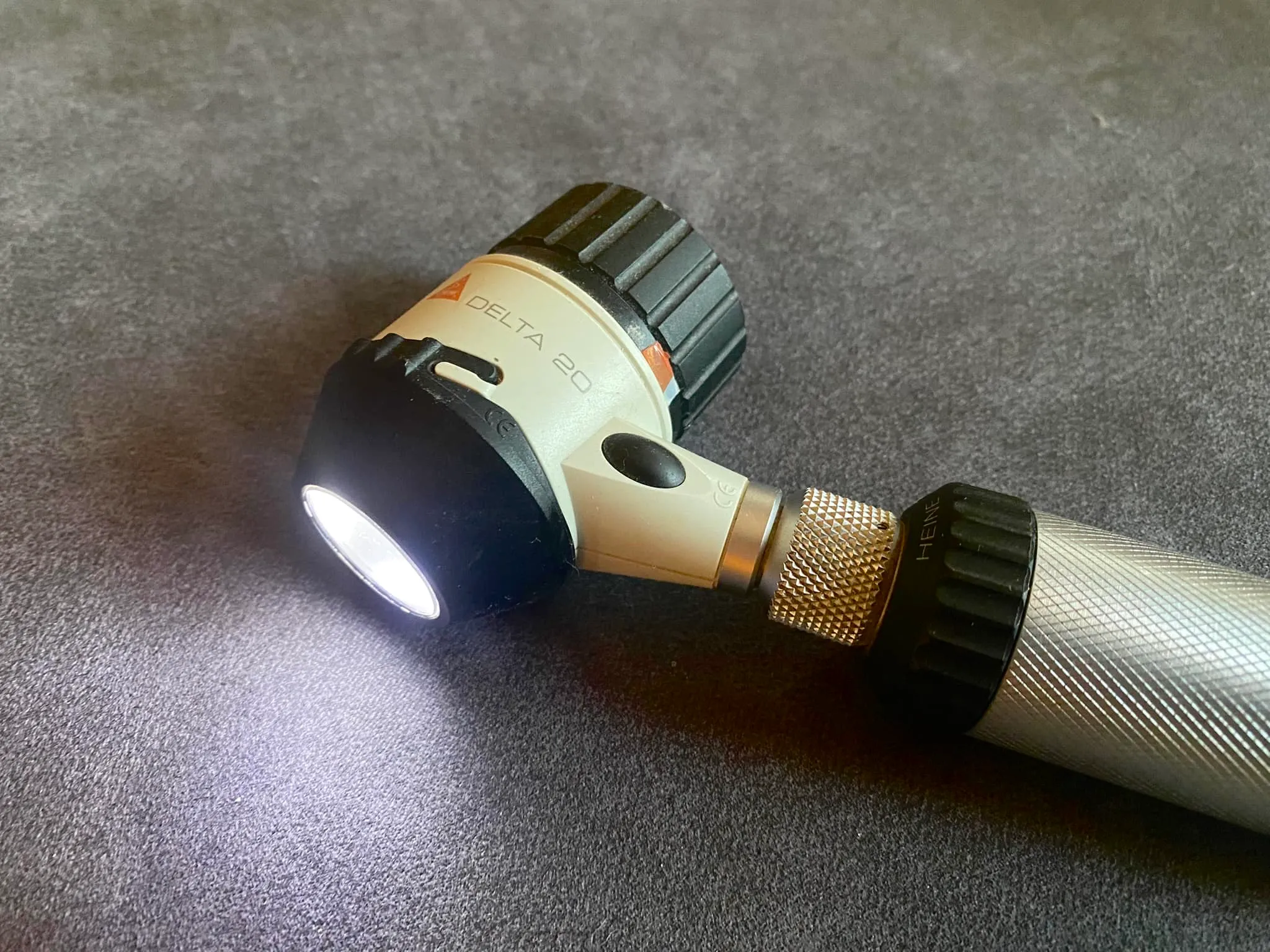
!A handheld dermatoscope device
A handheld dermatoscope — devices like this, paired with smartphone cameras, capture the magnified images that the DERM AI analyses. Credit: Frank33, via Wikimedia Commons (CC BY-SA 3.0).
The software, developed by the British company Skin Analytics, uses a fixed AI algorithm — it does not retrain itself on the fly — to classify the lesion as melanoma, squamous cell carcinoma, basal cell carcinoma, intraepidermal carcinoma, actinic keratosis, atypical naevus or benign. If the system flags a lesion as precancerous or cancerous, an NHS dermatologist reviews the case virtually and sets out a management plan. If it is judged benign, the patient can be discharged from the urgent suspected-cancer pathway with safety-netting advice, often within minutes.
Crucially, at St Luke's every image is still double-checked by a clinician before a diagnosis is confirmed. The AI accelerates and prioritises; it does not have the final word. That human-in-the-loop design is central to how the system earned the trust of regulators and the clinicians who use it.
Bradford's figures illustrate why the technology matters. The trust handles around 5,000 referrals a year for suspected skin cancer — yet only about 8% turn out to be malignant. The other 92% represent thousands of anxious patients occupying urgent-care slots while they wait for a specialist to tell them they are fine.
DERM attacks that mismatch directly. By confidently identifying benign lesions at speed, it lets the clinic see roughly a third more patients and has cut unnecessary biopsies by about 10% since April. For patients, the prize is reassurance in minutes rather than weeks of worry. For the department, it is the ability to focus scarce dermatologist time on the cases that genuinely need it.
The accuracy claims are striking. Skin Analytics says the system is 99.9% accurate at ruling out melanoma — the deadliest form of skin cancer. Data reviewed during the technology's assessment reported a negative predictive value for melanoma of 99.8% and overall detection of 97% of cancers, with the system performing as well as or better than dermatologists at ruling disease out. Across the NHS sites using it, the platform has now assessed more than 165,000 patients and identified over 15,500 skin cancers.
DERM's credibility rests on an unusually strong regulatory foundation. The National Institute for Health and Care Excellence — NICE, the body that decides which treatments the NHS should adopt — has conditionally recommended the system for NHS use over a three-year period while further evidence of its clinical and cost-effectiveness is collected. Early evidence assessed by NICE suggested that automated use of the tool could "approximately halve the number of referrals" to dermatologists within the urgent skin cancer pathway.
It is, by some distance, the most rigorously approved AI diagnostic in British healthcare. DERM is the first dermatology AI to achieve a Class III CE mark under the European Medical Device Regulation — the highest risk classification for medical devices — and the only AI software NICE has recommended for autonomous use in the suspected skin cancer pathway. A Bradford procurement notice records the trust awarding Skin Analytics a direct contract worth £764,304 excluding VAT, running from April 2026 to March 2029, on the grounds that no alternative supplier holds the necessary clearances.
The technology is now deployed across 40 NHS trusts, making skin cancer triage one of the largest real-world deployments of autonomous medical AI anywhere in the world. NICE's full early value assessment sets out the evidence base in detail.
Enthusiasm for medical AI often outruns the evidence, so the guardrails around DERM deserve attention. The algorithm is fixed rather than continuously learning, which means its behaviour in the clinic matches what was validated in testing. It is indicated only for patients aged 18 and over, and not for lesions under nails, on eyes or mucosal surfaces, on palms or soles, or on open, ulcerated or previously biopsied skin — exclusions that reflect the limits of its training data.
The economics are transparent, too: NICE's assessment priced an assessment via the online platform at £30 per referral, with a small additional cost where NHS teledermatology staff review a case virtually. Against the cost of a face-to-face dermatology appointment or an unnecessary biopsy, the trust argues the maths is compelling — particularly when multiplied across thousands of referrals.
None of this eliminates clinical judgement. Dermatologists stress that the system is a triage tool operating inside a pathway designed by doctors, not a diagnostician working alone. That distinction matters for patient trust — and for the regulators watching closely as AI moves deeper into frontline care.
For 73-year-old Laurence Patten, the system has already made a personal difference. The former builder from Bradford was urgently referred to the clinic by his GP over a suspicious mole on his back. With multiple myeloma and a previous history of skin cancer — a squamous cell carcinoma on his right forearm — he had every reason to be anxious.
Images of the mole were flagged as suspicious by the AI, and a subsequent examination by a specialist doctor suggested it was likely benign; the mole will be removed and tested to confirm the diagnosis. What struck Patten was the speed. "It's very good news," he said. "It's not ticking away in my mind, which is one of the biggest things with cancer. The sooner they find things, the quicker they can sort it."
His experience captures the quiet revolution DERM represents: not a dramatic robot doctor, but the removal of waiting — the anxious interval between referral and reassurance that has long been one of the cruellest parts of the cancer pathway.
Bradford's experience is part of a wider transformation in how the NHS handles surging demand. Skin cancer referrals have risen steeply for a decade, driven by an ageing population and greater public awareness, while dermatologist numbers have not kept pace. Tools that safely deflect benign cases from urgent pathways are no longer a luxury; they are a necessity.
The deployment also supports the NHS's 10 Year Cancer Plan, which aims to diagnose 75% of cancers at stages one or two by 2028 — a target that depends on finding disease earlier, when it is most treatable. DERM's ability to autonomously discharge up to 40% of urgent referrals, as early data suggests, could free capacity across the system.
For anyone worried about a changing mole, clinicians stress that AI triage is no substitute for getting checked promptly — Cancer Research UK's skin cancer information pages remain a trusted first port of call.
The story also illustrates a broader point about medical technology: the most valuable AI deployments are often the least glamorous. While headlines focus on chatbots and humanoid robots, systems like DERM are doing unglamorous, high-volume work — sorting the benign from the dangerous, thousands of times a day, inside one of the world's most scrutinised health systems. If Bradford's results hold at national scale, the little lens on a smartphone camera may turn out to be one of the most consequential medical devices of the decade. For more on health innovation — from cancer screening campaigns and personal stories of diagnosis to AI advances — follow Verity's dedicated coverage on the homepage.