A loud explosion at Riyadh's main airport
A loud explosion tore through Riyadh's main international airport on Saturday, forcing the evacuation of parts of the facility and bringing air traffic to a halt, in the latest escalation of a week-long campaign of reported Houthi strikes against Saudi aviation infrastructure. The blast at King Khalid International Airport, one of the busiest aviation hubs in the Middle East, sent more than a dozen ambulances racing to the scene and left travellers stranded as airlines scrambled to divert or cancel flights.
Two regional officials confirmed the attack to the Associated Press on Saturday, one saying the airport had been evacuated and the other that air traffic had stopped. Both spoke on condition of anonymity because they were not authorised to speak publicly. An eyewitness quoted by Reuters described ambulances streaming toward the airport and passengers being moved out of sections of the terminal after the blast was heard. A Riyadh resident, Ahmed Sayed, told the AP he heard at least two loud explosions that shook the capital.
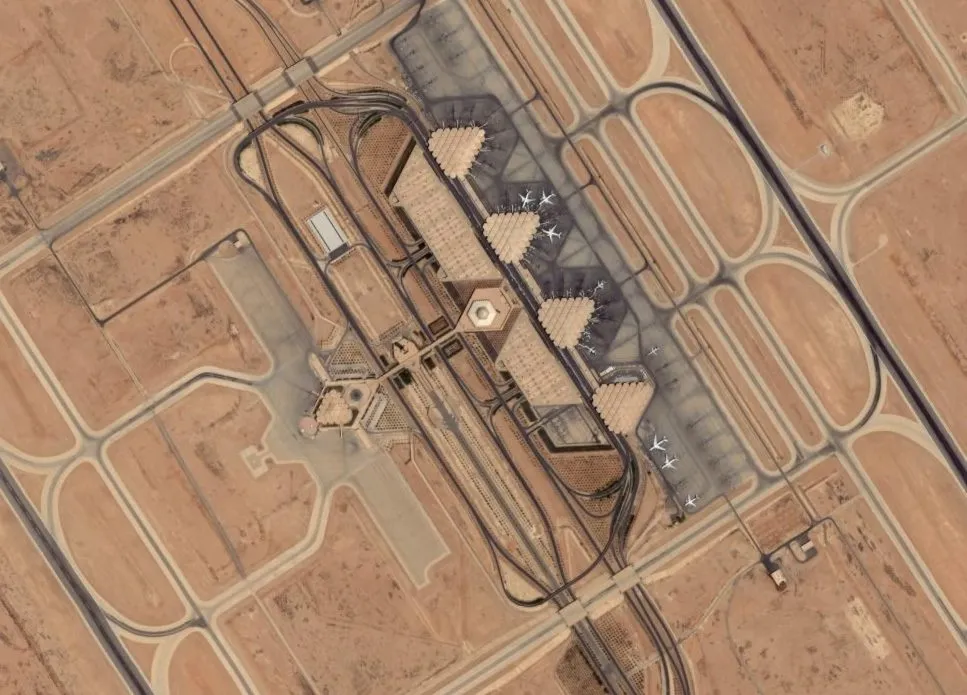
 Terminal buildings at King Khalid International Airport in Riyadh
Credit: Terminals at King Khalid International Airport. Photo: liton islam (CC BY 3.0 via Wikimedia Commons).
A chaotic scene at the airport
The immediate aftermath was one of confusion and urgency. Reuters reported that more than a dozen ambulances were seen rushing toward the airport, and that travellers were evacuated from parts of the building. Flight-tracking site Flightradar24 showed that every flight bound for Riyadh had either been diverted or cancelled, with only a helicopter visible over the airport at one point — an extraordinary picture for a hub that normally handles hundreds of daily movements.
The airport itself issued a terse public alert urging passengers to contact their airlines directly and check flight status before heading to the facility. According to flight-tracking data cited by the Associated Press, at least 225 flights at the airport had been cancelled over the preceding 24 hours alone, underscoring how quickly the disruption has compounded.
Airlines moved fast to protect passengers and crews. Etihad Airways and Qatar Airways cancelled several flights connecting their hubs with Riyadh, and some of those cancellations were expected to continue into Monday. Reports also described medical evacuation helicopters operating between the airport and Riyadh's National Guard Hospital, suggesting authorities were preparing for significant casualties — although no confirmed casualty toll for Saturday's incident had been released.
Local accounts circulating on social media described a bloody scene at the airport, with one unverified account claiming there was "blood everywhere". Those descriptions could not be independently corroborated, and the Saudi government's media office and the civil aviation authority did not immediately respond to requests for comment. Canada's embassy in Riyadh issued a statement warning of "ongoing military activity", an unusually direct advisory that underlined how seriously foreign governments were taking the situation.
A week of escalating strikes
Saturday's blast did not come out of nowhere. It is the latest in an extraordinary series of attacks on Saudi airports over the past week, amid a sharp escalation in the long-running conflict between the Saudi-led coalition and Yemen's Iran-aligned Houthi rebels.
Just two days earlier, an attack on the same airport killed three Saudi citizens, including a pilot, and badly damaged an aircraft, according to reports. Earlier in the week, the Houthis claimed responsibility for attacks including one on Wednesday that killed a Sudanese national and wounded eight other people. The BBC reported that three more people were killed in Houthi attacks on two Saudi airports on 6 and 7 October.
On Thursday, the Houthis claimed a new attack targeting King Khalid International Airport, as explosions were heard across the city and witnesses described passengers being evacuated and outgoing flights suspended. Saudi Arabia's civil defence authorities said debris from an intercepted missile had damaged a kindergarten and a medical complex, though no casualties were reported from that incident. The spokesperson for the Saudi-led coalition, Major General Turki al-Malki, said Saudi forces had intercepted and destroyed two ballistic missiles launched by the Houthis toward Riyadh, as well as another fired toward Khamis Mushait near the Yemen border.
The pattern is striking: a major international airport, in the capital of one of the world's most heavily defended states, has now been struck or targeted repeatedly within days. For an aviation hub that prides itself on operational resilience, the repeated penetrations represent a serious security failure — and a demonstration of the Houthis' growing ability to project force deep inside Saudi territory.
Flights grounded, airlines on edge
The disruption to air travel is spreading well beyond Riyadh. With hundreds of flights cancelled and air traffic repeatedly suspended, carriers across the Gulf are being forced into costly contingency planning. The airport's repeated closures create a cascade: aircraft and crews are displaced, schedules unravel across networks, and passengers face days of uncertainty.
The Houthis have explicitly warned international airlines against operating in Saudi airspace, and have urged people inside the kingdom to stay away from oil facilities, which they have described as targets. That warning, combined with the physical attacks, puts commercial carriers in an invidious position — balancing commercial routes against crew safety and insurance exposure in what is rapidly becoming a conflict zone for civil aviation.
The situation echoes earlier periods of the Yemen war when Houthi missiles and drones periodically reached Saudi airports and oil installations, but the current tempo appears markedly more intense. Aviation analysts will be watching whether insurers begin to reassess risk premiums for Saudi airspace, and whether more carriers follow Etihad and Qatar Airways in pre-emptively cutting services.
Why the attacks are happening now
The immediate trigger for the escalation is a major military offensive launched by the Saudi-led coalition against the Houthis in neighbouring Yemen. According to reporting on the campaign, the offensive aims to retake territory seized by the Houthis along Yemen's western Red Sea coast and near the Bab el-Mandeb Strait, the narrow chokepoint through which a significant share of global shipping passes.
The Houthis have responded with a two-pronged counter-campaign: striking back at Saudi territory with missiles and drones, and announcing what they call a "maritime embargo" against Saudi Arabia — a direct threat to shipping in waters the kingdom depends on for its oil exports. The group has repeatedly claimed attacks on Saudi airports, military facilities and oil installations in recent days.
The fighting marks a dangerous new phase in a war that has ground on, with varying intensity, for more than a decade. What makes the current moment particularly volatile is that the informal truce reached in 2022 — which had brought a measure of relative calm and opened the door to tentative peace talks — began unravelling in July. The renewed fighting pits Yemen's Saudi-backed government forces directly against the Houthis once again, with the coalition's new offensive representing the most serious attempt in years to roll back Houthi territorial gains.
What happens next
Much remains unclear. There was no immediate Houthi statement claiming Saturday's attack, and Saudi authorities had yet to provide a full account of the damage or casualties. The Saudi government-run Center for International Communication, which oversees foreign media in the kingdom, did not immediately respond to requests for comment.
Three questions will shape what follows. First, the casualty toll: if Saturday's blast caused significant deaths or injuries, pressure will mount on Riyadh to respond forcefully, potentially with strikes deep into Houthi-held Yemen. Second, the durability of the airport threat: if the Houthis can repeatedly penetrate Saudi air defences around the capital, the kingdom faces a sustained vulnerability that no amount of interception claims can fully reassure travellers about. Third, the wider regional picture: with the Houthis also threatening shipping and oil facilities, the confrontation risks spilling into global energy markets — a prospect that will alarm capitals far beyond Riyadh.
For now, passengers bound for Saudi Arabia face a simple, stark piece of advice, repeated by the airport itself and by foreign embassies: check with your airline before you travel, and be prepared for disruption. In a week that has already seen deaths at the airport, a damaged aircraft and hundreds of cancelled flights, Saturday's blast suggests the worst may not be over. Follow Verity's world coverage, our reporting on energy security and oil markets, strikes on Kyiv's infrastructure, and the deadly strike on buses in Kramatorsk. Return to the homepage for the latest, or read our about page.