A lifetime on the front line of justice
The Norwegian Nobel Committee announced in Oslo on Friday that the 2026 Nobel Peace Prize would go to Navanethem "Navi" Pillay, the 85-year-old South African jurist and former United Nations human rights chief, honouring her decades-long work to entrench accountability for the world's gravest crimes.
In a moment heavy with symbolism, Pillay learned of the award while she was attending the Nuremberg Forum on international law in Germany — inside Courtroom 600 of the Palace of Justice, the very room where Nazi leaders were prosecuted after the Second World War and where the foundations of modern international criminal law were laid, as the BBC reported. She said she would dedicate the honour to survivors, telling well-wishers she would "dedicate this award to all of the survivors of international crimes".
The award is the 125th Nobel Peace Prize. It places Pillay among a small group of South Africans to have received the honour, following Nelson Mandela and F.W. de Klerk, Archbishop Desmond Tutu and Albert Luthuli — making her the fifth South African laureate in the prize's history.
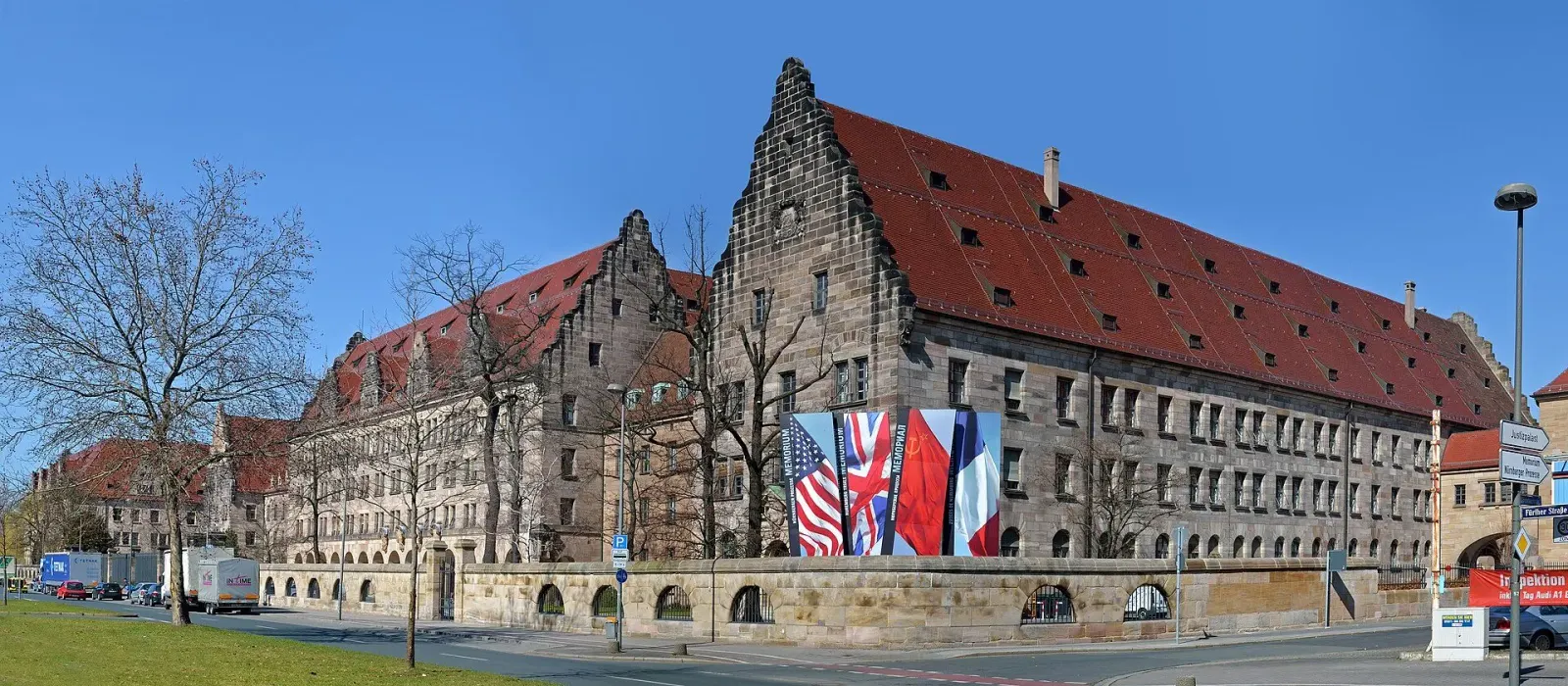 The Palace of Justice in Nuremberg, Germany, where Pillay learned she had won the Nobel Peace Prize
Credit: Andre Karwath, via Wikimedia Commons (CC BY-SA 2.5)
The committee's case for international law
In its citation, the committee said the prize underlined the importance of maintaining an organised international order, and of judges willing to defend it. Chairman Jorgen Watne Frydnes warned that the system of international law was under severe strain, describing judges as those who "guard the thin red line between order and chaos" at a time when its institutions face sustained political attack.
The committee's statement added that Pillay had been "instrumental in ensuring that war crimes, crimes against humanity and genocide are prosecuted", and said the laureate's work was "a source of hope and inspiration to all those who seek to bring about a more peaceful world". Legal analysts writing at EJIL:Talk! observed that the citation honours not just Pillay but international law itself as a project — one relevant far beyond any single conflict.
It also cautioned that the world was shifting toward power politics at the expense of legal frameworks, warning that "whenever might overtakes right, it undermines stability, trust and peaceful co-existence". The remarks landed amid open hostility from major powers toward international courts: the Hague-based International Criminal Court has been a repeated target of United States sanctions and political pressure, a campaign that has escalated since the court pursued arrest warrants against senior Israeli officials.
The prize arrives in a week already crowded with Nobel announcements, from Anne Carson's literature prize to the physics prize for ghost-particle research and this year's chemistry award — but the peace prize, as ever, carried the sharpest political edge.
From apartheid South Africa to The Hague
Pillay's path to the prize began under South Africa's apartheid system. Born in Durban in 1941 to a family of Indian Tamil descent, she grew up in a society built on racial hierarchy — and built a legal career around dismantling it. After graduating from the University of Natal with a law degree in 1965, she opened her own practice in 1967, becoming the first woman to establish a law firm in Natal Province. Her biography traces a career that moved from defending apartheid's opponents to the benches of the world's most important courts.
As an attorney, she defended opponents of apartheid, including activists persecuted by the white-minority government, and exposed the unlawful detention and torture of political prisoners by state security forces. She later earned a master's and a doctorate in law from Harvard University.
The end of apartheid opened the international stage. In 1995, she was appointed to South Africa's High Court — becoming the first Black woman to serve as a judge there — and was nominated to the International Criminal Tribunal for Rwanda, the court established to prosecute those responsible for the 1994 genocide in which some 800,000 people were killed. She served on the tribunal for eight years, four of them as its president.
The Rwanda tribunal and a landmark on sexual violence
Pillay's years at the Rwanda tribunal produced one of the most consequential legal precedents in modern international law. In the landmark 1998 judgment in the case of Jean-Paul Akayesu, the tribunal established that rape and sexual violence could constitute acts of genocide when committed with the requisite intent — a ruling that permanently sharpened how wartime sexual violence is prosecuted.
From 2003 to 2008, she served as a judge of the International Criminal Court, sitting in its Appeals Chamber, before being appointed UN High Commissioner for Human Rights in 2008 by Secretary-General Ban Ki-moon with the approval of the UN General Assembly. She held that post until 2014, becoming one of the most prominent global voices pressing governments to meet their obligations under international law. Readers can follow more of our coverage of international accountability in the World section.
The Gaza report that put her at the centre of a storm
The most politically charged chapter of Pillay's recent career came between 2021 and 2025, when she chaired the UN's Independent International Commission of Inquiry on the Occupied Palestinian Territory. Last year, the commission concluded that Israel was responsible for genocide in Gaza, carried out with a specific intent to destroy Palestinians there — a finding that drew furious condemnation from Israel, which dismissed the report as "scandalous" and "fake".
Speaking after the prize announcement, Pillay referred to that work directly, noting that the Gaza report had been her most recent undertaking. Israel's Foreign Ministry was quick to condemn Friday's award — as reported from Nairobi, Israel dismissed the commission's genocide finding at the time as "scandalous" — arguing that the choice rewarded a record it regards as irredeemably biased. A detailed profile of her career traces how the Gaza inquiry placed her once again at the centre of international scrutiny over accountability and the protection of civilians.
The controversy has also been absorbed into the long-running American row over the prize. Pakistan's Prime Minister Shehbaz Sharif had publicly repeated, hours before the announcement, that his country had "nominated" President Donald Trump and hoped he would "receive due recognition this time". After Pillay's win, Trump shared a supporter's post calling the South African jurist a "hater" and claiming the award had been demeaned. Pillay, in a lighter moment in Nuremberg, joked to her applauding audience: "If you clap a little bit more, I may share this prize with Trump" — a nod to last year's laureate, Venezuela's Maria Corina Machado, who had presented her own Nobel medal to the US president.
What comes next: Oslo on 10 December
The prize will be presented in Oslo on 10 December, the anniversary of Alfred Nobel's death, with 12 million Swedish kronor — about $1.2 million — in prize money attached. Pillay succeeds Machado, the 2025 laureate, who won for her efforts to promote democratic rights in Venezuela.
For the committee, the choice is a deliberate statement about where peace comes from. As Friday's citation made clear, in an era of multiplying conflicts and open attacks on the courts and conventions built to restrain them, the Norwegian Nobel Committee believes the judges are not a footnote to peace — they are its guardians. For more of our international reporting, visit the Verity homepage.