In Short (TL;DR)Anne Carson, 76, has won the 2026 Nobel Prize in Literature, announced by the Swedish Academy in Stockholm on Thursday. The Academy honoured her "bold and inventive oeuvre" and its playful dialogue with the classical tradition; the prize is worth 12 million Swedish kronor (about $1.2m). Reached by phone in Iceland, the famously private writer joked that the judges were "crazy". Carson succeeds Hungary's László Krasznahorkai and becomes the second Canadian winner after Alice Munro in 2013.
The Swedish Academy has awarded the 2026 Nobel Prize in Literature to Anne Carson, the Canadian poet, essayist and translator whose bold and inventive body of work has spent four decades dissolving the boundaries between poetry, scholarship and storytelling.
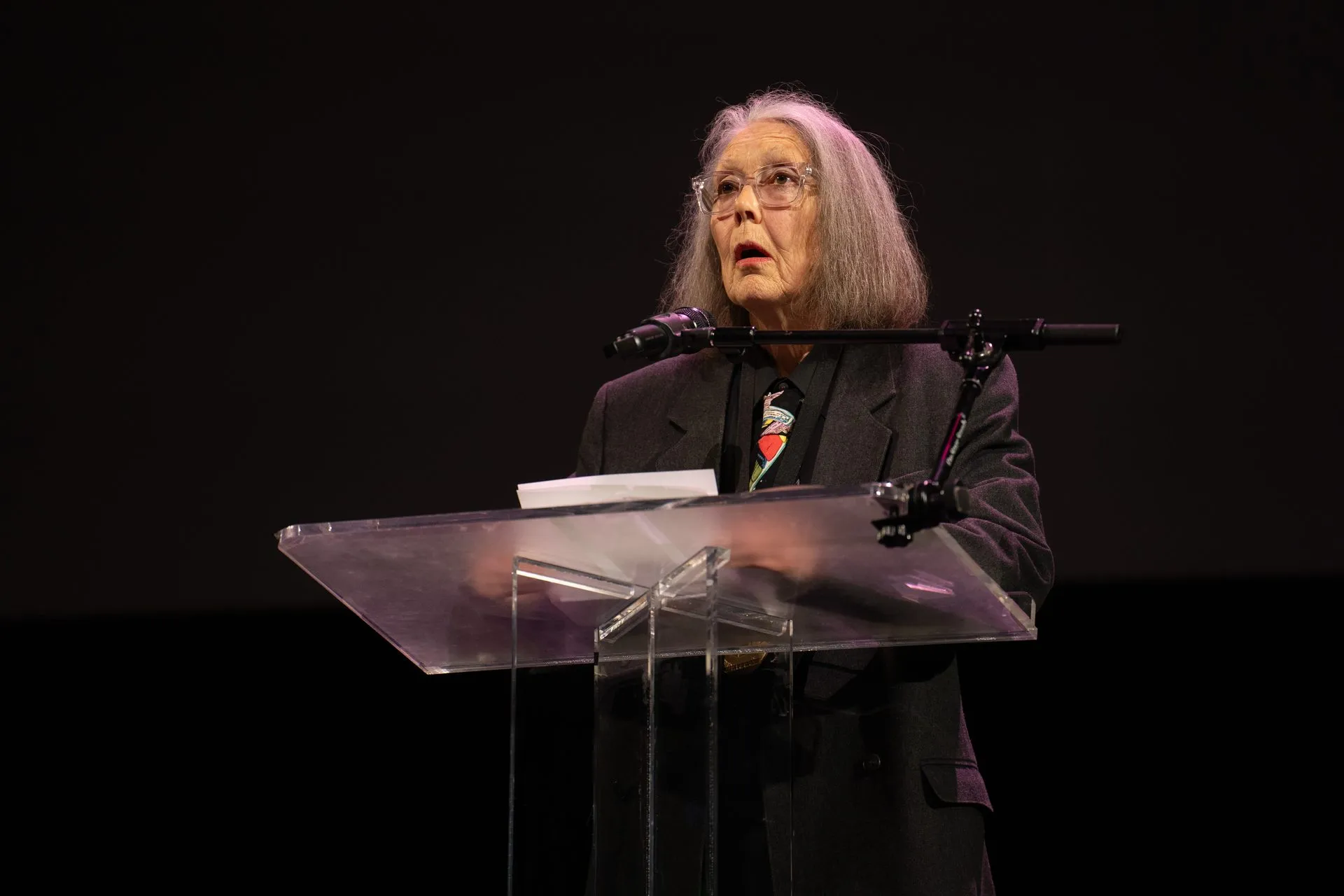
Carson, 76, was announced as this year's laureate at the Academy's headquarters in Stockholm on Thursday. In its citation, the Academy said it was honouring her for an oeuvre in playful engagement with the classical tradition that has created new forms for contemporary literature — a career built on the conviction that a 2,500-year-old Greek fragment can speak as urgently as this morning's headlines.
The prize, worth 12 million Swedish kronor (about $1.2 million), makes Carson the second Canadian to win the literature Nobel, thirteen years after the short-story writer Alice Munro received it in 2013. She succeeds the Hungarian novelist László Krasznahorkai, the 2025 laureate, and South Korea's Han Kang, who won in 2024.
True to her reputation as one of literature's most private figures, Carson learned of the honour far from the Stockholm spotlight. She was in Iceland — where she keeps a home and, since 2022, holds citizenship — when the Academy's call came through.
Her response, given to Icelandic broadcaster RUV, was pure Carson: wry, deadpan and allergic to ceremony. "Crazy, I think they're all crazy," she said of the judges. "I'll get a sticker on the front of my book."
Ingrid Carlberg, the Academy's permanent secretary, told the press conference in Stockholm that Carson had been taken completely by surprise but was clearly happy — adding that all the new laureate had time to tell her was that she was in Iceland, listening to the wind.
Back in Canada, the reaction was jubilant. Prime Minister Mark Carney called the award "an extraordinary achievement and a proud moment for Canada", and tributes poured in from writers and publishers across the English-speaking world — the latest landmark in a remarkable period for literary culture.
Carson was born in Toronto in 1950 and trained as a classical philologist at the University of Toronto before embarking on an academic career that took her to McGill University, the University of Michigan, Princeton and NYU. She has described the etymology of words as the starting point of all her work — a scholar's habit that became a poet's engine.
That dual identity — the philologist obsessed with words, the poet hungry for new meaning — is precisely what the Nobel committee celebrated. Its chairman, Anders Olsson, said almost all of Carson's writing lives at the intersection of scholarly word-obsession and a poet's hunger for new meaning, and singled out her translations from ancient Greek as works of art that stand on their own. Her full biography and bibliography trace a career of more than twenty books across five decades.
Her books resist every shelf label. They mix poetry with essays, translation with memoir, typography with silence. Nox, her 2010 elegy for her brother, unfolds as a single accordion-folded sheet part scrapbook, part dictionary, part lament. Float (2016) was published as a box of unbound chapbooks the reader can shuffle in any order. Antigonick (2012) drags Sophocles' Antigone into the present tense, footnoted with asides to Virginia Woolf and Judith Butler.
Along the way she has collected just about every honour the literary world offers: MacArthur and Guggenheim fellowships, two Griffin Poetry Prizes, the T. S. Eliot Prize, the Governor General's Award, the Princess of Asturias Award, the PEN/Nabokov Award and membership in the Order of Canada.
!The Parthenon in Athens
Credit: Mountain / Wikimedia Commons (public domain).
If one book made Carson's name, it is Autobiography of Red (1998), the novel in verse that remains her most beloved work. It takes the ancient Greek poet Stesichorus's fragmentary myth — in which Heracles slays the winged monster Geryon and steals his red cattle — and retells it as the story of a tender, red-winged boy growing up, falling in love and getting his heart broken in the modern world. The book's long narrative verse is framed by an erudite, enigmatic discussion of its source text, a structure that became a Carson signature.
The same alchemy runs through the rest of her catalogue. The Beauty of the Husband (2001) braids Keats into the story of a failing marriage. Grief Lessons (2006) offers taut, startling new translations of four Euripides tragedies. Norma Jeane Baker of Troy (2019), a performance piece, braids Euripides' Helen with the life of Marilyn Monroe. Her translation of Sophocles' Elektra reached the London stage last year with Brie Larson in the title role — a crossover moment that introduced her work to theatre audiences far beyond poetry's usual borders.
The Nobel committee's choice is a striking one: Carson is not a novelist of the conventional kind, nor a poet in any traditional mould, but a writer who has spent her career insisting that forms are meant to be broken. Olsson praised her exploration of the possibilities of writing, a process in which the literary sketch — the fragment, the note, the aside — has become as valuable to her as the finished poem.
It is also a choice with a clear lineage. By honouring a translator as much as an original author, the Academy has recognised that Carson's English versions of Sappho, Euripides and Sophocles are themselves acts of creation. Profiles of the new laureate have long noted how the ancient and modern live side by side in her pages; the Nobel citation makes that dialogue the centrepiece of her achievement.
The decision will inevitably divide critics and commentators — Nobel literature choices always do — but few would dispute that Carson has expanded what a book can be.
For Canada, the prize is a national moment: only the country's second literature Nobel, and a vindication of a writer who has often been described as Canada's best-kept literary secret. It caps a year in which Verity's entertainment pages have marked both triumphs and farewells in the literary world, including the passing of novelist Jeffrey Archer — and it lands at a turbulent moment for the wider culture business, from Hollywood mega-mergers to sold-out arena tours. French-language coverage noted that two English-speaking Canadians — Carson and Margaret Atwood — had been among the most cited names in this year's speculation, and the Academy chose the less familiar, more unconventional of the two.
For readers, the award is an invitation. Carson's work can be demanding — it asks you to know a little Greek, or to be willing to learn — but it repays the effort with some of the most startling sentences in contemporary English. As analysis of the decision has noted, she has spent forty years drawing on ancient myth to explore love, grief, desire and identity, challenging every conventional distinction between literary forms.
She will receive her medal in Stockholm on 10 December. Whether she will have much to say on the podium is another matter — but somewhere in Iceland, the wind is still blowing, and a new sticker is on its way to the front of her books. More arts and culture reporting appears on the Verity homepage.
*Read more about our newsroom.*