A blunt message from Rome
Italy's defence minister has delivered one of the most direct rebukes yet from a European ally to Donald Trump's handling of Ukraine. Guido Crosetto told the BBC in Rome that the US president is "completely wrong" to restrict the support Ukraine depends on to defend itself against Russian attacks, warning that weakening Kyiv would not end the war — it would prolong it, in an interview with the BBC's Sarah Rainsford.
"It is a complete mistake, a major mistake," Crosetto said, referring to any US move to limit Ukraine's access to satellite systems and intelligence. Such a step, he added, "makes absolutely no sense" at a moment when the war is grinding into another winter, as Ukrainska Pravda summarised.
The interview, conducted by the BBC's Sarah Rainsford at the defence ministry in Rome — also broadcast as a BBC video report — marks a sharp escalation in Italy's public criticism of Washington — and a notable break for a government whose prime minister was once considered one of Trump's closest allies in Europe.
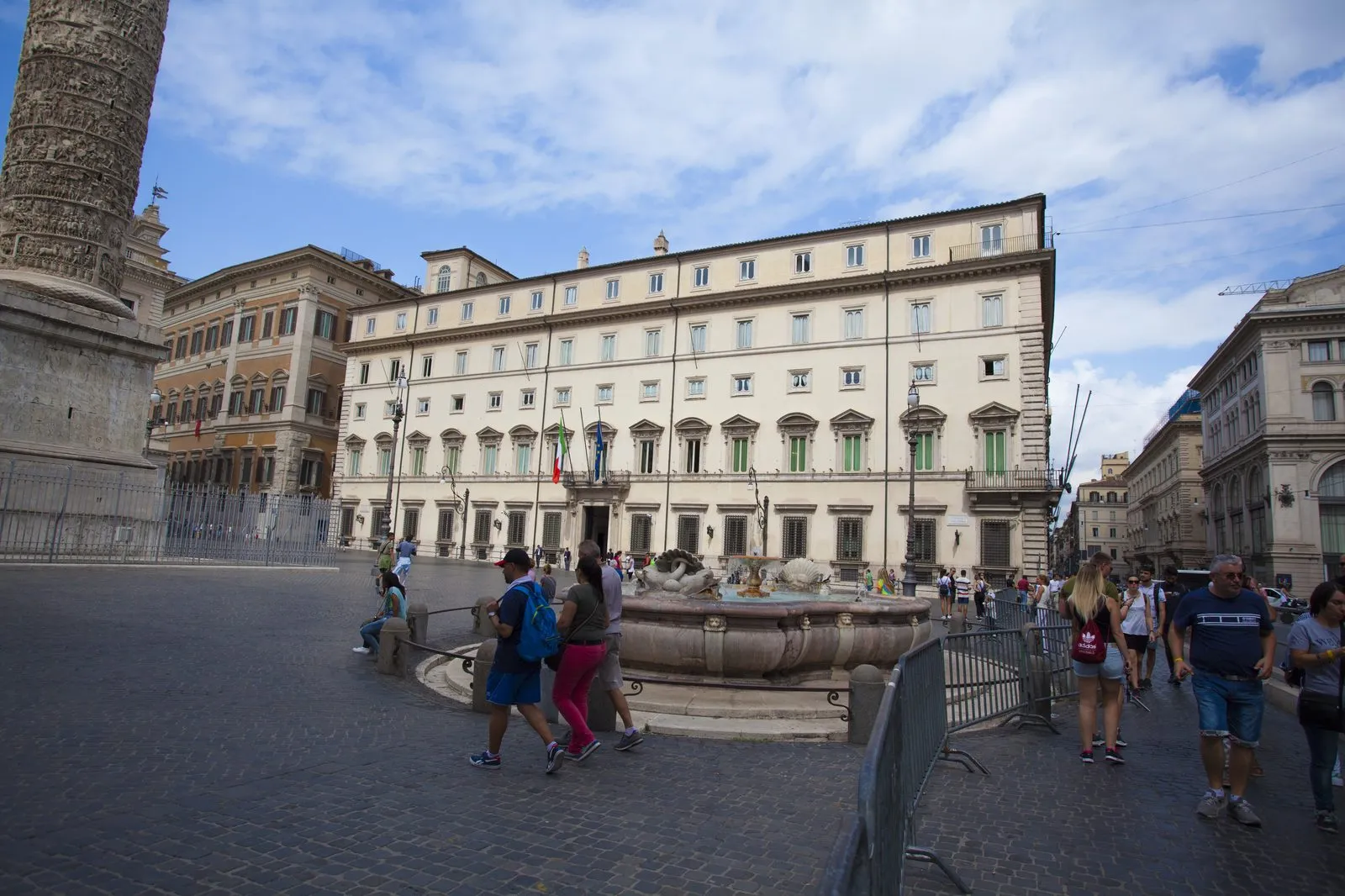
Palazzo Chigi in Rome, the seat of the Italian prime minister's office, seen from the square.
ScareCriterion12 / Wikimedia Commons (CC BY-SA 4.0)
The logic of stalemate
Crosetto laid out his argument in terms of what he sees as the only route to peace: convincing Vladimir Putin that the war cannot be won. "Peace will come when Putin is convinced there is a stalemate, that he cannot advance any further," he said. "If [Putin] sees weakness on the Ukrainian side — and if the US deprives Ukraine of resources, that creates weakness — then he will believe he can win. So he will continue the war. I think that is completely wrong."
The defence minister is a weighty voice in Italian politics. A co-founder of Giorgia Meloni's hard-right Fratelli d'Italia party, he has held the defence portfolio since the right-wing coalition took power in 2022, shortly after Russia's full-scale invasion began — his official biography is published by Italy's defence ministry. His ministry oversees Italian military deliveries to Ukraine — the details of which remain classified — and he pledged that support would continue "for as long as this government is in place."
The dispute centres on reported restrictions to the invisible infrastructure of Ukraine's defence: satellite connectivity and intelligence sharing, including early-warning alerts about incoming Russian air attacks. US officials insist Trump has not ordered a slowdown of the internet speeds provided to Ukraine and deny that early-warning sharing has stopped. But the perception in Kyiv — and now publicly in Rome — is that support is being quietly throttled as part of a broader American disengagement.
From Trump whisperer to sharpest critic
Crosetto's broadside did not come out of nowhere. It follows a week in which Italy's government has openly challenged Washington on Ukraine policy, as documented in our World news coverage.
Earlier this week, Prime Minister Giorgia Meloni called Trump's deal to buy diesel fuel from Russia "a choice that I consider very risky", saying it would "grant Russia legitimacy" while Moscow's forces bomb Ukrainian cities — remarks widely covered across Europe. Trump agreed the diesel deal with Putin and blamed Kyiv's own strikes on Russian refineries for rising fuel prices — the same strikes that have now hit St Petersburg's oil facilities overnight.
The shift is remarkable given Meloni's history with Trump. Once considered so close to the US president that she was dubbed the "Trump whisperer", she has become one of Europe's most vocal critics of his Ukraine policy — even as her government has had to manage its own right-wing coalition, whose internal dynamics were covered in our reporting on Italy's electoral reform approval.
The pattern is not unique to Italy. Across Europe, governments that spent the first years of the war deferring to Washington are now publicly dissenting — a trend that has been building through the sanctions debate, the dispute over Russian strikes on Ukrainian cities, and disagreements over how to handle intelligence and targeting support for Kyiv.
What Washington says — and what Kyiv sees
The US pushback has been firm but narrowly drawn. Officials say Trump did not request the slowdown of internet speeds, and deny that early-warning alerts have been cut off. But American statements have notably stopped short of a comprehensive denial of any change in support posture — and the administration's wider moves, including the reported withdrawal of key military assistance and the Starlink speed restrictions that Ukraine has publicly disputed, have fed a narrative in Kyiv that the ground is shifting.
Ukraine says it found no equivalent technical problems when using satellite services on European soil — an observation that implicitly challenges the US explanation that the Starlink restrictions were merely technical. For Crosetto, the details matter less than the direction of travel: any erosion of Ukraine's capabilities, he argues, sends precisely the wrong signal to Moscow.
That argument echoes the private warnings of other European defence chiefs, who have told their American counterparts that ambiguity about support is itself destabilising. As our politics coverage has noted, the transatlantic disagreement over Ukraine has moved from closed-door briefings to open interviews — a sign that quiet diplomacy is failing.
Domestic politics will test Rome's resolve
Crosetto was candid about the limits of his own pledge. While Italian support continues under the current government, he acknowledged that winning parliamentary approval for further military deliveries will become harder as elections approach. Italy must go to the polls by the end of 2027, and defence spending for Ukraine has become increasingly contested in domestic debate.
The defence minister's own party, Fratelli d'Italia, contains currents that have historically been more sympathetic to Moscow — a tension Meloni has managed by keeping delivery details classified and framing support as a matter of national interest rather than ideology. Crosetto's interview suggests that framing is now being extended to a direct critique of the American president, a step the Italian right would once have considered unthinkable.
Europe's response, and what comes next
Crosetto's intervention matters beyond the bilateral row. It is part of a broader European response to Trump's Ukraine stance — one in which leaders who once courted Washington are now openly contradicting it. The immediate question is whether Italy's criticism will be followed by concrete European steps to replace any support the US withdraws: joint intelligence sharing, satellite capacity, and air-defence supplies that European governments have discussed but not yet fully committed.
For Ukraine, the interview is a diplomatic win — a major Western defence minister validating Kyiv's complaint in the BBC's global spotlight. For the transatlantic relationship, it is another crack in an alliance that has survived three years of strain but is now being tested in public. Readers following the fast-moving diplomacy can keep up with our ongoing reporting on the Verity homepage and our guide to who we are.