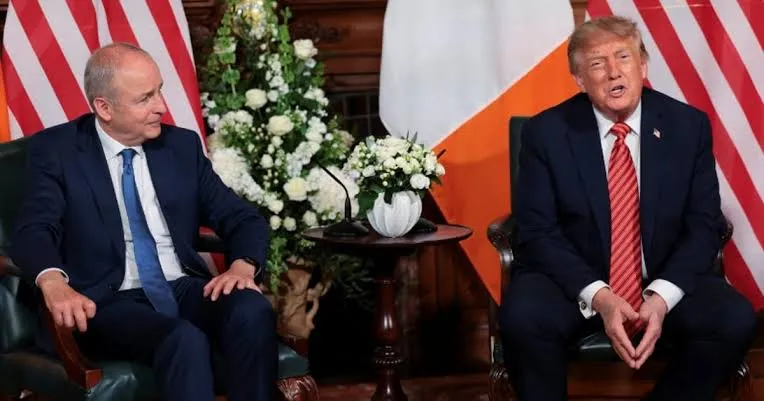
Former U.S. President Donald Trump’s recent declaration that a united Ireland would be 'fantastic' during a meeting with Irish leader Micheál Martin has ignited a fresh diplomatic debate, prompting an immediate reaffirmation from Downing Street of its commitment to the foundational Good Friday Agreement. This unexpected commentary from a prominent international figure underscores the enduring sensitivity and complexity surrounding the constitutional status of Northern Ireland, challenging the delicate balance of peace established over decades.
During a visit to Ireland, former U.S. President Donald Trump made headlines with an unsolicited comment on one of Europe’s most intricate and historically charged geopolitical issues: the prospect of a united Ireland. His remark, describing such an outcome as 'fantastic,' came during an encounter with Irish Taoiseach (Prime Minister) Micheál Martin. While the precise context of the conversation remains private, the public nature of the statement immediately reverberated across the political landscapes of Dublin, Belfast, and London, drawing both support from some nationalist quarters and sharp criticism from unionists and those advocating for strict adherence to established peace frameworks.
Trump’s history of unconventional diplomacy and a penchant for off-the-cuff, often provocative, statements is well-documented. Throughout his presidency, he frequently deviated from traditional diplomatic protocols, preferring direct, often unvarnished, commentary over carefully calibrated official positions. Even as a former head of state, his words carry significant weight, particularly when touching upon deeply embedded national aspirations and constitutional questions. His endorsement of a united Ireland, regardless of intent, lends a degree of international prominence to a debate that, while always simmering, typically operates within the carefully constructed parameters of the Good Friday Agreement.
For many observers, the intervention of a former American president, especially one known for disrupting the status quo, on an issue as sensitive as Irish unification, represented a significant departure from the United States’ historically neutral, albeit supportive, role as a guarantor of the peace process. The U.S. has traditionally played a crucial, bipartisan role in fostering stability and reconciliation in Northern Ireland, a role predicated on impartiality and respect for the principle of consent enshrined in the 1998 peace accord. Trump’s comment, therefore, risked being perceived as a partisan intervention, potentially unsettling the delicate political equilibrium.
To grasp the profound implications of Trump’s statement, one must delve into the complex tapestry of Irish history, particularly the events leading to and following the partition of the island. Ireland was divided in 1921 following the , which established the Irish Free State (later the Republic of Ireland) and retained six northern counties as part of the United Kingdom, creating Northern Ireland. This partition was intended to accommodate the wishes of the Protestant majority in the north-east, who largely identified as British and wished to remain within the Union, while the Catholic/nationalist population largely aspired to a united, independent Ireland.
The subsequent decades were marked by deep sectarian division and, from the late 1960s to the late 1990s, a period of intense conflict known as The Troubles. This brutal ethno-nationalist conflict pitted Irish republicans and nationalists (primarily Catholic) seeking a united Ireland against unionists and loyalists (primarily Protestant) who wished to remain part of the UK. Thousands lost their lives, and the region became synonymous with violence and political deadlock.
The culmination of years of painstaking negotiations, with significant involvement from the United States, was the . This landmark peace accord fundamentally reshaped the political landscape of Northern Ireland. Its core tenets include power-sharing arrangements between unionist and nationalist parties, the establishment of cross-border institutions, and crucially, the principle of consent. This principle dictates that Northern Ireland’s constitutional status can only change with the consent of a majority of its people, expressed through a border poll. The Agreement also recognized the birthright of the people of Northern Ireland to identify as British, Irish, or both, and to hold both British and Irish citizenship. The U.S., under President Bill Clinton, played a pivotal role in brokering this agreement, establishing itself as a key international guarantor of the peace process.
The immediate and unequivocal response from Downing Street following Trump’s remarks was a clear signal of the United Kingdom’s unwavering commitment to the Good Friday Agreement. A spokesperson for the British government stated that it would 'stick to the Good Friday Agreement,' emphasizing that the future of Northern Ireland is a matter for its people, determined by the principle of consent. This reaction underscores the Agreement’s foundational status in UK policy regarding Northern Ireland and its constitutional integrity.
For the UK government, the Good Friday Agreement is not merely a peace treaty but the constitutional bedrock upon which the current political arrangements in Northern Ireland rest. It provides the legal and political framework for power-sharing, ensuring that both nationalist and unionist communities have a say in governance. Any deviation from its principles, particularly by external actors, is viewed with significant concern, as it risks undermining the delicate balance that has sustained peace for over two decades. The principle of consent is particularly vital, as it safeguards the right of the people of Northern Ireland to determine their own future, free from external imposition.
The complexities surrounding Northern Ireland’s status have been further exacerbated by Brexit and the subsequent . This protocol, designed to avoid a hard border on the island of Ireland, created new trade arrangements that have been deeply contentious among unionists, who argue it undermines Northern Ireland’s place within the UK. The ongoing political instability in Northern Ireland, including periods of suspended power-sharing at Stormont, highlights just how fragile the peace remains and how easily external comments can inflame existing tensions. Downing Street’s swift rebuttal of Trump’s comments, therefore, was not just a diplomatic nicety but a strategic reaffirmation of its core policy and a reminder to all parties of the agreed-upon path for constitutional change.
While the aspiration for a united Ireland resonates deeply with many nationalists, the practicalities of such a transition present a myriad of complex challenges across economic, social, and political spheres. The journey from aspiration to reality would involve navigating an intricate web of integration issues that are often underestimated in public discourse.
Economic Integration
Economically, Northern Ireland operates under a distinct fiscal regime within the UK, benefiting from significant financial transfers from London and integrated into the broader British economy. The Republic of Ireland, conversely, is a member of the European Union, with its own independent fiscal and monetary policies. Unification would necessitate the integration of two vastly different economic systems, including questions of currency (Euro vs. Sterling), taxation, social welfare provisions, and public services like healthcare and education. Analysts project that the initial costs of such integration, including harmonizing public services and addressing potential economic disparities, could be astronomical, requiring substantial investment and careful planning to avoid economic shockwaves. The impact on investment, trade flows, and employment would need meticulous management.
Social Cohesion and Identity
Beyond economics, the social and cultural ramifications are profound. A united Ireland would require a new national narrative and symbols that are inclusive of both nationalist and unionist identities. For many unionists, their British identity is paramount, and forced integration into a Republic of Ireland without adequate safeguards for their heritage, language, and traditions would be deeply divisive. Issues around flags, anthems, national holidays, and even the name of a new state would become highly contentious. Reconciliation and creating a shared future, rather than simply absorbing one identity into another, would be the most significant social challenge. Addressing historical grievances and fostering genuine mutual respect would be paramount to avoid simply transplanting division rather than resolving it.
Political and Constitutional Framework
Politically, a united Ireland would necessitate the drafting of a new constitution, defining a new system of governance, and addressing how the two distinct legal systems would merge. Questions would arise about parliamentary representation, the role of local government, and how to ensure continued political representation and influence for the former unionist community within a new, larger Irish state. The Good Friday Agreement explicitly outlines a mechanism for constitutional change through a border poll, requiring the British Secretary of State for Northern Ireland to call such a poll if it appears likely that a majority would vote for unification. However, the criteria for determining such likelihood are not rigidly defined, and the decision remains politically charged. Even if a poll were successful, the subsequent transition period would be unprecedented in its complexity, demanding extensive cross-border and cross-community dialogue and cooperation.
Trump’s comments, while perhaps intended as a casual observation, carry significant weight given the historical role of the United States in the Northern Ireland peace process and its enduring relationships with both the UK and Ireland. The U.S. has long been regarded as a critical, impartial arbiter and supporter of the Good Friday Agreement, a role that has been carefully cultivated across successive administrations, from Clinton to Biden. Any statement that appears to favor one constitutional outcome over another risks undermining this perceived neutrality.
For the United Kingdom, maintaining the 'special relationship' with the United States is a cornerstone of its foreign policy. While a comment from a former president might not immediately strain official diplomatic ties, it can create awkwardness and signal a potential shift in U.S. sentiment that the UK would monitor closely. The UK’s commitment to the union and its constitutional integrity is non-negotiable, and it expects its allies to respect the mechanisms established by international agreements like the GFA.
For the Republic of Ireland, an endorsement of unification from such a high-profile figure could be seen as a boost to a long-held national aspiration, particularly among certain political parties. However, Irish governments have consistently emphasized that any move towards unification must be peaceful, democratic, and based on the principle of consent, as outlined in the Good Friday Agreement. Publicly welcoming such an intervention without careful qualification could risk alienating unionist communities and potentially destabilizing cross-border relations. The Irish government’s nuanced approach seeks to manage the legitimate aspiration for unity within the confines of the peace process, prioritizing stability and reconciliation.
Globally, the intervention highlights the delicate balance between national sovereignty, the right to self-determination, and the sanctity of international peace agreements. While the principle of self-determination is widely recognized, its application in complex, post-conflict scenarios like Northern Ireland is always constrained by existing treaties and the need to protect minority rights. Trump’s remarks, therefore, serve as a reminder of the enduring international interest in the future of Northern Ireland and the potential for external voices, however well-intentioned, to inadvertently complicate deeply sensitive domestic political issues.
The unexpected intervention by Donald Trump has momentarily shone an international spotlight on the ongoing debate surrounding a united Ireland, yet it ultimately reinforces the centrality of the Good Friday Agreement as the only legitimate pathway for constitutional change. The Agreement, forged in compromise and sustained by vigilance, remains the bedrock upon which any discussion about Northern Ireland’s future must be built. Its principle of consent ensures that the people of Northern Ireland, and not external figures, hold the ultimate decision-making power over their constitutional destiny.
The conversation around a united Ireland is a legitimate and evolving one, with significant demographic and political shifts occurring within Northern Ireland itself. However, for any move towards unification to be successful and sustainable, it must emerge from careful planning, extensive cross-community dialogue, and a profound respect for the diverse identities and aspirations within Northern Ireland. Political leaders in Dublin, London, and Belfast are tasked with navigating this sensitive future, ensuring that peace and stability remain paramount. The challenge lies in fostering an environment where all voices are heard, and where any potential constitutional evolution is managed through democratic means, upholding the spirit and letter of the peace agreement that has brought two decades of relative calm to a historically turbulent region.