Prime Minister Andy Burnham and Conservative leader Kemi Badenoch traded blows at Prime Minister's Questions on Wednesday over government borrowing, the controversial approval of the Jackdaw gas field in the North Sea, and the cost of household energy bills.
Ms Badenoch opened her questioning by pressing the prime minister on the government's decision to approve drilling at Jackdaw, the biggest new British gas field in almost a decade. She accused Labour of dithering for two and a half years over a single licence, saying Britain could not be a serious player on the world stage while ministers took so long to make a decision. The Times' as-it-happened coverage reported that she also pressed the prime minister to lift the ban on new licence applications.
Mr Burnham hit back by laying the blame for the delay squarely at the previous Conservative government's door. The field had originally been given consent in 2022 under the Tories, he said, but the process had not been done properly and the decision was later overturned in court. "That's why there was the delay, because they didn't do the process properly," he told the Commons.
The Court of Session had ruled the original approval unlawful because it failed to account for the emissions produced by burning the gas extracted from the field. Only after a fresh environmental assessment was completed could the field be re-approved, something Mr Burnham said his government had now done properly and in line with the UK's climate obligations.
A pragmatic decision — and a bridge to renewables
The prime minister defended the approval as a pragmatic response to Britain's energy needs at a time when households were struggling. He said the revenues flowing from the decision would allow the government to invest in renewables, bring forward clean energy and, within this parliament, substantially separate gas and electricity prices so that bills could come down.
Ministers remain committed to the target of reaching net zero by 2050, Mr Burnham added, and revenues from North Sea oil and gas would be invested in renewable and low-carbon projects as part of a £2 billion energy wealth fund. He also suggested the door remained open to further decisions: Energy Secretary Miata Fahnbulleh had weighed the Jackdaw decision against the UK's climate obligations and would apply the same test to similar cases in future — widely read as a signal on the Rosebank field.
Ms Fahnbulleh, who previously led the New Economics Foundation think tank, insisted she had not changed her view on fossil fuels. She told the BBC she intended to legislate to ban new licences because the long-term goal remained transitioning away from fossil fuels.
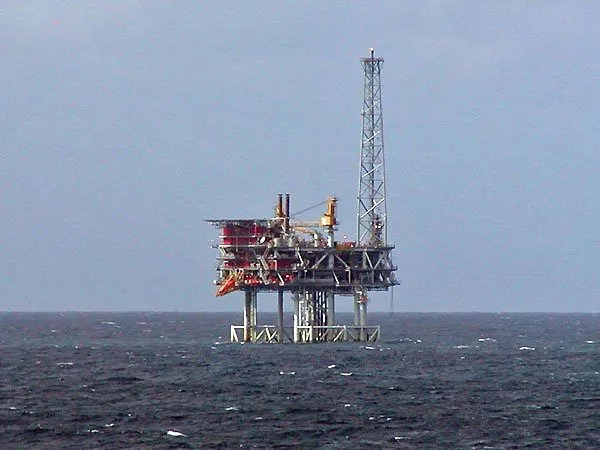 An offshore oil and gas platform in the North Sea.
Credit: Stan Shebs, CC BY-SA 3.0, via Wikimedia Commons.
Standing charges review announced
The most notable moment of the session came when Mr Burnham announced a potential lifeline for bill-payers. He told MPs he had asked Chancellor John Healey and Ms Fahnbulleh to examine whether standing charges could be removed from gas bills, and to report back to the House "at the earliest opportunity".
Standing charges are the fixed daily fees added to energy bills whatever a household uses — around 30p a day for gas on a typical direct debit tariff, according to industry estimates cited by The Sun's reporting. They do not pay for the energy itself but cover the cost of delivering gas and electricity to homes, including network maintenance and infrastructure upgrades — the kind of detail set out in the energy regulator's guidance. Campaigners have long argued they hit the poorest households hardest, since they fall equally on low and high users.
"I can tell the House today that I have asked the Chancellor and the Energy Secretary to look at whether we can remove standing charges from gas bills," he said, adding that they would report back to the Commons at the earliest opportunity.
Nothing has been decided: the review has been requested but no date, mechanism or figure was given, and ministers have acknowledged that Jackdaw's approval will not bring down bills this winter.
Ms Badenoch welcomed the idea but accused Labour of appointing one of the campaigners who had tried to block drilling as Energy Secretary, claiming jobs had been lost and time and money wasted in the meantime.
Trump hails the decision
The approval drew an unexpected endorsement from across the Atlantic. US President Donald Trump praised the move on social media, calling it great news for Britain and the Aberdeen region, claiming the North Sea would make the UK wealthy again and urging the government to drill at full blast.
Mr Trump, whose grandmother was born in Scotland, has long urged both Mr Burnham and his predecessor Sir Keir Starmer to drill more in the North Sea — having earlier clashed with allies over oil and diesel exports — although the Jackdaw approval covers gas rather than oil, as his post suggested. He finished his message by urging Britain to abandon wind turbines.
Borrowing and the Budget loom
The clash on borrowing and drilling came just a week before the Chancellor delivers his first Budget on 28 October, amid a difficult set of figures. UK inflation rose to 3.5 per cent in the year to September and government borrowing hit £24.5 billion in that month, while vacancies have fallen to a five-year low — adding pressure on ministers, as explored in our coverage of the Chancellor's pre-Budget position.
Mr Healey has ruled out raising capital gains tax, though he has refused to rule out other tax increases amid high borrowing costs — a story covered in depth when the decision was announced. His pre-election promises not to raise income tax, National Insurance or VAT constrain his room for manoeuvre.
During PMQs Mr Burnham also took aim at the Conservatives' record on the economy, criticising the 2022 mini-Budget and their handling of adult social care following a Covid inquiry report on care homes published this week. He said he had concerns about Ukraine's access to the Starlink satellite network, in a session that ranged well beyond energy — as tracked in the BBC's live coverage and analysed in the Independent's political reporting. The PA wire's national report noted the standing-charge review was the session's standout announcement.
A test of economic credibility
The exchanges underlined how central energy and the economy will be in the week ahead. With the Budget seven days away and household costs rising, Wednesday's session set the tone for a fight over who can be trusted with the nation's finances — and its fuel. The debate continues in our Politics section, alongside the main UK and world news. You can read more about Verity's editorial approach on our about page.