
Record profits, painful timing
Microsoft has reported profits of more than 36.6 billion dollars for the three months to the end of September, just days after announcing plans to offer voluntary buyouts to about 60,000 of its workers. The contrast between soaring earnings and a shrinking workforce captures the defining tension in big technology right now: companies richer than ever, spending vast sums on artificial intelligence, while telling tens of thousands of staff their roles may no longer be needed.
The results, published on Wednesday, beat expectations on every major measure. Revenue rose 19 per cent year on year to 92.3 billion dollars, up from 77.7 billion dollars in the same quarter last year. Net income jumped 32 per cent to 36.6 billion dollars. Operating income increased 21 per cent to 45.9 billion dollars. Shares rose about 2.9 per cent in after hours trading in New York as investors welcomed the numbers.
Chief executive Satya Nadella described a fast start to Microsoft's fiscal year, noting that Microsoft Cloud revenue had surpassed 63 billion dollars with growth accelerating to 30 per cent. Chief financial officer Amy Hood said the company had exceeded expectations across revenue, operating income and earnings per share.
Cloud and AI power the numbers
The engine of the results is cloud computing. Microsoft Cloud revenue reached 63.9 billion dollars, up 30 per cent year on year and 31 per cent in constant currency terms. Azure, the company's cloud platform and its main rival to Amazon Web Services, grew 48 per cent during the quarter, a remarkable rate for a business of its size.
Revenue from the Agents and Infra segment, which covers much of Microsoft's AI and infrastructure work, rose 25 per cent to 76.8 billion dollars. Perhaps the most telling figure in the whole report is the commercial remaining performance obligation, contracted revenue not yet recognised, which jumped 73 per cent to 677 billion dollars. That backlog suggests customers are committing to Microsoft's cloud and AI services at a scale that should support growth for years, even if the current spending boom cools.
Nadella said AI development had helped broaden adoption of the technology and was having real world impact across every industry. The company has positioned its Copilot assistants and Azure AI services at the centre of its pitch to businesses, arguing that AI tools are moving from experiments to everyday work.
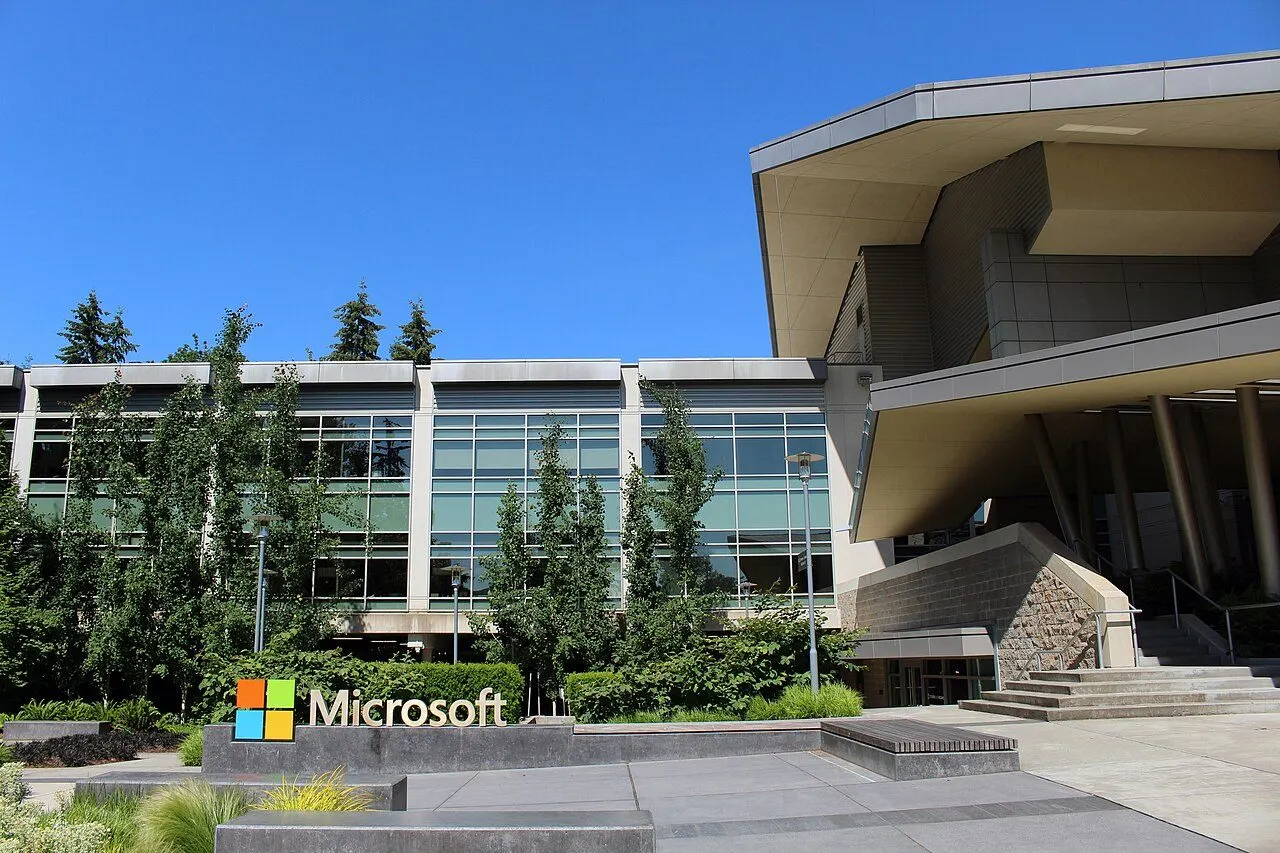 Building 92 on the Microsoft campus in Redmond
. Credit: Wikimedia Commons, freely licensed.
The buyout offer
On Monday, just days before the results, Microsoft said it would offer buyouts to around 60,000 employees, more than a quarter of its global workforce, as part of efforts to cut costs. The voluntary programme applies to eligible staff in teams across Canada, India, the UK and the US, and offers financial support and career planning resources to those who choose to leave.
Microsoft framed the move as adapting its workforce to changing needs and creating greater flexibility. The company currently employs more than 220,000 people worldwide, with about 223,000 on staff at the end of June, down from 228,000 at the end of 2025. The buyout offer is one of the largest voluntary exit programmes ever announced by a technology company, and it follows a series of smaller rounds of layoffs across the industry over the past two years.
For staff, the timing is brutal. Workers learned their jobs were at risk in the same week their employer reported one of the most profitable quarters in corporate history. Unions and labour advocates argue that the juxtaposition exposes a shift in how technology giants share their success, with shareholders and AI infrastructure absorbing the gains while headcount is treated as a cost to be managed down.
Microsoft's defenders would counter that the two stories are linked rather than contradictory. The company is redirecting money from roles it considers less essential towards the data centres, chips and power capacity needed to run AI services. In that view, the buyouts are not a sign of weakness but of a deliberate reallocation of resources towards the next phase of computing.
The AI spending question
That reallocation is the subject of intense scrutiny on Wall Street. Microsoft, Amazon, Meta and Alphabet are expected to spend more than 700 billion dollars this year on AI chips and data centre infrastructure, a figure that would have been unthinkable just a few years ago. Investors are asking, with increasing urgency, whether that spending will generate returns large enough to justify it.
Microsoft itself flagged the risk in its results, warning that substantial investments in AI and other uncertainties could affect its financial performance. The concern is not that AI demand is weak, since Azure's 48 per cent growth suggests the opposite, but that the cost of building and running AI systems is rising faster than the revenue they generate, and that competition could compress margins over time.
So far, the market has given Microsoft the benefit of the doubt. The share price rise after the results suggests investors believe the cloud backlog and the profit growth justify continued spending. But the mood could change quickly if growth slows or if rivals show that similar AI services can be delivered more cheaply. The next few quarters will be a test of whether the AI boom is a durable platform shift or an expensive arms race.
What it means for workers and the industry
Microsoft's announcement will be watched closely by other technology employers. If a company reporting 36.6 billion dollars in quarterly profit can offer exits to a quarter of its workforce without serious backlash from investors, others may feel emboldened to follow. The pattern of the past two years, in which technology firms cut staff even while growing, looks set to continue, with AI automation cited as both the reason for cuts and the justification for investment.
For the workers affected, the practical questions are immediate: how generous the buyout terms are, how long they have to decide, and what support is genuinely available for finding new roles. Microsoft says departing staff will receive financial support and career planning help, but the scale of the programme means thousands of experienced technology workers will enter the job market at once, in an industry where hiring has already slowed.
The broader lesson of Microsoft's week is that profitability and job security have decoupled in big technology. A company can be more successful than ever and still decide it needs far fewer people. Whether that is a temporary adjustment to a new technological era or a permanent feature of the AI economy is the question now facing the entire sector.
Read more technology and business coverage in our Technology section and our Business section, including Microsoft pulling out of a UK data centre project, the UK AI minister on not leaving AI to tech giants, and Anthropic warning of AI risk ahead of a stock listing. You can also read about Barclays job cuts or return to the homepage.
The BBC's report on this story is available here: Microsoft profits soar days after announcing thousands of layoffs. Other reporting includes The Times of India on the 32 per cent profit rise, Ada Derana on the layoff timing, Thai Rath on the quarterly results, Uzalendo News on the profit surge, and Metro Punch on the layoff plan.